Baba Yara Stadium is now ready for CAN 2008.


Wednesday, December 05, 2007

Cop faces trial for alleged murder

Police Constable Dennis Aryee of the Akomadan Police who allegedly shot and killed a suspected illegal timber operator on the Nkenkensu-Akomadan road has been remanded into prison custody by the Offinso Court.
He was charged with the offence of murder when he was arraigned last Monday, December 3, 2007.
His plea was not taken and would re-appear on December 17, 2007. This is to enable the police conduct further investigations into the matter.
The Deputy Ashanti Regional Police Commander, ACP Seth Oteng confirmed this to the Daily Graphic.
Constable Aryee who fled his station after allegedly killing Yaw Agyen on a moving KIA cargo truck was picked up last Friday by the Police.
On Wednesday December 28, 2007, Constable Aryee was said to be on guard duty when the deceased and a group allegedly entered a teak plantation to fell teak.
While transporting the logs to Akomadan on a KIA cargo truck, Constable Aryee who was on guard duty at a construction company signaled the driver of the truck to stop but he refused.
The Policeman was said to have opened fire from his AK 47 rifle and hit Agyen, who was then sitting on top of the logs.
Agyen died on top of the vehicle but the driver sped off until he got to Akomadan where the body was brought down.
The constable went back to the police station to deposit his weapon and went into hiding, refusing to disclose the shooting incident.
The shooting incident subsequently resulted in a mob attack on the Akomadan Police station, with destruction to property.

Owabi Dam under threat

CONTINUED sand winning and farming activties in the catchments of the Owabi Dam, which provides portable water to residents of Kumasi, are posing a serious threat to the lifespan of the dam.

Officials feared unless action was taken to stop the development, Kumasi and its residents would face severe water shortage in the near future since the volume of water could reduce heavily.

The sand winners have completely cleared parts of the forest reserve, which protects the Owabi River, which empties into the dam.

The forest prevents siltation as well as rapid evaporation of the water in the dam from the intense sun.

On an inspection tour it was detected that there was serious logging and clearing of the bushes in the catchments to the extent that many big trees have all been cut to pave way for sand winning.

It was also detected that parts of the forest had been cleared and pillars had been erected giving an indication that someone was allocating the plots to prospective developers.

The trend of encroachment if not checked could put the dam in danger in the near future, pre-empting a looming water crisis in Kumasi in the coming years.

The Owabi Dam was built to produce a total of 12million gallons of water a day but it currently produces only about three million gallons a day to supplement that of the Barekese Dam in the provision of pipe borne water for residents of Kumasi and its surrounding areas.

There were 10 tipper trucks in the catchments being filled with sand to be hauled away at the time of the visit.

It was, however, gathered that an average of 15 tipper trucks were available daily in the catchments to haul sand.

Four different access roads to the catchments had been created by the sand winners and many men were on site at vantage points busily digging for sand at the time of the visit.

A source said the sand winners were mainly from Bokankye, Nyankyereniase and Apatrapa and that the sand winning started about three years ago.

Although the Ghana Water Company Limited (GWCL) had on numerous occasions appealed to neighbouring villages to desist from clearing the forest cover and to discontinue with the sand winning that seems to be falling on deaf ears.

Information gathered indicated that security personnel of the GWCL have on numerous occasions sacked the sand winners from the catchments and seized their equipment yet the practice is unrelenting. The practice is said to have started on a gradual note and was now very vibrant.

For instance a number of houses totalling about 400 are known to have been illegally constructed in the Owabi catchment area and out of this 140 of them were demolished in 1998.

Just before the rest could be razed to the ground, the encroachers obtained a court injunction from a Kumasi High Court to restrain the GWCL and the case had since been pending.

The company subsequently refused to accept any negotiated settlement to the encroachment on the Owabi Dam catchment area to allow the illegal structures built there to remain.

It was gathered that as a result of the activities of the sand winners, any time it rained, polythene materials and sand washed into the dam, polluting it and reducing the depth of the water gradually.

The natives are said to have vowed to continue clearing the forest for farming purposes and sand winning as a means of livelihood unless compensation were paid to them.

They claim compensation for the land has not been paid to them since the construction of the dam and as a result their only source of livelihood depended on the land.

Tuesday, December 04, 2007

Gangster lifestyle gaining roots in Kumasi

SECURITY reports of the emergence of gangsters in some surburbs of Kumasi, has once again brought to the fore, the growing security challenges of the metropolis.

Clearly, the once peaceful metropolis of Kumasi is gradualy gaining notoriety for heinous crimes, a situation which continue to put fear in many residents.

This comes in spite of strenuous efforts by the security services to nib the canker in the bud.

Startling revelations about the rate at which gangster lifestyles were gaining roots among the youth in the metropolis, had drum home the need for the police and other security agencies to double their efforts in security control and checks.

A recent case of gangster activity is the manner in which 26-year-old goldsmith, Jordan Osei Yaw, was axed to death by some assailants who attacked him in his room at South Suntreso while he was sleeping on November 24, 2007.

The Police revealed that the deceased was murdered by a gang of six youth based at Bantama in Kumasi.

Using machetes, axe, cutlasses and other sharp objects the gangsters nicodemously entered the deceased’s bedroom and brutally inflicted deep wounds on the head, neck, palms, back and other parts of the body of the deceased, leaving him to bleed to death.

The deceased was said to belong to a rival gang based at Asante New Town and that his gang is also said to be seriously planning to revenge his death.

Undoubtedly, the murder was one of the most serious ever to occur in the metropolis.

Other serious crimes have occurred but in those cases the victims were either shot or stabbed to death. And in those cases it was not under circumstances such as this latest one, where the assailants boldly entered a house, walked past three or four rooms and entered the young man’s room to finish him in just a matter of seconds armed with dangerous implements such as cutlasses and axes. Nothing was stolen from the room, thus ruling out robbery.

That something needs to be done swiftly to help avert such crime would be an understatement.

It is an undeniable fact that present day modernisation has its own set of disadvantages one of which is an upsurge in crime as cities develop and expand. But it should be noted that the rate at which the crime wave is increasing in the Kumasi metropolis is unprecedented and very dangerous to residents.

In 2004 for instance some youth from Asawasi and Zongo clashed under inexplicable reasons leaving behind a number of casualties as they used very dangerous implements to slash themselves and destroyed property worth millions of cedis belonging to law abiding citizens.

One person from Asawasi had one of his fingers severed off while another from Zongo had his right wrist also severed.

On the dawn of January 1, 2004, similar gangs struck at various areas in the metropolis and succeeded in robbing members of the public who attended watchnight service and were on their way home. Some victims were inflicted with cutlass wounds and reported to the Komfo Anokye Teaching Hospital (KATH) for medical attention.

It is difficult to fathom the direction the present generation is heading where people would want to take the law into their hands and settle personal scores with murder. This sort of behaviour is alien to Ghanaian culture.

Although in the recent case of the murder of Yaw Jordan, the motive for the murder was yet to be officially identified, information gathered as of now, points to the fact that it is likely a matter of retaliation.

A few years ago, apart from the central business area, to be specific Kejetia and the Central market where pickpockets used to rob people of their monies and personal belongings, the entire city was peaceful and the crime wave was minimal.

Even with those robbery cases, the perpetrators resorted to stealing on the quiet and taking to their heels. In those times, no force was applied by the pickpockets. They snatched people’s bags at public places and took to their heels.

And they always tried to steal on the quiet where no one was looking. And in those cases too, the robbers mainly chose people they perceived to be naive and ignorant and whose appearances, especially dressing and movements indicated that they were new in town and had probably just arrived in town either from the hinterlands or a different part of the country.

In those days, it was only Kejetia and the central market which was perceived to be very fearsome when it came to matters of robbery.

But the opposite is what is happening today where the crime wave has spread to all parts of the metropolis.

Hitherto burglars went into people’s homes without arms and ammunitions. They resorted to sneaking into people’s homes under the cover of darkness, steal items unnoticed and run away. They either entered people’s homes when no one was around in the afternoon or when the people were sleeping at night and secretly and silently steal and run away, quietly unnoticed.

But these days the robbers strike in broad daylight with weapons and ammunitions. Even when this menace started the robbers normally resorted to the usage of masks to cover their faces to at least go about their activities with their identity not being known.

Surprisingly the trend has changed in latter days and many of these armed robbers go about their operations boldly without covering their faces. You dare challenge them during an attack on you, and you would be counted among the dead.

It is dangerous to enter a taxi these days at night since many taxis in the metropolis are loaded with robbers. They forcibly take away people’s mobile phones and money and throw them out of moving taxis.

About five years ago, a new trend of crime emerged in the metropolis where young men organised themselves into gangster groups nicknaming themselves, “Al Qaeda”, “Taliban” and “Akata” and resorted to fighting among themselves with dangerous implements such as guns, knives and cutlasses as well as harassing, terrorising and robbing lawful citizens of personal belongings on the streets.

When these activities started, the perpetrators approached people without wearing masks and demanded that you hand over your mobile phone and money.

Woe unto you if you had no mobile phone or money on you to offer them, or you dare them, and you end up being slashed with a knife to serve as a remembrance for you never to challenge them.

I recall a case where a friend of mine was slashed for carrying a mobile phone which his attackers claimed was not an expensive one and in another case where someone was also slashed for not carrying a mobile phone or money on him. In those cases the attackers were said to have warned them to carry along with them cash and expensive mobile phones so that the next time they happen to come across them, their booty would be worthwhile.

When the activities of these young men were reported in the media, the city authorities and the Ashanti Regional Co-ordinating Council (ARCC) then under the leadership of Mr Sampson Kwaku Boafo, Member of Parliament for Subin and former Ashanti Regional Minister blamed the media for over estimating the issue and argued that the media was reporting it as if the entire city of Kumasi was under siege.

I could then understand the Minister’s plight to some extent since as the political head of the region he did not want his region to be perceived as a hub of criminals but rather a peaceful place.

He equally blamed the crimes on modernisation and attributed it to the development of the city and gave the assurance that the security agencies were on top of the issue.

To me the media did what was right and adequately reported on the issue. The media at the time even helped in bringing the situation under control since security was beefed up with the Police Service bringing on board more personnel from other regions to help maintain peace in the region.

That is not to say that security in the region has lapsed in recent times thus the recent upsurge in the crime.

The gangster groups still exist on the quiet in the metropolis and occasionally strike.

I want to believe that the security agencies are up to the task and doing their possible best to clamp down on the menace. To me the security services would succeed in combating this menace if the public would cooperate by volunteering information.

Thursday, November 01, 2007

ASAFO INTERCHANGE, now in use

At long last the Asafo Interchange has been completed and traffic jams and congestion of vehicles as well as the slow pace of vehicles around some parts of the metropolis will cease.

Commuters in the city centre, will now heave a sign of relief especially since they would not be in the vehicles for long periods anymore.

According to Eng. Owusu Sekyere Antwi, the Resident Engineer of the project, work on the project has finally been completed and by the end of November, the few things left to be done would be completed.

“These include minor works such as placing pavement blocks under the interchange, so that cars could park there and the building of a lorry park behind the Asafo Market, so that vehicles discharging goods, would not park on the streets.”

“There is also the overhead pedestrians footway at Kejetia, which is expected to be completed at the end of November,” he added.

According to Eng. Sekyere Antwi, these were not included in the original plan, but had to be added to ensure smooth movement of vehicles to and from the interchange.

He mentioned also that the road has been temporarily opened, to enable people get used to it, while some education is done to make the public aware of the directions and new signs connected to its usage.

The interchange expected to be completed last December, was unexpectedly delayed due to labour and other constraints.

However, all is set for residents of the metropolis, to have the interchange delivered to them as a Christmas present.

The interchange was designed by Hag Consult and Municipal Development Collaborative Limited (MDC) and constructed by Saroch/Selfi a joint venture.

Hag and MDC were the supervisors until half-way through the project, when the Ghana Highways Authority (GHA) and the Department of Urban Roads took over the supervision.

The interchange known officially as the Asafo-UTC Interchange is a dual carriageway which enables traffic to move in opposite directions.

Its construction is supposed to aid free flow of traffic in the Kumasi metropolis.

Written by Nii Addokwei Moffatt, Graphic Nsempa

Thursday, September 27, 2007

GAS EXPLOSION IN KSI

The reason why petroleum products such as gas and petrol should not be sold in residential areas, was given expression last Friday evening, when the Engas Filling Station at Asokwa, a suburb of Kumasi suffered a devastating explosion.

LOUD BOOM

A loud boom, which shook several houses, near the gas station and others several metres away in the metropolis, shattered wooden doors, ceilings and glass doors and windows of some of the houses.

It also burnt 20 vehicles, six of which were packed at the gas station including the gas tanker, which was dispensing gas at the time and a tipper truck, which was partially burnt.

Among the hardest hit were houses opposite the gas station and those adjacent to it as well as others several hundred metres away.

Hotel de Texas a few metres away had all of its glass windows and doors completely broken and so was another building directly opposite the gas station, which suffered the same fate.

Another building housing the African Development Bank (ADB) at the Millennium Plaza and a Shell filling station about a hundred or more metres away had most of their glass windows and doors destroyed.

A vehicle repair shop, a restaurant and a chop bar as well as a sawmill sharing walls with the gas station were severely damaged.

Flames which shot up high several feet into the air and was seen as far away as Asafo and surrounding areas also burnt a number of people who were rushed to hospitals across the metropolis.

The force of the blast was so huge that it carried part of the steel cover of the tanker over a hundred metres away into the compound of The New Asafo Junior High School.

CAUSE OF EXPLOSION

According to ASP D.K. Gyabaa Crime Officer of the Asokwa District Police, who briefed this paper on the cause of the accident, around 5.30pm, while a gas tanker was dispensing gas at the station, the nozzle of the tube came off from the tanker, hit the floor and sparked a fire.

Workers immediately started running helter skelter for dear life. Consequently, the fire became uncontrollable and before fire personnel from various parts of the metropolis got to the scene, there was a raging inferno.

This eventually resulted in a number of explosions which caused injuries and destroyed property. According to ASP Gyabaa, about 140 people were injured and they were sent to hospitals across the city. Thankfully there were no deaths.

INJURED PEOPLE

At the Komfo Anokye Teaching Hospital (KATH) that, the hospital received 123 people with various degrees of burns.

According to Dr. Stephen Opuni, Head of the Accident and Emergency Department, 15 of the people had severe burns and are at the Burns Unit.

Ten others were admitted at the Casualty Department while two went on admission at the Intensive Care Unit.
However over 90 people were treated and discharged. About 20 doctors including some who were off duty all came by to assist in treating the injured.

Pharmacists, paramedics, nurses, and management staff of the hospital including Dr. Karikari, Medical Director, Mr Offeh Gyimah, Director of Administration, Director of Pharmacy, Mr Frank Amoh and Director of Nursing services, Mrs Patience Ampomah were all around to help calm the injured.

Dr Opuni praised the National Fire Service and the Police for handling the situation effectively and for sending the injured immediately to the hospital.

Dignitaries

Some dignitaries were also there to visit the injured at the hospital. They included Mr Kan Dapaah, Minister of Defence, DCOP Frank Adu-Poku Ashanti Regional Police Commander and Mr Osei Asibey Antwi, Deputy Ashanti Regional Minister.

In another development, Mr P.K. Manu a political activist who together with others fought against the siting of the gas station at its present location, said even though it was an unfortunate incident, he and all those who fought against the siting of the station there, have been vindicated.

Protests

According to him in 2000, the owner of the land decided to relocate the public toilet, which was on the land to another place and site the gas station there, but he and some others protested because, it was not safe as the location, was a residential area and also had a school nearby.

“I went with a delegation to see the late Osei Kweku who was the Member of Parliament here and he agreed to see the then KMA boss Hon. Maxwell Kofi Jumah.”

“Initially Mr Jumah agreed that the station could not be sited there, but afterwards Mr Jumah, the Assembly member Mr Adjei Darko a.k.a, Action and the late Osei Kweku, came to the site and said where the toilet was sited was not good,” he added.

Mr Manu continued that the same day, the toilet was broken down by a bulldozer on the orders of the ex-mayor and the owner of the place known as Mama Pat, claimed that all the relevant organisations had approved for the gas station to be built.

He also mentioned that with the support of the Buffalo Unit, who came on the scene Mama Pat had the foundation of the place laid.

“I thank God that there are no deaths and hope that this will be a lesson for the future,” He said.

Most people who flocked the site of the incident to witness it were full of praise for the NFS and the police who did well in fighting the fire and protecting property as well as controlling the crowd.

KSI VENUE OF CAN 2008 UPDATE

The Kumasi Venue Organising Committee (KVOC) of next year’s ­African Nations Cup (CAN 2008) is to work out a contingency plan to get alternative training pitches for the Kumasi venue of the tournament.

This is because with just about three months to the start of the tournament, construction works on the four training pitches in Kumasi were still yet to reach any appreciable level in readiness for the games.

Not a single pitch out of the four is ready for the tournament. Thus, in case the contractors, CST Limited, are unable to deliver the training pitches by November ending as promised, the contingency plan would be relied on.

Alternative training pitches to be considered under the contingency plan includes the Ridge Park, where Kumasi Asante Kotoko train­, the GGBL park, Jachie Pramso School Park, Konongo Park, T. I, Amass school park among others.

Prof K. K. Adarkwa, Chairman of the KVOC at an inspection tour remarked that the progress of work on the training pitches was totally unacceptable.

“It is embarrassing and completely unacceptable”, he said.

He explained that so much investment had gone into the training pitches and the contractor has to ensure that construction works were completed for the pitches to be used during the tournament.

“But in case, they are unable o finish then we may have to look at alternative pitches”.

Surprisingly when the Chairman requested from the contractor to furnish him with his­ work programme, he was told that a copy of the work programme was not available on site.

This made Prof Adarkwa furious as he felt the contractor ought to have a work programme on site.

During the inspection tour, it was observed that apart from the Opoku Ware training pitch which had seen a remarkable improvement in the last three weeks the rest were still greatly lagging behind.

The school fields at Opoku Ware Secondary School (OWASS), Kwame Nkrumah University of Science and Technology (KNUST), Prempeh College and Wesley College are the ones which are being refurbished to be used as training pitches for the tournament.

At Opoku Ware the contractor was about finishing with the planting of green grass whiles at Prempeh College he was still working on the drainage. The Paa Joe and WESCO pitches were being levelled with black soil.

Monday, September 10, 2007

DRIVERS FOND OF DISREGARD FOR TRAFFIC LIGHT SIGNALS IN KUMASI


“When you reach the traffic light, there is something you should know, red means: stop, yellow means: get ready, green means: go go go and go!”
This is a popular song on the lips of many kids in Ghana whom because of the song, are conscious of what every motorist or pedestrian should do when he comes across a traffic light.
Surprisingly however, the opposite of this popular rule is what many motorists in the Kumasi metropolis practice.
A traffic light, is a signaling device positioned at a road intersection, pedestrian crossing or other location in order to indicate which specific movement motorists should drive, ride or pedestrians should walk.
The Highway Code with regards to traffic light signals states that whenever there is RED it means 'Stop'. Wait behind the stop line on the road.
RED AND AMBER also means 'Stop'. Do not pass through or start until GREEN shows.
GREEN means you may go on if the way is clear but take special care if you intend to turn left or right and give way to pedestrians who are crossing.
AMBER means 'Stop' at the stopline. You may go on only if the AMBER appears after you have crossed the stop line or are so close to it that to pull up might cause an accident.
A GREEN ARROW may be provided in addition to the full green signal if movement in a certain direction is allowed before or after the full green phase. If the way is clear you may go but only in the direction shown by the arrow.
Alternately flashing red lights mean YOU MUST STOP at level crossings, lifting bridges, airfields, fire stations and others.
The Highway Code is essential reading for everyone. Its rules apply to all road users, drivers, motorcyclists, cyclists, pedestrians as well as even horse riders although in Kumasi and in the entire country, horse riding on the road is not popular.
Many of the rules in the Code are legal requirements, and if you disobey these rules you are committing a criminal offence. One may be fined, given penalty points on their license or be disqualified from driving. In the most serious cases one may be sent to prison.
Although failure to comply with the other rules of the Code will not, it itself, cause a person to be prosecuted, but the code may be used in evidence in any court proceedings to establish liability.
Knowing and applying the rules contained in the Highway Code could significantly help reduce road accident casualties. Again cutting the number of deaths and injuries that occur on the roads every day is a responsibility we all share and the Highway Code can help discharge that responsibility.
I have observed with keen interest that in the Kumasi metropolis many motorists have disregard for traffic lights. They tend to move faster in an attempt to cross a red light the moment they are approaching and see the AMBER on even though the Highway Code preaches against that.
I was mesmerized the other time, when I saw a driver on television saying the AMBER light means, go faster even if you have not crossed the line before red catches up with you. This driver was apparently being tested on television on an outreach sensitisation programme by the National Road Safety Commission (NRSC).
I told myself no wonder drivers in Kumasi tend to speed at traffic lights the moment the AMBER shows even before they get there.
One other behavior I have observed about motorists in Kumasi, especially commercial taxi drivers is that, they tend to toot their horns haphazardly even to an extent that, when they are behind a vehicle at the traffic lights, and it turns green, hardly do they allow a second to pass than you hear them tooting to persuade the one in front of them to move.
In many of the cases, the drivers ahead would make an attempt to move yet those behind them would toot their horns loud to beckon them to move.
The disregard for traffic lights, especially jumping of the red light has become very common that I wondered the other time if the law enforcing agencies were aware of the menace.
It was then gratifying to hear that the Police Motor Traffic and Transport Unit (MTTU) in Kumasi has resorted to the use of digital cameras to start arresting offending drivers at traffic light spots in the Kumasi metropolis.
It was gathered that the police place the camera men at vantage points with their focus on the traffic lights and that they capture any offending driver on tape as well as inform police dispatch riders who normally lay ambush via a walk-talkie for the arrest of the offending driver.
According to Ashanti Regional Commander of the MTTU, DSP James Sarfo Peprah his outfit was now waging the war on red light jumpers.
He explained that within the shortest possible time that the digital camera was introduced, many offending drivers have been arrested and prosecuted accordingly.
He mentioned for instance that on a two day pilot exercise at the Amakom traffic lights about 20 drivers were arrested for open disregard for the traffic lights there by jumping the red light.
It is the hope that the exercise would be sustained so as to bring recalcitrant drivers to book. It is believed that if this was done, sanity would prevail at the traffic lights.

TRAINING PITCHES FOR KUMASI CAN 2008 VENUE BEHIND SCHEDULE

The Minister of Education, Science and Sports, Professor Dominic Fobih has expressed displeasure at the contractors handling the training pitches at the Kumasi venue of the 2008 African Cup of Nations. With just about four months to the start of the tournament construction works on the training pitches in Kumasi are yet to reach any appreciable level in readiness for the games. Not a single pitch out of the four is ready for the tournament. The school fields at Opoku Ware Secondary School (OWASS), Kwame Nkrumah University of Science and Technology (KNUST), Prempeh College and Wesley College are being refurbished to be used as training pitches for the tournament. While three of them have seen some amount of works done on them, that of Prempeh College was lagging behind greatly. The contractors, CST Limited, are still leveling the ground and have not even started with the drainage works on the pitch at Prempeh not to mention the leveling and greening of the pitch. The other three have had their drainage systems completed with top soil filled on them awaiting black soil and greening. The shower rooms at all the four training pitches were also yet to reach any appreciable level. Prof Fobih, who was on an inspection tour of facilities for the tournament in the Kumasi venue on Tuesday, expressed equal displeasure at the consultants for the project, ABP Consult. He said the consultants should have been up and doing to put pressure on the contractor to deliver. “It does not have to take the Minister to come here to know that the project was delaying” “The rate at which you are working is not appreciable”, the Minister told Mr John Antwi, Quantity Surveyor for CST Limited. The Minister said he would come to Kumasi to inspect progress of work on the training pitches in two weeks time.
The contractor has up to November ending to hand over the training pitches. Prof Fobih said the contractor did not have to wait until November ending to complete the project and urged him to take a cue from the Chinese who constructed the Essipong Stadium, saying they were aware of the deadline, yet they managed to finish ahead of schedule. He expressed displeasure at the limited number of the workforce of the contractor and urged him to increase his work force so as to be able to complete the work on time. It was observed that the contractor had a skeleton workforce on site at the time of the Minister’s visit. While there was no worker on site at WESCO there were only seven workers on site at Paa Joe and eight at Opoku Ware. Prof Fobih visited the Baba Yara stadium which was about 90 percent complete and the City Hotel project. He said he was happy with the work at the stadium and described it as quality work. The contractors, Consar Limited were putting finishing touches to the Baba Yara Stadium project. They are currently working on the ceiling for the roof at the VIP stand, the tartan tracks, spectator seats, the scoreboard and furnishing of the VVIP.

Tuesday, August 28, 2007

ASAFO INTERCHANGE NEARING COMPLETION

After several months of waiting, the Asafo-UTC interchange, which is to help ease vehicular traffic in the Kumasi metropolis is nearing completion.
Residents of Kumasi have been waiting ansciously for the completion of the project. It has been gathered that President J. A. Kufuor would formally commission the project to enable motorists to start using the new interchange in a few weeks time. The opening of the interchange for traffic would go a long way to help ease traffic congestion on other roads in the metropolis.
PICTURE SHOWS THE NEW INTERCHANGE IN KUMASI


Monday, August 27, 2007

BUMPER TO BUMPER TRAFFIC INTENSIFIES IN KUMASI

Traffic congestion on Kumasi roads is becoming an ever-present nightmare for road users, negatively affecting productivity and the environment.

The road transport infrastructure in the metropolis has not kept pace with the increased number of vehicles that have been bought as a result of the city’s significant economic growth in recent years, itself uderpinned by a boom in consumer spending.

The city of Kumasi has spread out over the past years. Being the second largest city in Ghana it is experiencing rapid urbanisation and accelerated population growth and an exploded traffic on the road. Nowhere is this more evident than in the Central Business District (CBD) and on other arterial roads.

One result of this phenomenon is the severe traffic congestion as witnessed on the Lake Road, 24th February Road and the Sunyani Road which results in loss of working time, affecting productivity, higher vehicle running cost and negative environmental impact.

Information at the Driver and Vehicular Licensing Authority (DVLA) indicate that the number of vehicles imported into Kumasi keep increasing year after year.

Owing to inadequate public transport options in the metropolis, private cars are more a necessity than a choice.

An upwardly mobile middle class, coupled with increased access to car finance, and the entry of a greater range of less-expensive vehicle models (second hand) into the market have all contributed to the rise in vehicles on the roads.

Because there is too much private cars than the public transport, people are running away from public transport, because it is not that much good, reliable and enough, as they want it to be.

Hitherto, bumper to bumper traffic was uncommon in Kumasi but it has become prevalent nowadays on many arterial roads in the metropolis.

Surprisingly however, it has been observed that at certain intersections in the metropolis, where traffic lights are located, vehicular movement becomes slow and traffic normally jams when the traffic lights are operating normally.

But when the lights go off, or was put only on amber, traffic flow is fast and smooth. The question then is - what is the essence of the traffic lights at those areas, if its presence impede on traffic flow.

Areas where this is prevalent is the traffic lights at the Kumasi Club, the one in front of the offices of the Kumasi Metropolitan Assembly (KMA), Krofrom and Abrepo Junction.

Some residents interviewed expressed worry about the traffic situation and called on the city authorities to institute measures to help curb the situation.

Mr Kofi Abebrese, a resident of Ashtown on his part said he reckon that, vehicular traffic congestion was one of the characteristics of a developing city and Kumasi was no exception.

“But city authorities also need to develop our road networks in tandem with the development of the city”, he said and maintained that the situation of the current traffic congestion was bad since it affects businesses and appointments.

He called for the speedy completion of the Asafo interchange and said the government also needed to construct more interchanges in the metropolis at various intersections so as to help curtail the traffic situation.

Mr George Frimpong, a taxi driver said the traffic situation was affecting the commercial taxi business, since taxi drivers now spend more fuel to transport passengers to their destinations by spending more time in traffic.

It is essential to augment existing transport infrastructure through the construction of more roads and interchanges to help ease the road. But that is also a very complex, slow-moving and capital-intensive process.

For instance, the Asafo-UTC interchange project, which was commenced two years ago and was to be completed in 18 months, is well over 24 months and even not yet completed yet.

Because of the closure of the Asafo Roundabout to make way for the construction of the interchange, traffic on alternative routes have intensified and have been “bumper to bumper” all this while.

Passengers form queues at bus stops, especially in the rush hour as vehicles jam the roads. The hassle is very evident, especially during rush hours in the mornings and evenings and sometimes in the afternoon at the central business district.

Information from the Urban Roads Department in Kumasi indicates that government has secured funds from donor partners to implement various road projects in the metropolis as a way of helping to reduce the traffic congestion and its related problems.

And indeed, the President, Mr J. A. Kufuor himself has cut sod for the commencement of those projects but the contractors are yet to be seen on site working. The projects include the road from the Komfo Anokye roundabout through Bekwai roundabout, Sofoline roundabout to Abuakwa Road with interchanges at various intersections and the Oforikrom -Asokwa by - pass also with an interchange at Timber Gardens intersection. All these roads are expected to be made dual carriage ones.

It would be appreciated if the implementing agencies would speed up the projects so as to help ameliorate the traffic congestion and its related problems on residents of the Kumasi metropolis.

Sunday, August 26, 2007

KUMASI BRACES ITSELF FOR CAN 2008

Authorities of the Kumasi Metropolitan Assembly (KMA) have outlined a number of measures to ensure that Kumasi was well positioned to host the various visitors who would be coming to Kumasi during next year’s Cup of African Nations Tournament (CAN 2008).

Like the Accra Metropolitan Assembly, the KMA has sent a request to all taxi drivers to put on uniforms for neat appearance and easy identification. They are also to be provided with identification cards.

Again all taxis are going to be embossed with certain unique numbers for easy identification.

Miss Patricia Appiagyei, Metropolitan Chief Executive who made this known at the official launch of the Kumasi Venue of CAN 2008 said any visiting taxi to the Kumasi metropolis would be made to register with the KMA for an entry permit to be in the city for a required period of time.

These and many other measures are to help ensure that the city was well positioned for the tournament to be able to attract tourists.

The football tournament of African Nations to be held in Ghana from January 20 is the 26th Edition and out of the 16 participating teams, four would be hosted in Kumasi.

About half of the estimated one million visitors to Ghana during the tournament are expected to be in Kumasi.

Looking at the importance being attached to the tournament, the KMA has already started a series of activities towards ensuring a cleaner, more beautiful and befitting city for the tournament.

These include the decongestion and beautification exercise currently underway.

Many measures have also been discussed and are to be instituted to ensure that service providers deliver excellently, according to Miss Appiagyei.

Again, to help ease traffic congestion at about a 2-kilometre radius around the Baba Yara Stadium, which would be the centre of attraction when the tournament kicks off, the KMA in conjunction with the Kumasi CAN 2008 Venue Organising Committee (KVOC), as well as the Metro Mass Transit (MMT), is to introduce the park and ride system.

This system would require motorists to park their vehicles at designated points in the city, where security would be provided, pay a fee and join a bus, which would convey them to and from the stadium before and after the match.

To help make the system workable, certain areas have been identified. These areas include the Central Post Office, KMA Parking lots, Prempeh Assembly Hall, Asem School Park, all the training pitches, the premises of the Centre for National Culture (CNC) and certain spaces at the sub metros.

The KMA Chief Executive also said that the security agencies were planning to ensure that matters of security were treated with the utmost urgency it deserves adding that there is a comprehensive plan to give maximum protection to both the citizenry and visitors.

With respect to accommodation, apart from the about 222 hotels that are already in existence in the metropolis, 120 more including the City Hotel, which are under construction would be completed for usage during the tournament.

Accommodation facility in the tertiary institutions including the one at the Kwame Nkrumah University of Science and Technology (KNUST) is to support the accommodation plan.

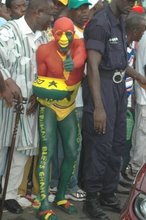
As a result discussions are underway with the university authorities in an attempt to alter the university’s calendar on re-opening for the second semester to enable the organising committee have access to the students’ accommodation on campus. The idea of creating tented villages to support the accommodation plan is also seriously being considered. PICTURE SHOWS A SOCCER FAN IN KUMASI

CAN 2008 LAUNCHED IN KUMASI


Traditional adowa dance by the Amamereso fie Cultural Group from the Centre for National Culture and “Jama” songs from various football supporters union were some of the side attractions that heralded the official local launch of the Kumasi Venue of CAN 2008 at the Prempeh Assembly Hall yesterday.

It signified the official information for the people of Kumasi and the Ashanti region about the impending CAN 2008 tournament and the benefits of the tournament.

An excited Ashanti Regional Minister, E. A. Owusu Ansah, who lauched the programme said, “from today let us all think, eat, drink and toast CAN 2008, of which the Black Stars of Ghana will be crowned champions for the 5th time”.

The Kumasi local launch of the competition marks a turning point in whipping up public interest in the tournament. This is premised on the fact that the tournament would bring a lot of advantages, such as attracting tourists, fostering business partnerships and friendships as well as good neighbourliness with other nations.

CAN 2008 kicks off on January 20, 2008 with an opening ceremony at the Ohene Djan Sports Stadium in Accra. Other local venues — Accra, Sekondi and Tamale — are also expected to do their launches in the coming weeks.

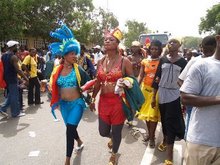
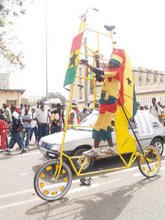
The Kumasi official launch was followed by a street float which attracted cheers from members of the public.

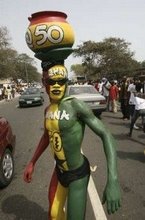
Dressed in the Ghana national colours, the various supporters union stormed the Prempeh Assembly Hall amidst the singing of the Ghana Black Star Cheer Song which sent the entire hall into a frenzy.

“I have just been made conscious of the excitement that would go with the hosting of the tournament” was what Miss Eno Akua Brantuo, a patron at the official launch, was overheard saying as the hall went into a frenzy.

The Ashanti Regional Minister called for an unflinching public support and cooperation in the quest to get Kumasi prepared for the tournament.

He explained that Ghana was chosen to host the tournament for a number of reasons, such as previous experiences in hosting it in 1963, 1978 and co-hosting it in 2000 with Nigeria.

“The peaceful political climate, the exploits of the Black Stars in recent international tournaments and the reputable standing of the country among the comity of nations are all significant factors.

“With such an impressive background, it is important that we strive to ensure another successful tournament”, the Minister said.

He maintained that the decongestion exercise currently being embarked upon by the Kumasi Metropolitan Assembly (KMA) was laudable and stressed that every nook and cranny of the city needed to be kept clean since visitors would take advantage to tour the city.

He also called for a warm welcome from residents to all visitors to the city during the period of the tournament.

“Kumasi has always been a pacesetter when it comes to participating and organising national events of this sort”, the Minister said.

Professor K. K. Adarkwa, Chairman of the Kumasi Venue Organising Committee (KVOC) said his outfit was doing its best to ensure that all the infrastructure for the tournament - stadia, training pitches and the city hotel project - were completed on schedule for the competition.

The Chief Operating Officer of the Local Organising Committee (LOC), Mr Rex Danquah, mentioned that a number of activities had been scheduled prior to the competition to help whip up public interest in the competition.

Miss Patricia Appiagyei, KMA Chief Executive mentioned that the KMA would ensure that enough buses were made available to transport supporters to the stadium. She said private vehicles would not be allowed entry into a two-kilometre radius of the stadium to help curtail traffic congestion at the stadium area, Rather, the KMA would provide buses for patrons to park and ride.

One significant hiccup of the official launch which the KVOC may have to rectify in future activities was the usual Ghanaian attitude of lateness to functions.

The official launch programme was advertised to start at 8:30am at 10:00am the organisers were not ready for the start of the programme.