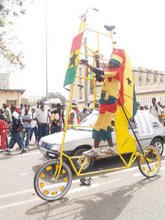
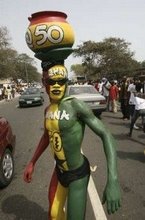
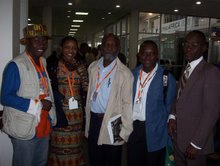
Baba Yara Stadium is now ready for CAN 2008.


Thursday, June 28, 2007

Kumasi Shoe Factory to be resuscitated

PICTURE SHOWS ALAN KYEREMATEN (third from right), MINISTER OF TRADE, INDUSTRY, PRIVATE SECTOR DEVELOPMENT AND PRESIDENTIAL SPECIAL INITIATIVES (PSI) INSPECTING THE SHOE FACTORY

THE Ministry of Trade, Industry, Private Sector Development and President’s Special Initiatives (PSIs) has launched a fact-finding mission into the activities of the GIHOC Shoe Factory in Kumasi as a way of helping to resuscitate the defunct factory.
The factory was divested to Newack Commercial Capital of the Czech Republic in 2003 but it has not been able to resuscitate the factory as of now.

Equipment at the factory is currently deteriorating, while thieves have made away with vital components of the machinery.
That, according to Mr Alan Kyerematen, the sector Minister, was deeply worrying to the government.
“We are going to hold negotiations with the Czechs and see how a way forward can be found,” he said in Kumasi on Friday as he paid a familiarisation tour of the factory premises.

He explained that if it came out that the Czechs were no longer interested in the factory and returned it to the government, then his outfit would collaborate with the Association of Shoe Makers in Kumasi to find a possible way of resuscitating the factory.
The shoe factory started operations in 1967 as a state enterprise under the Ghana Industrial Holdings Company (GIHOC), in partnership with a company in the then Czechoslovakia, and produced mainly industrial boots but occasionally produced fashionable shoes upon request.

Between 1973 and 1995, activities at the factory took a nosedive and it was subsequently listed for divestiture.

Some workers of the factory hung around the factory, hoping that a prospective buyer would come on board to engage them.
They subsequently produced shoes upon requisition and used the proceeds to pay themselves until 2003 when Newack came on board to close down the factory permanently.

Mr Kyerematen said Newack paid a deposit and the factory was subsequently handed over to it, hoping that it would resuscitate it.
Currently, part of the factory premises is being occupied by some private individuals, a church and some companies, all of whom are said to be paying rent to Newack.


Tuesday, June 12, 2007

Kiosks owners try to outwit KMA decongestion team

A NEW development has emerged in the ongoing decongestion exercise in Kumasi, with owners of a number of container shops and kiosks sited at unauthorised locations painting their structures in the national colours of red, yellow and green in a bid to save those structures from demolition.
Most of those structures are located in areas like Asokwa, Asafo, Amakom and the Kwame Nkrumah University of Science and Technology (KNUST) Junction.
City authorities have, however, indicated that there is no policy that exempted such structures from demolition, even if their locations were illegal.
“The issue is where the structures are located and not the national colours,” Mr Charles Ampomah-Mensah, the Metropolitan Engineer, explained in an interview.
He said the Kumasi Metropolitan Assembly (KMA) decongestion team had been compelled to remove and demolish some of those structures painted in the national colours at Kaase because they had been wrongly sited.
He expressed the hope that the Kaase example would drum home the fact that the KMA meant business and would not favour anybody for one reason or another.
The metropolitan engineer indicated that some people might have been wrongly carried away by the decision of the KMA to spare kiosks belonging to the Department of National Lotteries (DNL) in the exercise. DNL kiosks are in red, yellow and green.
On the decongestion exercise, Mr Ampomah-Mensah said it was progressing steadily, explaining that the team was now concentrating on the eastern railway line from the Central Market through Alabar and Aboabo to join the eastern by-pass.
He said the KMA decongestion team had faced serious security problems in the exercise in parts of the Zongo area, saying the security personnel attached to the team had had to fire warning shots to dispel rampaging residents who pelted various missiles on the members of the team.
Mr Ampomah-Mensah explained that the KMA was not out to destroy business in the Kumasi metropolis through the decongestion exercise, as some people might want to believe.
“The informal sector in Kumasi is so big and contributing immensely to the economy of the metropolis and as such we will not do anything to destroy the sector,” he said.
He pointed out that many of the people selling on pedestrian walkways could move to safe areas but they would simply not do that, adding that said a such situation could compel the KMA to forcibly remove them, creating problems for the affected persons.
He said the KMA was talking with identified groups like car dealers and mechanics to ensure that they complied with the directives without any disturbances.

Decongestion exercise extended outside CBD

THE Kumasi Metropolitan Assembly (KMA) has extended the decongestion exercise to the ring roads in the metropolis.

This is after it has brought sanity to the central business district (CBD) of Adum by ejecting traders transacting business on pavements and streets and demolishing major slum areas alleged to be the hiding places of criminals, illegal drug peddlers and prostitutes.

Last week the KMA started clearing all kiosks, containers and structures along the route from the Anloga Junction, where the Ring Road begins, to the Airport Roundabout down to the Krofrom traffic lights.

According to officials of the task force who are carrying out the demolition exercise, it would be extended to the Sofoline and Santasi roundabouts and continue to the Asokwa Police Station area.

The exercise, which started barely two months ago, forms part of efforts by the KMA to restore Kumasi to its former glory as the Garden City of West Africa.

According the Transport Officer of the KMA, Mr Atta Boafo, the exercise would come to an end in two weeks’ time, “by which period we would have cleared all unauthorised structures from the ceremonial roads”.

Explaining further, he said some of the structures were used for both business and residential purposes, explaining that that was against KMA regulations on trading and residential accommodation.

He said in the course of the exercise, the task force encountered some obstacles but its desire to clear all unauthorised structures prevailed and that made it possible for it to successfully execute the programme.

Mr Boafo expressed concern about some recalcitrant residents who refused to remove their structures from the restricted areas, even when, prior to the exercise, the KMA had notified the affected persons to remove the structures before the task force hit the road.

He said while some of the affected persons complied with the directives and removed their structures, “the recalcitrant ones refused so we had no option but to remove them to pave the way for the beautification programme to begin in earnest”.

He said the decongestion exercise was on course, adding that it would be extended to Suame Magazine “as soon as we clear the ceremonial roads of all structures which undermine our beautification programme”.

He said artisans at Suame Magazine had extended their activities to the major roads in the area, creating vehicular and human traffic, as well as sanitation problems, in the metropolis.

Mr Boafo said the KMA had already notified the executive members of the artisans and the Ghana National Garage Owners Association about the upcoming exercise and those who would be affected had started clearing their structures.

He gave the assurance that the exercise would not be a nine days’ wonder but would be sustained “to enable residents to appreciate the need to comply with the directives of the KMA”.

Mr Boafo said the KMA had set up a monitoring team to stop recalcitrant traders from returning to the CBD to transact business on pavements and streets.

The team consisted of a few members, he said, adding, “But when we finish with the demolition exercise we will increase the number of the monitoring team to enable it to stamp its authority on all restricted areas which had been used over the years for business transactions.”

Meanwhile, a section of the residents affected by the decongestion exercise has complained bitterly about the “excesses of the assembly”.

They contended that the KMA was taking the exercise too far and venturing into areas where they were not supposed to go.

According to Mr Moses Boadi, a resident of Krofrom, whose container was removed by the demolition team, his structure was far from the main road and so he did not understand why it had to be removed.

He said the KMA’s action was affecting the businesses of a lot of people and, therefore, urged it to take a second look at it.

Other affected people who spoke expressed similar sentiments and urged the KMA to suspend the exercise.

Thursday, June 07, 2007

Accra traders throng Kumasi for poultry products

There is an influx of traders and farmers into the Ashanti Region to buy poultry and poultry products for distribution in Greater Accra.
"That follows an increased bio-security and hygienic conditions in poultry farms in the region against a possible spread of Avian Influenza (Bird flu)," Dr Thomas Addai, the Ashanti Regional Veterinary Officer has said.
Ghana recorded the outbreak of the deadly bird flu at Sunyani in the Brong Ahafo region and Tema in Greater Accra and efforts are underway to prevent the spread of the disease beyond the two areas.
In an interview with the Daily Graphic in Kumasi, Dr Addai said with the security measures underway in the region, “unless an airplane sprays the virus into the region, poultry farmers could be assured of the safety of their birds.
“However, we should know that we are not living in isolation”, he said and added that everything humanly possible was being done to prevent a possible spread to the region.
Dr Addai said the demand for poultry products in the region especially from Accra had increased and that he had been called upon on numerous occasions to issue permits for the products to be transported to Accra.
“I just issued a permit for some birds to be transported from the region to Prampram in the Greater Accra region”, he said.
Avian Influenza is caused by an orthomyxovirus or influenza virus and can survive for considerable lengths of time outside of the host and birds are infected through contact with other birds, mechanical vectors such as vehicles and equipment and personnel travelling between farms, markets and abattoirs.
Precautionary requirements include cleaning and disinfection of premises and the establishment of a bio-security barrier to help prevent spread of disease.
Dr Addai said that was essentially what was being done in many poultry farms and other areas in the Ashanti region with the assistance of the Veterinary Services Department.
Avian Influenza is a potentially devastating disease, predominantly of chickens and turkeys, although the virus can also affect game birds (migrating birds).
Dr Addai explained that the migrating birds normally preferred to land in wetland areas and explained that there are security measures also in place to ensure that, the disease did not spread from such areas.
There are three wetland zones in the Ashanti Region - Owabi, Bosomtwe and Nobewam - and the Veterinary Officer explained that in collaboration with Wildlife Officers, they had been carrying out random surveillance in the wetland areas hoping that any of the migrating birds found dead could be tested to see if it had been infected, but that has proved negative as of now.
He said they have also been conducting active surveillance activities involving sample collection from poultry farms all of whom have proved negative.
Dr Addai said with the measures instituted, a barrier has been placed to prevent the virus from spreading and said there was an active search ongoing in the region together with an intensified awareness creation on the disease.
He however expressed regret that the Regional outfit of the Veterinary Services was yet to be adequately resourced in terms of laboratory requirements and gadgets to deal with actual outbreaks, in case there was one.
Dr Addai proposed that from the recent bird flu cases in the country and the world at large, not everybody at all should be allowed to set up a poultry farm in future.
He called for the introduction of a policy that would require all prospective poultry farmers to register and be granted a license like it was being done with pharmacy shops and expressed the hope that would help curtail other poultry diseases.
“In this case, you could be sure of poultry farmers who would follow bio-security and hygienic conditions set out for them”, he said.

Wednesday, May 23, 2007

Sodom and Gomorrah slum in Kumasi demolished

THE biggest single demolition exercise ever to hit the ‘Garden City’ of Kumasi took place yesterday when the Kumasi Metropolitan Assembly (KMA) razed down Sodom and Gomorrah, a sprawling slum near Adum, sending more than 3000 residents looking for places to lay their heads.
Armed soldiers and policemen supervised the demolition exercise which took two caterpillars about one hour to complete as several wooden and mud houses in which the residents, mostly of northern extraction lived, came crumbling down. The exercise was part of the second phase of the decongestion exercise, embarked upon by the city authorities about two months ago.

There was virtually no resistance from
the residents, even though KMA officials said there was an initial potential for it.
A number of the residents had gone out when the exercise took place and those who were around had to struggle to pull away their personal belongings.
Some wailed uncontrollably and two nursing mothers holding strongly to their one-week and three-day old babies were seen running away to a safer place.
Officials said with Sodom and Gomorrah gone, the next target was Angola, another fast growing slum near Kaase in Kumasi.

Some people had associated the slum, the biggest in Kumasi, to vices including prostitution and gambling, but the leaders of the community denied these some months ago at a news conference.

There was a market, day care centre and other ‘facilities’ in the area, which was also connected to electrical power from the national grid.
KMA officials said the decision to demolish the slum was due to reasons other than immorality.

Mr Charles Ampomah-Mensah, the Metropolitan Engineer at the KMA, told the Daily Graphic that the area was simply not zoned for human habitation and the general conditions there was nothing to write home about.

He stated that the sewer system from the Komfo Anokye Teaching Hospital ran to the area and it was an eyesore to see human beings living with all sorts of unhealthy materials at Sodom and Gomorrah.

Again, the metropolitan engineer indicated that the Volta River Authority (VRA) and the Electricity Company of Ghana (ECG) had their sub stations very close to the area, which was dangerous for the residents.

He said the decision to demolish the place was taken about two years ago when the KMA informed the residents accordingly.
However, the leaders of the ‘community’ petitioned the KMA to extend the deadline for the exercise “ and we agreed”.

Mr Ampomah-Mensah said when the deadline expired the leaders again petitioned the Commission for Human Rights and Administrative Justice (CHRAJ) over the intended exercise “and again we have to wait until the commission saw that the petitioners had no case”.
To a question as to whether the KMA would look for an alternative place for the residents to live, the engineer said “we are not duty-bound to look for a place for them”
He said the KMA was planning on what to do in the area but said it was likely the place would first be beautified to serve as a green zone for a recreational centre.

Monday, May 21, 2007

Anglogold initiates fish farming project at Homase

Anglogold Ashanti (Obuasi Mine) Limited has commenced a US$550,000 aquaculture project for the people of Adubrem, Hemang, Krodua and Homase in the Amansie Central District of Ashanti.

The project forms part of a sustainable livelihood support programme being instituted by Anglogold in the area, which is located about 20kilometres north of Obuasi.

It is expected to offer employment to the communities as well as serve as a training ground for those interested in modern aquaculture.

The company is using a disused mined out pit at its Homase concession to undertake the project which would comprise fish farming integrated with livestock rearing, a year round vegetable farming and ecotourism.

The Minister of Fisheries, Mrs Gladys Asmah, the Deputy Minister of Lands, Forestry and Mines, Mr Andrew Adjei Yeboah and the Deputy Minister of Ashanti, Mr Osei Assibey Antwi jointly performed a sod-cutting ceremony on Friday at the area for the commencement of the project.

Also at the ceremony was the Omanhene of the Bekwai Traditional Area, Nana Kakari Apau.

The Homase mined out pit was a two-pit surface gold mining operation which was commenced by Anglogold in June 2002 and came to a close in December 2003 because of the depletion of the delineated economically accessible ores and failure of the eastern wall of the northern portion of the pit.

A decommissioning plan was prepared according to the Environmental Assessment Regulations but during consultations with the host communities and other stakeholders, it was agreed that the pit should be used as a fishpond instead of it being backfilled so as to enable it form part of a sustainable livelihood programme in the area.

This is because, a similar project undertaken at Manso Nkran in the Amansie West District of Ashanti where disused mined out pits of Resolute Amansie Limited (RAL) have been turned into fish ponds was serving the community very well as a sustainable livelihood programme.

The Homase project design emphasises the use of technological innovations and scientific knowledge in modern aquaculture practices.

Mrs Gladys Asmah commended Anglogold for commencing the project saying it gave credence that degraded lands could be put to good use.

Mr Osei Assibey Antwi, the Deputy Ashanti Regional Minister said the project when properly managed would help put money directly into the pockets of the local people.

He said a mine was like a human being, which has a definite lifespan and would die at one point or another. Therefore it was important during the active life of the mine, policies are evolved to leave the mining area a better place that it was before the mine so as to enable the people to remember the mine with nostalgia.

The Minister said he was touched by the sophisticated nature of the technology used, that allowed fish to be bred in cages and which makes harvesting an easier and exciting enterprise.

He expressed government’s appreciation for the effort of AGA towards the socio-economic development of the nation and urged the community leaders to support the project.

The Regional Minister said there are various accusations against Anglogold including pollution of water bodies, damaging people’s houses without the payment of requisite compensation and causing other environmental havocs.

He said whereas he agreed that some of the accusations may be misplaced, in the majority of the cases the accusations have some substance and are worthy of consideration and said the problem was traceable to the lack of consultation and the absence of consensus building among the mine and its stakeholders.

KMA to demolish unauthorised buildings at Breman Abusuakuruwa

The Kumasi Metropolitan Assembly (KMA) is to pull down some houses at Breman Abusuakuruwa, a Kumasi suburb, since the buildings have been constructed on a waterway at a natural reserve area.

The situation of the buildings, which have no building permits has been resulting in perennial flooding in the area since they are blocking the free flow of water and thus destroying properties worth millions of cedis.

It is unclear the exact number of buildings to be pulled down but Ms Patricia Appiagyei, the Metropolitan Chief Executive explained that the situation cannot be allowed to go on and since the buildings have no permits, they ought to be pulled down.

This came to light when a delegation from the Ashanti Regional Coordinating Council led by the Regional Minister, Mr E. A. Owusu Ansah visited the area last week.

Other members of the delegation included the Deputy Regional Minister, Mr Osei Assibey Antwi, the KMA Chief Executive and officials from the KMA and the Regional Coordinating Council.

Prior to the visit, the entire residents, including those with buildings without permits had petitioned the Ashanti Regional Coordinating Council for assistance for a lasting solution to a perennial flooding problem at the Breman Abusuakuruwa area.

The residents had suggested a possible desilting of the River Acheamponmene, which runs through the area and had also blamed the construction of a bridge on the Kumasi-Offinso road for contributing to the flooding.

Ironically the residents, especially those with no building permits who gets mainly hit by the perennial flooding had claimed that the construction of the bridge was allowing more water to flow from the other side of the road (Breman Asuogya) to their side resulting in more flooding and therefore suggested the desilting of the River to allow the water to flow well without flooding the area.

It was revealed during the delegation’s visit that the area close to the Acheamponmene river was a natural reserve but it was detected that buildings have sprang up along the whole area thus blocking the free flow of the river.

It came to light that there are about three tributaries of the river, which meet at the area and that none of the buildings on the water way had building permits thus, the existence of those buildings was rather resulting in the flooding, which most of the time extended to areas where buildings are legally situated.

It was also detected that the area is a low lying ground and that not even the desilting of the River Acheamponmene could help stop the flooding and that the only solution was to demolish the buildings on the waterway so as to allow the free flow of the water in order to also save legal residents from getting their properties destroyed by floods.

Mr Kwabena Owusu Aduomi, the Regional Highways Director explained that the bridge in contention initially had small culvert so anytime it rained, the water used to overtop the road, hence his outfit decided to install more and bigger culverts in order to prevent forestall the overtopping of the road by the water.

He said it was based on that instance that the residents complained that the new bridge would allow more water to flow to their side of the road and thus more flooding and subsequently followed it up with a petition to the Regional Coordinating Council for assistance.

He said his outfit realised that the area was a low lying place and that nothing could be done to avert flooding unless those buildings water way were removed.

Ms Patricia Appiagyei said it was ironic for residents who have no building permits and whose actions are a direct result of the flooding problem would turn around wanting assistance to help avert the flooding in the area.

She said once the buildings are in a natural reserve, the occupants ought to vacate the area and that desilting the river would not the answer.

She said she suspected most of the residents are squatters and that they should move out of the area before floods spoil their property and blamed the Assembly member for the area for negligence and said the Assemblyman should have been on the look out and drawn the KMA’s attention to the anomally.

Tuesday, May 08, 2007

HOW THE ASANTEHENE CELEBRATED HIS 57th BIRTHDAY WITH AN AKWASIDAE


Last Sunday’s Akwasidae festival, celebrated at the forecourt of the Manhyia Palace, portrayed once again the rich culture of the Asanteman Kingdom and the international dimension the festival has assumed.

Otumfuo OseiTutu II who sat in state was adorned with gold ornament at almost all parts of the body, and crowned it with a beautiful native sandals to match.

He was at his usual best when it comes to traditional way of dressing, but it was President John Agyekum Kufour, who stole the show when he obliged the former Mayor of Kumasi, Okumkom Nana Akwasi Agyemang to a kete dance just before he left the durbar grounds.

It was Nana Akwasi, as he is popularly referred to in Kumasi, who initiated the move by teasing President Kufour to kete dance.

President Kufour was by then, bidding farewell to the numerous celebrants who had converged at the forecourt of the Manhyia Palace to take part in the Akwasidae celebration.

The May 6th, 2007, Akwasidae festival was unique, in that, it fell on the 57th birth day of Otumfuo Osei Tutu II, and also marked the 8th anniversary celebration of the enstoolment of the King on the Golden Stool.

It was therefore not surprising that Otumfuo Osei Tutu was adorned in gold ornaments to showcase the richness of the Asanteman kingdom in terms of gold to mark the great day.

As usual, President Kufour also appeared in kente cloth, with a beautiful native sandals to match and after participating in the event for over two hours where he presented Otumfuo Osei Tutu with assorted drinks, including schnapps, champagne and wine, he decided to bid farewell to the celebrants, and it was at that time that Nana Akwasi teased him to the kete dancing show.

For over five minutes, the two great sons of Asanteman treated the celebrants to unique kete dance. Their steps, hand signals, smiles which go with the dance and body signs proved the abundance of skills they had, and this brought many of the celebrants to their feet which added much flavour to the celebration.

Ten minutes after President Kufour left the scene, former President Jerry John Rawlings also appeared and took his seat.

His presence also added much colour to the already charged atmosphere, and a few minutes later, he also paid homage to Otumfuo by not only embracing the King, but also presented drinks to support the occasion.

Apart from dignitaries who attended the festival from neighbouring countries such as Cote d’ Ivoire, Nigeria and Burkina Faso among others, and paid homage to the Asantehene, a special delegation from Libya led by the Vice Chancellor of the Al Fateh University in Libya, Professor Salah M. Azwal, also participated in the celebration and presented some gifts to the Asantehene, Otumfuo Osei Tutu II.

Professor Azwal was led to the durbar grounds by the Vice Chancellor of the Kwame Nkrumah University of Science and Technology, Professor Kwasi Kwafo Adarkwa.

Some Chiefs, from Yamousukro who trace their lineage to Ghana , together with other Chiefs from various parts of the country, also joined Asanteman to celebrate the occasion .

Among the dignitaries who accompanied President Kufour were the Ashanti Regional Minister, Mr Emmanuel Asante Owusu Ansah, the Minister of Defence, Dr, Addo Kufour, the Minister of Finance, Mr Kwadwo Baah Wiredu, the Minister of Trade ,Industry and Presidential Special Initiatives, Mr Allan Kyeremanten and the Minister of Works and Housing, Mr Hackman Owusu Agyemang.

Others were, the Minister of Interior, Mr Albert Kan Dapaah, the Minister of Chieftaincy Affairs, Mr Sampson Kwaku Boafo, the Deputy Minister of the Ashanti Region, Mr Osei Asibey Antwi, the Mayor of Kumasi, Madam Patricia Appiagyei, Deputy Minister of Works and Housing and Madam Cecilia Abena Dapaah

The Chief Executive of the Korle Bu Teaching Hospital, Professor Kwabena Frimpong Boateng, The Chief Executive of Komfo Anokye Teaching Hospital, Dr Anthony Nsiah Asare, the Ashanti Regional Director of Health Services, Dr Kofi Asare , the Ashanti Regional Director of Education, Mrs Bellinder Serwaa Addo, also joined the Asanteman Kingdom to celebrate the unique Akwasidae festival.

Other dignitaries included the British High Commissioner to Ghana, HIs Excellency Gordon Wetherell and his American counterpart, as well as the Brazilian, Netherlands and Nigeria Ambassadors to Ghana.

As usual, the Paramount, Divisional and sub Chiefs of Asanteman were there in their numbers, and the various colours of their cloth, native sandals and umbrella brought home the rich cultural values of the kingdom.

Their dressing, especially the gold ornaments which adorned them, their turbans and the beads they wore among others, did not only add colour to the festival, but also proved the steadfastness that the present generation has held to the legacy that past generation has bestowed to us, as well as the manner the present generation is fusing the customs, traditional values and culture to the future generation.

By 10 am, all seats at the durbar grounds were filled up and the celebrants expectantly waited for Otumfuo Osei Tutu to arrive at the durbar grounds to take his seats to enable them pay homage and present their gifts as the occasion demanded.

President Kufour finally arrived at 11;50 am, and was treated to a rousing welcome as soon as he arrived in his rich kente cloth. He took time to go round to greet some of the dignitaries who had already taken their seat, and ten minute later, Otumfuo Osei Tutu , riding in a palanquin and bustling with life also arrived.

It was the Kete drummers who heralded the arrival of the Asantehene and his retinue onto the durbar grounds at 12 noon, and his arrival ignited life onto the grounds which was already busting.

In the palanquin, Otumfuo portrayed his skills in traditional dancing as he confidently responded to the kete drummers, which reached its climax when he reached the dais where President Kufour and other government officials were seated.

President Kufour responded by standing up and pointed his fore and middle fingers at the Asantehene to show his admiration for his dancing skills and his unflinching support for his reign.

The scene lasted for just over two minutes, but the message it portrayed was not only profound but memorable as well.

The presence of President John Agyekum Kufour and former President Jerry John Rawlings at different points of the day also became a topic of discussion among the celebrants.

While President Kufour, together with some Ministers of state and Parliamentarians arrived at the fore court of the Manhyia Palace where the festival was celebrated at 11; 50 am, former President Rawlings, together with Mr Daniel Ohene Agyekum, a former Ashanti Regional Minister, Mr Victor Smith, Special Aide to former President Rawlings, and Dr Stephen Opuni of the Komfo Anokye Teaching Hospital, arrived there a few minutes after President Kufour and some of his entourage had left the durbar grounds.

The presence of the two dignitaries at different points of the festival, was cheered by the chiefs and people of Asanteman who were participating in the Akwasidae festival.

The Bantamahene, Baffour Asare Owusu VI, the Paramount Chief of Tepa Traditional Area, Nana Adusei Atwerewa Ampem, the Chief of Apeadu, Odeefuo Owusu Amoaye, The Paramount Chief of Agogo Traditional Area, Nana Akuoko Sarpong, the Paramount Chief of Manso Nkwanta, Nana Bi- Kusi, the Paramount Chief of Asokore Traditional Area, Nana Susubribi Krobea Asante, as well as the Asokore Mamponghene, Nana Boakye Ansah Debrah,the Paramount Chief of Bechem traditional Area, Nana Ofosu Gyeabuo Akoto, were among the traditional rulers who joined the Asantehene to celebrate the festival.

The Editor of the Daily Graphic, Mr Yaw Boadu Ayeboafoh, the General Manager of the Ghana News Agency, Nana Appau Duah, as well as the Editorial Consultant of the News Times Corporation, Mr Ebo Quansah were also present.

Some Members of the Council of State including Professor John Nabila, were also present and fully participated in the festival.

Some Chiefs from Cote D Ivoire, and a delegation from the Benin State in Nigeria led by the Governor of the State ,also joined the Asantehene to celebrate the festival.

The clergy, which included the Arch Bishop of the Kumasi Catholic Diocese, Rt. Rev Peter Kwasi Sarpong, the Methodist Bishop of Kumasi, Nuben Abubakr, the Bishop of the Kumasi Anglican Diocese RT. Rev Oyinka Sarfo were not left out of the unique Akwasi festival celebration.

AS soon as the Asantehene arrived at the durbar grounds, he went round to greet the dignitaries, which included President Kufour and his entourage as well as the Paramount Chiefs of Asanteman, foreign dignitaries and a cross section of the public.

In the palanquin, Otumfuo Osei Tutu responded to the Fontomfrom and Kete drummers with a stylish dance which portrayed the rich culture and custom of Asanteman.

Just after he sat in state, President Kufour was led by the Ashanti Regional Minister, Mr E.A Owusu Ansah and the Mayor of Kumasi, Madam Patricia Appiagyei to pay homage to Otumfuo Osei Tutu and congratulated him on his 57th birthday celebration.

They also congratulated him on his eighth year reign as the occupant of the Golden Stool and wished him well on the Akwasidae festival celebration which attracted both local and foreign dignitaries.

It was at that point that the Ashanti Regional Minister presented the drinks.

The dignitaries who participated then took turns to pay homage to Otumfuo Osei Tutu and presented him with gifts and wished him well on his reign.

Just before President Kufour left the durbar grounds, he engaged the former Mayor of Kumasi, Nana Akwasi Agyeman to kete dancing, which attracted the dignitaries.

It was a few minutes after President Kufour left the place that former President Rawlings also arrived to greet the Asantehene, Otumfuo Osei Tutu II, and the dignitaries and later presented his gift to the Asantehene and wished him well on the celebration and God’s guidance on his reign as the Asantehene.

AHENSAN GETS A YOUTH CENTRE

THE Chinese Ambassador to Ghana, Mr Zhang Ke Yuan, has cut the sod for construction work to begin on a youth centre at Ahensan Estate in Kumasi.
The centre, which is being funded by the Chinese government at a cost of $1.3 million and is expected be completed in May next year, is designed to create an enabling environment for the youth to develop their potential more effectively.
It is being executed by Messrs Jiangsu Jiangdu, a construction company in China, and will have adequate facilities which will enhance indoor games and a multi-purpose conference centre for the youth in the metropolis in particular and other parts of the country in general.The construction of the centre is in line with the Chinese government’s foreign policy of collaborating more effectively with the government of Ghana by investing in the youth to enable them to develop their potential to the fullest.
In a speech, Mr Yuan said the Chinese government’s support to Ghana “is not a one-way traffic” because while China had been providing monetary support and technical expertise for Ghana in various sectors to boost its economy, Ghana had also been providing invaluable co-operation for China in the fields of bilateral relations and international co-operation.
“ We have been working hand in hand to develop our various economies and we will explore all avenues to support Ghana to reduce poverty among the populace to enable it to become a middle-income country in the near future,” he stressed.
He said it was through such relations that the government of China was supporting the construction of the Bui Dam at a cost of $600 million, in addition to the renovation of the National Theatre and other projects throughout the country.
Mr Yuan pointed out that the youth centre in Kumasi, which is the first of its kind in the country, was dear to the Chinese government and, therefore, urged the contractors to commit themselves to quality work for the benefit of the present and future generations.
In her welcoming address, the Kumasi Metropolitan Chief Executive, Madam Patricia Appiagyei, said the government initiated the National Youth Employment Programme (NYEP) as a way of exhibiting its commitment to the development of the youth.
She pointed out that the programme was now bearing fruits throughout the country and said in the Kumasi metropolis, for example, programmes in agriculture, community protection, waste and sanitation, as well as the rapid results revenue mobilisation and auxiliary health care, were being implemented.
According to Madam Appiagyei, 1,500 youths in the Kumasi metropolis had so far been engaged under the NYEP, while 1,000 more had also been screened to be recruited into various sectors where their services would be needed.
She said with the construction of the youth centre at Ahensan Estate, The Kumasi Metropolitan Assembly (KMA) would be providing the youth with a facility which would help them to harness their potential.
She commended the Chinese government for its invaluable support to Ghana and pointed out that such assistance was making it possible for the country to “achieve its goal of a holistic youth development”.
Madam Appiagyei also reiterated the need for the contractor to demonstrate a passion for quality work, timeliness and respect for the laws of the land, as spelt out under the agreement.
She assured the contractor that the assembly would not only be committed to the project to ensure its timely and smooth completion but also continue to support the National Youth Council and the youth in general to enable them to realise their God-given potential for national development.

Monday, May 07, 2007

KMA extends decongestion exercise to KNUST junction

Pictures show security personnel of the Kumasi Metropolitan Assembly (KMA) demolishing unauthorised structures that have sprung up at Ayigya along the main road from the KNUST junction towards the centre of Kumasi.
The KMA has intensified its decongestion exercise by extending it outside the central business district of the metropolis to other suburbs where unauthorised structures have sprung up along the roadside.
The assembly has earmarked about ¢1.1 billion for both the first and second phases of the decongestion exercise.
The exercise is meant to prevent traders from transacting business at unauthorised places in the metropolis and to remove all unauthorised structures from the ceremonial and ring roads and the railway lines in all parts of the metropolis.

The entire exercise started about a month ago.


POWER (ELECTRICITY) FROM GARBAGE - Kumasi takes the lead

THE construction of a plant to generate between 30 and 52 megawatts of electricity from garbage is under way in Kumasi.

President John Agyekum Kufuor performed the sod-cutting at the project site at the weekend.

The almost $136 million project is expected to generate energy from the Kumasi Metropolitan Assembly’s (KMA’s) landfill site at Oti to serve the Kumasi metropolis, depending on the volume of waste supplied to the landfill site per day. The gas from the waste materials will be used to generate energy.

The Kumasi metropolis currently generates about 1,000 tonnes of waste per day.

In November last year, the government, through the Ministry of Local Government, Rural Development and Environment, and the KMA signed a contract with the contractors, Cinergex Solutions Limited from Canada, for the construction of the plant.

Cinergex Solutions is the sole financier of the project, excluding Value Added Tax (VAT), and is expected to use 14 months to construct the plant, which is on a build-operate-and-transfer (BOT) basis.

Cinergex has consequently signed a power purchase agreement (PPA) with the Electricity Company of Ghana (ECG). The electricity produced by the waste-to-energy plant will supplement the ECG’s power supply from the Volta River Authority (VRA) for the Kumasi metropolis.

At the sod-cutting ceremony, President Kufuor said the government, through the Ministry of Local Government, Rural Development and Environment, would encourage other metropolitan and municipal assemblies which had the capacity and capability to explore the possibility of turning their waste into energy.

He said that was in fulfilment of the government’s desire not to rely solely on one power supply company but to open up the energy sector to others to create competition.

The energy to be generated by the plant depends greatly on the volume of waste supply to the landfill site and, according to experts, 500 tonnes of waste per day will generate 12 megawatts of electricity, 1,000 tonnes will produce between 30 and 52 megawatts of power, while 1,600 tonnes of waste per day will produce a maximum of 60 megawatts, which happens to be the maximum capacity of the plant.

President Kufuor said it would be prudent on the part of the KMA to liaise with other assemblies nearby to supplement and complement its waste requirements so that the plant could operate at full capacity.


He urged the KMA to strive to intensify its waste collection in order to provide enough raw materials for the plant.

“This is where your collaboration with the private sector comes on stream. Since the assembly alone cannot supply sufficient waste, the services of private companies should be sought,” the President said.

He stressed the need for people to have a positive attitude towards waste generation, saying, “Let us see waste as an economic resource. As such, let us stop littering the environment and rather separate waste into manageable components.”

President Kufuor said apart from helping the Kumasi metropolis with its sanitary challenges, the project would also provide jobs for young engineers and administrators and could again serve as an industrial training centre for Electrical Engineering students of the Kwame Nkrumah University of Science and Technology (KNUST), thereby serving as a source of transferring knowledge and skills to Ghanaians.

He said the current energy situation had affected every aspect of the economy, especially the manufacturing sector, adding that government would embrace projects such as the waste-to-energy programme to add to the energy requirement.

President Kufuor said the government would continue to pursue its policy of creating a congenial economic environment for both foreign direct investment and local entrepreneurship to flourish.


The Minister of Local Government, Rural Development and Environment, Mr Stephen Asamoah-Boateng, said the issue of waste collection and sanitation in general had been a major challenge for local authorities and that it was good news that energy could now be generated from waste in Ghana.

The KMA Chief Executive, Madam Patricia Appiagyei, said Kumasi had one of the best landfill sites in the West African sub-region and that it was good news that the site was going to be used to generate electricity.

She said the KMA would soon launch the city-wide waste collection levy.

Wednesday, May 02, 2007

Device to reduce fridge consumption of electricity developed in Kumasi

A Kumasi based electronics technician at the Suame Magazine, Mr Kwame Adjei Manu has developed an electronic device that is capable of reducing the domestic electricity consumption of refrigerators by half.

Known as “Fridge Timer”, the device when connected enables the fridge to automatically cut off electricity consumption at a prescribed time like the way a thermostat maintains a desired set point temperature in a system.

The fridge timer has been designed to automatically switch off and on electric power to the fridge at an interval of four hours helping to save about 50 percent of the energy consumption.

Samples of the device have since been given to the Ghana Standards Board (GSB) for trials and testing.

Speaking in an interview with the Daily Graphic in Kumasi, Mr Manu who is also the Managing Director of Amec Electronics at the Suame Magazine said research had proved that fridges were the highest consumer of domestic electricity supply due to their constant switch-on.

He said most people do not bother to switch off their fridges and that the fridge is always allowed to be switched on all the time except when there was a power outage.

He said research had also indicated that when a refrigerator is switch on for about four hours, the set point temperature amassed in it could be maintained for the next four hours whiles the fridge is switched off.

“Hence I decided to manufacture a device that would switch-on and off the fridge at a four hour interval so as to help save electricity consumption domestically.”

Mr Manu said the device, some of which had already been given to the Ghana Standards Board for trials and testing, was developed after a two-year intensive research work by him.

He said majority of the people in Ghana use second hand fridges most of which are faulty and have their thermostats not working at all, hence the Fridge Timer would help to reduce their energy consumption and safe them a lot of money.

A thermostat is a device for regulating the temperature of a system so that the system's temperature is maintained near a desired set point temperature. The thermostat does this by controlling the flow of heat energy into or out of the system. That is, the thermostat switches heating or cooling devices on or off as needed to maintain the correct temperature.

Mr Manu explained that the Fridge Timer allowed the fridge to cut off energy automatically for four hours before it re-starts power consumption, adding that, “at the end of the day, energy consumption of the fridges is reduced by 50 percent without reducing the temperature of the fridge”.

He said the device would not only help Ghanaians to conserve energy but also help reduce energy cost paid by consumers to the Electricity Company of Ghana (ECG).

“In these days of rising energy prices and corresponding energy crisis, people should be interested to see how their thermostat works but unfortunately most of the second refrigerators being imported into the country today have their thermostats not functioning”, he said.

The fridge timer is very useful for small domestic refrigeration, he said.

Mr Manu also said his company had also developed a DC-AC Invertor/Charger device, which served as alternative power supply during electricity outages.

He said the device could be used by the energy consumption appliances in the home for a period of 12 hours.

He appealed to Ghanaians to accept the devices in order to reduce energy consumption and electricity bills.

Monday, April 23, 2007

Accra zoo animals arrive in Kumasi zoo

All animals in the Accra Zoological Gardens have been transported to the Kumasi Zoo to make way for the construction of the new Presidential Complex at the Flagstaff House.
In the meantime, arrangements are underway for the construction of a new modern zoo at a place identified in the Achimota Forest in Accra.
According to Professor Dominic Fobih, Minister of Lands, Forestry and Mines, the transfer of the animals would in no way stall the plan for Accra to have a fitting zoo.
The new Accra Zoo is to be built within the next five years with the help of the London Zoological Society. The animals are expected to be transported back to Accra upon completion of the new zoo in Accra.
The transfer of the animals has, however, enriched the Kumasi Zoo in terms of animal stock, putting it in a position where it can appropriately offer recreational grounds for relaxation.
This is because it now boasts about 60 different animal species on display including lions, elephants, primates, reptiles and birds.
Hitherto, it had only about 37 different species of animals on display and had become a pale shadow losing its status as a major tourist attraction in the Garden City.
The Kumasi Metropolitan Assembly (KMA) has pledged to help improve facilities at the zoo, which includes walkways and access roads.
At a ceremony to officially welcome the animals to their new “home” in Kumasi, Prof. Fobih stressed the need for the public to patronise the zoo.
The minister says it is unfortunate that many Ghanaians do not seem to appreciate zoos as facilities among the very important assets of the country.
“Most people therefore do not consider visiting the zoo when planning their holidays or leisure times”, he noted.
Zoos are in most cases the only opportunity for urban dwellers to have first-hand experiences with wildlife.
Prof. Fobih notes further that despite the numerous benefits of zoos there is a wide gap between revenues accruing in the form of gate proceeds and the cost of maintaining the zoos, thus making it difficult to run and maintain them.
He said that despite such difficulties there was still the need to continue keeping the zoos for sustainable use of wildlife resources, conserving endangered animal species and researching for improvement in the management of various species of fauna across the globe.
He expressed appreciation to all stakeholders for ensuring the safe transportation of the animals to Kumasi and also extended a personal appreciation to President Kufuor and the Asantehene, Otumfuo Osei Tutu II, for their immense interest and support for the zoo so far.
He appealed to other stakeholders including traditional authorities and corporate bodies to support the Kumasi Zoo so that it could deliver its expected benefits.
The Kumasi Zoo was established in 1957 by Dr A.A.Y. Kyeremanteng who also founded the Kumasi Cultural Centre.
The Cultural Centre was set up to create a venue for the reinforcement of Akan culture among the youth. Another popular activity at the centre was the telling of Ananse stories.
Thus the zoo was a natural extension of the activities of the centre because young people could go to the zoo to see the very animals they were hearing about in the Ananse stories.
The Accra Zoo was set up by the first President of Ghana, Dr Kwame Nkrumah, as a private menagerie in the early 1960s. The Accra Zoo was opened to the public after his overthrow in 1966.