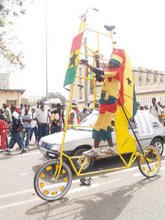
Baba Yara Stadium is now ready for CAN 2008.


Tuesday, August 28, 2007

ASAFO INTERCHANGE NEARING COMPLETION

After several months of waiting, the Asafo-UTC interchange, which is to help ease vehicular traffic in the Kumasi metropolis is nearing completion.
Residents of Kumasi have been waiting ansciously for the completion of the project. It has been gathered that President J. A. Kufuor would formally commission the project to enable motorists to start using the new interchange in a few weeks time. The opening of the interchange for traffic would go a long way to help ease traffic congestion on other roads in the metropolis.
PICTURE SHOWS THE NEW INTERCHANGE IN KUMASI


Monday, August 27, 2007

BUMPER TO BUMPER TRAFFIC INTENSIFIES IN KUMASI

Traffic congestion on Kumasi roads is becoming an ever-present nightmare for road users, negatively affecting productivity and the environment.

The road transport infrastructure in the metropolis has not kept pace with the increased number of vehicles that have been bought as a result of the city’s significant economic growth in recent years, itself uderpinned by a boom in consumer spending.

The city of Kumasi has spread out over the past years. Being the second largest city in Ghana it is experiencing rapid urbanisation and accelerated population growth and an exploded traffic on the road. Nowhere is this more evident than in the Central Business District (CBD) and on other arterial roads.

One result of this phenomenon is the severe traffic congestion as witnessed on the Lake Road, 24th February Road and the Sunyani Road which results in loss of working time, affecting productivity, higher vehicle running cost and negative environmental impact.

Information at the Driver and Vehicular Licensing Authority (DVLA) indicate that the number of vehicles imported into Kumasi keep increasing year after year.

Owing to inadequate public transport options in the metropolis, private cars are more a necessity than a choice.

An upwardly mobile middle class, coupled with increased access to car finance, and the entry of a greater range of less-expensive vehicle models (second hand) into the market have all contributed to the rise in vehicles on the roads.

Because there is too much private cars than the public transport, people are running away from public transport, because it is not that much good, reliable and enough, as they want it to be.

Hitherto, bumper to bumper traffic was uncommon in Kumasi but it has become prevalent nowadays on many arterial roads in the metropolis.

Surprisingly however, it has been observed that at certain intersections in the metropolis, where traffic lights are located, vehicular movement becomes slow and traffic normally jams when the traffic lights are operating normally.

But when the lights go off, or was put only on amber, traffic flow is fast and smooth. The question then is - what is the essence of the traffic lights at those areas, if its presence impede on traffic flow.

Areas where this is prevalent is the traffic lights at the Kumasi Club, the one in front of the offices of the Kumasi Metropolitan Assembly (KMA), Krofrom and Abrepo Junction.

Some residents interviewed expressed worry about the traffic situation and called on the city authorities to institute measures to help curb the situation.

Mr Kofi Abebrese, a resident of Ashtown on his part said he reckon that, vehicular traffic congestion was one of the characteristics of a developing city and Kumasi was no exception.

“But city authorities also need to develop our road networks in tandem with the development of the city”, he said and maintained that the situation of the current traffic congestion was bad since it affects businesses and appointments.

He called for the speedy completion of the Asafo interchange and said the government also needed to construct more interchanges in the metropolis at various intersections so as to help curtail the traffic situation.

Mr George Frimpong, a taxi driver said the traffic situation was affecting the commercial taxi business, since taxi drivers now spend more fuel to transport passengers to their destinations by spending more time in traffic.

It is essential to augment existing transport infrastructure through the construction of more roads and interchanges to help ease the road. But that is also a very complex, slow-moving and capital-intensive process.

For instance, the Asafo-UTC interchange project, which was commenced two years ago and was to be completed in 18 months, is well over 24 months and even not yet completed yet.

Because of the closure of the Asafo Roundabout to make way for the construction of the interchange, traffic on alternative routes have intensified and have been “bumper to bumper” all this while.

Passengers form queues at bus stops, especially in the rush hour as vehicles jam the roads. The hassle is very evident, especially during rush hours in the mornings and evenings and sometimes in the afternoon at the central business district.

Information from the Urban Roads Department in Kumasi indicates that government has secured funds from donor partners to implement various road projects in the metropolis as a way of helping to reduce the traffic congestion and its related problems.

And indeed, the President, Mr J. A. Kufuor himself has cut sod for the commencement of those projects but the contractors are yet to be seen on site working. The projects include the road from the Komfo Anokye roundabout through Bekwai roundabout, Sofoline roundabout to Abuakwa Road with interchanges at various intersections and the Oforikrom -Asokwa by - pass also with an interchange at Timber Gardens intersection. All these roads are expected to be made dual carriage ones.

It would be appreciated if the implementing agencies would speed up the projects so as to help ameliorate the traffic congestion and its related problems on residents of the Kumasi metropolis.

Sunday, August 26, 2007

KUMASI BRACES ITSELF FOR CAN 2008

Authorities of the Kumasi Metropolitan Assembly (KMA) have outlined a number of measures to ensure that Kumasi was well positioned to host the various visitors who would be coming to Kumasi during next year’s Cup of African Nations Tournament (CAN 2008).

Like the Accra Metropolitan Assembly, the KMA has sent a request to all taxi drivers to put on uniforms for neat appearance and easy identification. They are also to be provided with identification cards.

Again all taxis are going to be embossed with certain unique numbers for easy identification.

Miss Patricia Appiagyei, Metropolitan Chief Executive who made this known at the official launch of the Kumasi Venue of CAN 2008 said any visiting taxi to the Kumasi metropolis would be made to register with the KMA for an entry permit to be in the city for a required period of time.

These and many other measures are to help ensure that the city was well positioned for the tournament to be able to attract tourists.

The football tournament of African Nations to be held in Ghana from January 20 is the 26th Edition and out of the 16 participating teams, four would be hosted in Kumasi.

About half of the estimated one million visitors to Ghana during the tournament are expected to be in Kumasi.

Looking at the importance being attached to the tournament, the KMA has already started a series of activities towards ensuring a cleaner, more beautiful and befitting city for the tournament.

These include the decongestion and beautification exercise currently underway.

Many measures have also been discussed and are to be instituted to ensure that service providers deliver excellently, according to Miss Appiagyei.

Again, to help ease traffic congestion at about a 2-kilometre radius around the Baba Yara Stadium, which would be the centre of attraction when the tournament kicks off, the KMA in conjunction with the Kumasi CAN 2008 Venue Organising Committee (KVOC), as well as the Metro Mass Transit (MMT), is to introduce the park and ride system.

This system would require motorists to park their vehicles at designated points in the city, where security would be provided, pay a fee and join a bus, which would convey them to and from the stadium before and after the match.

To help make the system workable, certain areas have been identified. These areas include the Central Post Office, KMA Parking lots, Prempeh Assembly Hall, Asem School Park, all the training pitches, the premises of the Centre for National Culture (CNC) and certain spaces at the sub metros.

The KMA Chief Executive also said that the security agencies were planning to ensure that matters of security were treated with the utmost urgency it deserves adding that there is a comprehensive plan to give maximum protection to both the citizenry and visitors.

With respect to accommodation, apart from the about 222 hotels that are already in existence in the metropolis, 120 more including the City Hotel, which are under construction would be completed for usage during the tournament.

Accommodation facility in the tertiary institutions including the one at the Kwame Nkrumah University of Science and Technology (KNUST) is to support the accommodation plan.

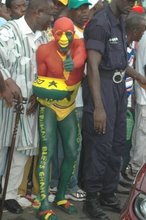
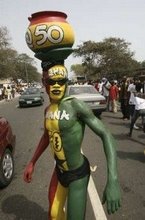
As a result discussions are underway with the university authorities in an attempt to alter the university’s calendar on re-opening for the second semester to enable the organising committee have access to the students’ accommodation on campus. The idea of creating tented villages to support the accommodation plan is also seriously being considered. PICTURE SHOWS A SOCCER FAN IN KUMASI

CAN 2008 LAUNCHED IN KUMASI


Traditional adowa dance by the Amamereso fie Cultural Group from the Centre for National Culture and “Jama” songs from various football supporters union were some of the side attractions that heralded the official local launch of the Kumasi Venue of CAN 2008 at the Prempeh Assembly Hall yesterday.

It signified the official information for the people of Kumasi and the Ashanti region about the impending CAN 2008 tournament and the benefits of the tournament.

An excited Ashanti Regional Minister, E. A. Owusu Ansah, who lauched the programme said, “from today let us all think, eat, drink and toast CAN 2008, of which the Black Stars of Ghana will be crowned champions for the 5th time”.

The Kumasi local launch of the competition marks a turning point in whipping up public interest in the tournament. This is premised on the fact that the tournament would bring a lot of advantages, such as attracting tourists, fostering business partnerships and friendships as well as good neighbourliness with other nations.

CAN 2008 kicks off on January 20, 2008 with an opening ceremony at the Ohene Djan Sports Stadium in Accra. Other local venues — Accra, Sekondi and Tamale — are also expected to do their launches in the coming weeks.

The Kumasi official launch was followed by a street float which attracted cheers from members of the public.

Dressed in the Ghana national colours, the various supporters union stormed the Prempeh Assembly Hall amidst the singing of the Ghana Black Star Cheer Song which sent the entire hall into a frenzy.

“I have just been made conscious of the excitement that would go with the hosting of the tournament” was what Miss Eno Akua Brantuo, a patron at the official launch, was overheard saying as the hall went into a frenzy.

The Ashanti Regional Minister called for an unflinching public support and cooperation in the quest to get Kumasi prepared for the tournament.

He explained that Ghana was chosen to host the tournament for a number of reasons, such as previous experiences in hosting it in 1963, 1978 and co-hosting it in 2000 with Nigeria.

“The peaceful political climate, the exploits of the Black Stars in recent international tournaments and the reputable standing of the country among the comity of nations are all significant factors.

“With such an impressive background, it is important that we strive to ensure another successful tournament”, the Minister said.

He maintained that the decongestion exercise currently being embarked upon by the Kumasi Metropolitan Assembly (KMA) was laudable and stressed that every nook and cranny of the city needed to be kept clean since visitors would take advantage to tour the city.

He also called for a warm welcome from residents to all visitors to the city during the period of the tournament.

“Kumasi has always been a pacesetter when it comes to participating and organising national events of this sort”, the Minister said.

Professor K. K. Adarkwa, Chairman of the Kumasi Venue Organising Committee (KVOC) said his outfit was doing its best to ensure that all the infrastructure for the tournament - stadia, training pitches and the city hotel project - were completed on schedule for the competition.

The Chief Operating Officer of the Local Organising Committee (LOC), Mr Rex Danquah, mentioned that a number of activities had been scheduled prior to the competition to help whip up public interest in the competition.

Miss Patricia Appiagyei, KMA Chief Executive mentioned that the KMA would ensure that enough buses were made available to transport supporters to the stadium. She said private vehicles would not be allowed entry into a two-kilometre radius of the stadium to help curtail traffic congestion at the stadium area, Rather, the KMA would provide buses for patrons to park and ride.

One significant hiccup of the official launch which the KVOC may have to rectify in future activities was the usual Ghanaian attitude of lateness to functions.

The official launch programme was advertised to start at 8:30am at 10:00am the organisers were not ready for the start of the programme.

ACCIDENT CENTRE FOR CAN 2008

An ultra modern Accident and Emergency Centre being constructed by the Komfo Anokye Teaching Hospital (KATH) is to be ready by December 2007, making it available for usage during next year’s Cup of African Nations (CAN 2008) in Ghana.

The project is about76 percent complete and currently being equipped with modern gadgets.

It is to help put KATH in a position to be able to handle ordinary and mass casualty cases, in case any should occur during the tournament period.

Dr Anthony Nsiah Asare, Chief Executive of the hospital, who made this known at a mid-year performance review meeting of the hospital in Kumasi mentioned that, a number of staff in the hospital have also undergone training in mass casualty and the hospital was in the process of training more.

He said the hospital has positioned itself to be able to handle medical cases during the tournament period and added that, the move was not only for CAN 2008 but formed part of an overall strategy to turn the hospital into a modern “centre of excellence” in the provision of clinical and non clinical services comparable to international standards.

The Accident and Emergency Centre has been equipped with a helipad on top of the building where helicopters could easily land to drop and pick patients.

Consar Limited is the contractor working on the project.

Dr Asare said so far eight nurses have received training in Israel to support the Accident and Emergency Centre and three more have been sent to South Africa to also train in handling casualty cases. These nurses are expected to serve as trainer of trainees on their return to the country.

He noted that many patients die in trauma cases because of the lack of proper handling and requisite equipment to help take care of them; hence the construction of the modern facility at the hospital was welcome news.

He said hospital has been receiving support from the Israeli government and that it was currently collaborating with it to use the Accident and Emergency Centre as a training centre in mass casualty not only for Ghana but the entire West African region.
The Israeli government in 2002 helped to set up a trauma centre at KATH and subsequently helped to train six staff to help man the place.

MINISTRY TO TACKLE SANITATION PROBLEMS

The Ministry of Local Government, Rural Development and Environment (MLGRDE) is liaising with Attorney General and the Judicial Service to adequately equip the district courts to deal expeditiously with sanitation cases.

This followed moves by the ministry to enforce sanitation laws through education and the courts.

This came to light at a two-day meeting in Kumasi to discuss the report of an environmental sanitation tour undertaken by a delegation of the ministry to Bangladesh and Ethiopia recently.

The tour was to help develop a sustainable rural sanitation module in the country, with the aim of finding a lasting solution to environmental problems confronting the nation.

Participants of the tour were sponsored by MLGRDE to undertake a study tour of Ethiopia and Bangladesh, where sanitary conditions are far better off than Ghana.

It enabled them to acquaint themselves with the sanitation situation in those countries and replicate them in Ghana.

Among the participants were Mr Osei Asibey Antwi, Deputy Ashanti Regional Minister, Mr Amin-Adams Anta, Tamale Municipal Chief Executive, Mr Kweku Quansah, Programme Officer at MLGRDE and other experts in sanitation from various district assemblies across the country.

Environmental sanitation had been identified as a powerful driver of the nation’s development as it affects the quality of life and productivity of the population.

A greater number of diseases reported to the hospitals and other health institutions in Ghana are sanitation related among which, includes malaria, typhoid, diarrhea diseases, worm infestations and bilharzias.

These diseases are said to account for over 70 percent of outpatient department attendance in hospitals and are responsible for most infant mortality.

According to the participants their study tour revealed a greater political and community commitment to sanitation issues in those countries.

“There are no open defecations there”, Mr Quansah, Programme Officer at MLGRDE said and added that it came to light that it required a lot of political commitment in Ghana to develop feasible strategies and coherent programmes to address the sanitation challenges facing the country.

“As a nation, we have not placed priority on sanitation”, he said.

Sanitation in Ghana is poor and as one goes round the cities and towns, what one sees is filth.

Drains are choked with garbage and human excreta, open spaces and beaches which, should serve as recreational grounds have become defecating and dumping sites for all kinds of waste.

Major roads and streets including lorry parks are all littered with garbage. The situation in low income communities especially those in the cities and major towns is a sorry sight.

In some cases inadequacy of resources have been accused of aggravating the problem but in other cases indiscipline seem to be a major contributory factor.

People throw out waste and urinate anyhow and in some cases defecate in public places with careless abandon.

Contributing, the Ashanti Regional Minister, Mr Emmanuel A. Owusu Ansah said over the years, so much resource had been committed by government, metropolitan, municipal and district assemblies and their development partners into sanitation yet there seemed to be no breakthrough for to the problem.

He also added his voice to the need to enforce laws on sanitation adding, “if the courts are properly resourced it should not take more than three days to deal with a sanitation case”.

The Minister observed that the problem of sanitation should not be left on the shoulders of government and its agencies alone since it was a national problem and everybody should be part of its solution.

Accordingly, he called for the need for the private sector to be encouraged to build their capacities to meet the challenges in waste management.

“We have reached a stage in the country’s development when sanitation services can no more be free. At present less than 15percent of the population pay for sanitation services.

“The assemblies therefore find themselves in a dilemma when they have to spend their development budget on sanitation to the detriment of other projects”, he said.

Mr Owusu Ansah challenged the MMDAs and the technocrats to come up with appropriate technologies of waste collection, transportation, treatment and final disposal.

“It is about time we move away from the traditional ways of waste management and rather see to as a resource which can be used to create wealth and generate employment opportunities”.

Friday, August 03, 2007

SOKOBAN WOOD VILLAGE

Construction work on a Wood Village at Sokoban for wood workers in the Kumasi metropolis is progressing steadily.

The Kumasi Metropolitan Assembly (KMA) has acquired land at the area and is developing it into an industrial estate for wood workers.

The project would have facilities such as access roads and internal roads, sheds and stores, an administrative block and a modern car park. These facilities would be used by the wood workers at a fee to be paid to the KMA.

It is financed with funding secured by the Ghana Government from the French Government, through Agence Francaise de Development (AFD).

The chiefs and people in the Sokoban area have lauded the idea of siting the wood village there, saying the project opened job opportunities to residents operating in the wood industry.

They said land owners could also take advantage to provide other facilities that may be needed such as warehousing, show rooms, as well as provide commercial and residential accommodation.

Speaker after speaker from the surrounding communities at a sensitisation durbar organised by the KMA on the relocation of wood workers to the area lauded the idea.

The durbar was aimed at conscientising the community members to receive the wood workers and also to enable them voice out their concerns.

Madam Patricia Appiagyei, KMA Chief Executive, recommended to the project contractors to enhance the use of the facility by providing access to modern systems like automated gates and ticketing facilities and called on community members to support the project to enhance its successful implementation.

“Let us all, as partners in development pledge to support this project and contribute our individual and collective efforts to ensure its successful implementation”, she said.

She pointed out that “It is my hope that the activities of the wood workers would be mutually beneficial to both the host community and the wood workers”.

Other projects being financed with funds from AFD in the Kumasi metropolis under the Urban Development Project include construction of Oforikrom –Asokwa by-pass, improvement of the Lake Road, an interchange at Timber Gardens and landscaping of the Aboabo River bank.

The concept of a wood village at Sokoban, which is to serve as an industrial hub for wood workers was envisaged by wood workers in Kumasi themselves in times past but had remained on paper until now.

It was the Ghana Furniture Producers Association, now Federation of Wood Workers Association of Ghana (FAWAG), which conceived the idea in the late 1980s.

While some, especially those operating on large scale, have been keen about relocating there, the small scale operators were reluctant to relocate. There are presently 12 large scale operators located in the area.

It became necessary to construct a Wood Village as a result of the construction of the Oforikrom –Asokwa by-pass, which is likely to displace close to 5,000 wood workers at Anloga.

The displaced workers, are therefore, to be relocated to the Sokoban Wood Village.

Kumasi being the second largest city in Ghana is experiencing rapid urbanisation and accelerated population growth.

One result of this phenomenon is the severe traffic congestion as witnessed on the Lake Road, 24th February Road and the Sunyani Road which results in loss of working time, affecting productivity, higher vehicle running cost and negative environmental impact.

In an attempt to reduce the traffic congestion and its related problems, the government has secured funds from the donor partners to implement the projects.

The execution of the projects is expected to displace nearly 8,000 persons engaged in various businesses, as well as affect 141 permanent structures, according to the KMA.

The KMA Chief Executive , therefore, called on wood workers at Anloga and other areas in the metropolis to relocate to the wood village upon completion since it would enable them have expanded markets and easy access to wood, as well improvement in transport and utility services.

She said the KMA was also considering a move to create a hub for the numerous garages being used by car sellers in the metropolis and appealed to chiefs to help release lands for the project.

She explained that the move was to help prevent car sellers men from parking their vehicles on pavements to do business.

Thursday, July 19, 2007

KUMASI STADIUM IS 82 % COMPLETE FOR CAN 2008

I recently paid a visit to the Baba Yara Sports Stadium in Kumasi to aquaint myself with the progress of reconstruction works at the stadium. The stadium is one of the four venues to host next years Africa Cup of Nations (CAN 2008). The contractors working on the project, Consar Limited told me that work is 82 percent complete. The project started in May 2006 and the contractors are to handover by October 31st.
I was impressed with the progress of work. The green grass is ready. the contractors are yet to install the spectator seats but the plastic chairs have arrived at the project site.
Work on the roof at the VIP stand is in progress.
The floor to host the tartan tracks is being prepared
Below is an artist impression of how the stadium would like when completed.

Wednesday, July 04, 2007

Kumasi form sister city relationship with Ouagadougou

Picture show Mr Simon Compaore (left), Mayor of Ouagadougou in a handshake and exchanging documents with Ms Patricia Appiagyei, KMA Chief Executive. This was after the two of them have appended their signatures to the protocol agreement to implement a partnership between the cities of Kumasi and Ouagadougou.

Thursday, June 28, 2007

Kumasi Shoe Factory to be resuscitated

PICTURE SHOWS ALAN KYEREMATEN (third from right), MINISTER OF TRADE, INDUSTRY, PRIVATE SECTOR DEVELOPMENT AND PRESIDENTIAL SPECIAL INITIATIVES (PSI) INSPECTING THE SHOE FACTORY

THE Ministry of Trade, Industry, Private Sector Development and President’s Special Initiatives (PSIs) has launched a fact-finding mission into the activities of the GIHOC Shoe Factory in Kumasi as a way of helping to resuscitate the defunct factory.
The factory was divested to Newack Commercial Capital of the Czech Republic in 2003 but it has not been able to resuscitate the factory as of now.

Equipment at the factory is currently deteriorating, while thieves have made away with vital components of the machinery.
That, according to Mr Alan Kyerematen, the sector Minister, was deeply worrying to the government.
“We are going to hold negotiations with the Czechs and see how a way forward can be found,” he said in Kumasi on Friday as he paid a familiarisation tour of the factory premises.

He explained that if it came out that the Czechs were no longer interested in the factory and returned it to the government, then his outfit would collaborate with the Association of Shoe Makers in Kumasi to find a possible way of resuscitating the factory.
The shoe factory started operations in 1967 as a state enterprise under the Ghana Industrial Holdings Company (GIHOC), in partnership with a company in the then Czechoslovakia, and produced mainly industrial boots but occasionally produced fashionable shoes upon request.

Between 1973 and 1995, activities at the factory took a nosedive and it was subsequently listed for divestiture.

Some workers of the factory hung around the factory, hoping that a prospective buyer would come on board to engage them.
They subsequently produced shoes upon requisition and used the proceeds to pay themselves until 2003 when Newack came on board to close down the factory permanently.

Mr Kyerematen said Newack paid a deposit and the factory was subsequently handed over to it, hoping that it would resuscitate it.
Currently, part of the factory premises is being occupied by some private individuals, a church and some companies, all of whom are said to be paying rent to Newack.


Tuesday, June 12, 2007

Kiosks owners try to outwit KMA decongestion team

A NEW development has emerged in the ongoing decongestion exercise in Kumasi, with owners of a number of container shops and kiosks sited at unauthorised locations painting their structures in the national colours of red, yellow and green in a bid to save those structures from demolition.
Most of those structures are located in areas like Asokwa, Asafo, Amakom and the Kwame Nkrumah University of Science and Technology (KNUST) Junction.
City authorities have, however, indicated that there is no policy that exempted such structures from demolition, even if their locations were illegal.
“The issue is where the structures are located and not the national colours,” Mr Charles Ampomah-Mensah, the Metropolitan Engineer, explained in an interview.
He said the Kumasi Metropolitan Assembly (KMA) decongestion team had been compelled to remove and demolish some of those structures painted in the national colours at Kaase because they had been wrongly sited.
He expressed the hope that the Kaase example would drum home the fact that the KMA meant business and would not favour anybody for one reason or another.
The metropolitan engineer indicated that some people might have been wrongly carried away by the decision of the KMA to spare kiosks belonging to the Department of National Lotteries (DNL) in the exercise. DNL kiosks are in red, yellow and green.
On the decongestion exercise, Mr Ampomah-Mensah said it was progressing steadily, explaining that the team was now concentrating on the eastern railway line from the Central Market through Alabar and Aboabo to join the eastern by-pass.
He said the KMA decongestion team had faced serious security problems in the exercise in parts of the Zongo area, saying the security personnel attached to the team had had to fire warning shots to dispel rampaging residents who pelted various missiles on the members of the team.
Mr Ampomah-Mensah explained that the KMA was not out to destroy business in the Kumasi metropolis through the decongestion exercise, as some people might want to believe.
“The informal sector in Kumasi is so big and contributing immensely to the economy of the metropolis and as such we will not do anything to destroy the sector,” he said.
He pointed out that many of the people selling on pedestrian walkways could move to safe areas but they would simply not do that, adding that said a such situation could compel the KMA to forcibly remove them, creating problems for the affected persons.
He said the KMA was talking with identified groups like car dealers and mechanics to ensure that they complied with the directives without any disturbances.

Decongestion exercise extended outside CBD

THE Kumasi Metropolitan Assembly (KMA) has extended the decongestion exercise to the ring roads in the metropolis.

This is after it has brought sanity to the central business district (CBD) of Adum by ejecting traders transacting business on pavements and streets and demolishing major slum areas alleged to be the hiding places of criminals, illegal drug peddlers and prostitutes.

Last week the KMA started clearing all kiosks, containers and structures along the route from the Anloga Junction, where the Ring Road begins, to the Airport Roundabout down to the Krofrom traffic lights.

According to officials of the task force who are carrying out the demolition exercise, it would be extended to the Sofoline and Santasi roundabouts and continue to the Asokwa Police Station area.

The exercise, which started barely two months ago, forms part of efforts by the KMA to restore Kumasi to its former glory as the Garden City of West Africa.

According the Transport Officer of the KMA, Mr Atta Boafo, the exercise would come to an end in two weeks’ time, “by which period we would have cleared all unauthorised structures from the ceremonial roads”.

Explaining further, he said some of the structures were used for both business and residential purposes, explaining that that was against KMA regulations on trading and residential accommodation.

He said in the course of the exercise, the task force encountered some obstacles but its desire to clear all unauthorised structures prevailed and that made it possible for it to successfully execute the programme.

Mr Boafo expressed concern about some recalcitrant residents who refused to remove their structures from the restricted areas, even when, prior to the exercise, the KMA had notified the affected persons to remove the structures before the task force hit the road.

He said while some of the affected persons complied with the directives and removed their structures, “the recalcitrant ones refused so we had no option but to remove them to pave the way for the beautification programme to begin in earnest”.

He said the decongestion exercise was on course, adding that it would be extended to Suame Magazine “as soon as we clear the ceremonial roads of all structures which undermine our beautification programme”.

He said artisans at Suame Magazine had extended their activities to the major roads in the area, creating vehicular and human traffic, as well as sanitation problems, in the metropolis.

Mr Boafo said the KMA had already notified the executive members of the artisans and the Ghana National Garage Owners Association about the upcoming exercise and those who would be affected had started clearing their structures.

He gave the assurance that the exercise would not be a nine days’ wonder but would be sustained “to enable residents to appreciate the need to comply with the directives of the KMA”.

Mr Boafo said the KMA had set up a monitoring team to stop recalcitrant traders from returning to the CBD to transact business on pavements and streets.

The team consisted of a few members, he said, adding, “But when we finish with the demolition exercise we will increase the number of the monitoring team to enable it to stamp its authority on all restricted areas which had been used over the years for business transactions.”

Meanwhile, a section of the residents affected by the decongestion exercise has complained bitterly about the “excesses of the assembly”.

They contended that the KMA was taking the exercise too far and venturing into areas where they were not supposed to go.

According to Mr Moses Boadi, a resident of Krofrom, whose container was removed by the demolition team, his structure was far from the main road and so he did not understand why it had to be removed.

He said the KMA’s action was affecting the businesses of a lot of people and, therefore, urged it to take a second look at it.

Other affected people who spoke expressed similar sentiments and urged the KMA to suspend the exercise.

Thursday, June 07, 2007

Accra traders throng Kumasi for poultry products

There is an influx of traders and farmers into the Ashanti Region to buy poultry and poultry products for distribution in Greater Accra.
"That follows an increased bio-security and hygienic conditions in poultry farms in the region against a possible spread of Avian Influenza (Bird flu)," Dr Thomas Addai, the Ashanti Regional Veterinary Officer has said.
Ghana recorded the outbreak of the deadly bird flu at Sunyani in the Brong Ahafo region and Tema in Greater Accra and efforts are underway to prevent the spread of the disease beyond the two areas.
In an interview with the Daily Graphic in Kumasi, Dr Addai said with the security measures underway in the region, “unless an airplane sprays the virus into the region, poultry farmers could be assured of the safety of their birds.
“However, we should know that we are not living in isolation”, he said and added that everything humanly possible was being done to prevent a possible spread to the region.
Dr Addai said the demand for poultry products in the region especially from Accra had increased and that he had been called upon on numerous occasions to issue permits for the products to be transported to Accra.
“I just issued a permit for some birds to be transported from the region to Prampram in the Greater Accra region”, he said.
Avian Influenza is caused by an orthomyxovirus or influenza virus and can survive for considerable lengths of time outside of the host and birds are infected through contact with other birds, mechanical vectors such as vehicles and equipment and personnel travelling between farms, markets and abattoirs.
Precautionary requirements include cleaning and disinfection of premises and the establishment of a bio-security barrier to help prevent spread of disease.
Dr Addai said that was essentially what was being done in many poultry farms and other areas in the Ashanti region with the assistance of the Veterinary Services Department.
Avian Influenza is a potentially devastating disease, predominantly of chickens and turkeys, although the virus can also affect game birds (migrating birds).
Dr Addai explained that the migrating birds normally preferred to land in wetland areas and explained that there are security measures also in place to ensure that, the disease did not spread from such areas.
There are three wetland zones in the Ashanti Region - Owabi, Bosomtwe and Nobewam - and the Veterinary Officer explained that in collaboration with Wildlife Officers, they had been carrying out random surveillance in the wetland areas hoping that any of the migrating birds found dead could be tested to see if it had been infected, but that has proved negative as of now.
He said they have also been conducting active surveillance activities involving sample collection from poultry farms all of whom have proved negative.
Dr Addai said with the measures instituted, a barrier has been placed to prevent the virus from spreading and said there was an active search ongoing in the region together with an intensified awareness creation on the disease.
He however expressed regret that the Regional outfit of the Veterinary Services was yet to be adequately resourced in terms of laboratory requirements and gadgets to deal with actual outbreaks, in case there was one.
Dr Addai proposed that from the recent bird flu cases in the country and the world at large, not everybody at all should be allowed to set up a poultry farm in future.
He called for the introduction of a policy that would require all prospective poultry farmers to register and be granted a license like it was being done with pharmacy shops and expressed the hope that would help curtail other poultry diseases.
“In this case, you could be sure of poultry farmers who would follow bio-security and hygienic conditions set out for them”, he said.

Wednesday, May 23, 2007

Sodom and Gomorrah slum in Kumasi demolished

THE biggest single demolition exercise ever to hit the ‘Garden City’ of Kumasi took place yesterday when the Kumasi Metropolitan Assembly (KMA) razed down Sodom and Gomorrah, a sprawling slum near Adum, sending more than 3000 residents looking for places to lay their heads.
Armed soldiers and policemen supervised the demolition exercise which took two caterpillars about one hour to complete as several wooden and mud houses in which the residents, mostly of northern extraction lived, came crumbling down. The exercise was part of the second phase of the decongestion exercise, embarked upon by the city authorities about two months ago.

There was virtually no resistance from
the residents, even though KMA officials said there was an initial potential for it.
A number of the residents had gone out when the exercise took place and those who were around had to struggle to pull away their personal belongings.
Some wailed uncontrollably and two nursing mothers holding strongly to their one-week and three-day old babies were seen running away to a safer place.
Officials said with Sodom and Gomorrah gone, the next target was Angola, another fast growing slum near Kaase in Kumasi.

Some people had associated the slum, the biggest in Kumasi, to vices including prostitution and gambling, but the leaders of the community denied these some months ago at a news conference.

There was a market, day care centre and other ‘facilities’ in the area, which was also connected to electrical power from the national grid.
KMA officials said the decision to demolish the slum was due to reasons other than immorality.

Mr Charles Ampomah-Mensah, the Metropolitan Engineer at the KMA, told the Daily Graphic that the area was simply not zoned for human habitation and the general conditions there was nothing to write home about.

He stated that the sewer system from the Komfo Anokye Teaching Hospital ran to the area and it was an eyesore to see human beings living with all sorts of unhealthy materials at Sodom and Gomorrah.

Again, the metropolitan engineer indicated that the Volta River Authority (VRA) and the Electricity Company of Ghana (ECG) had their sub stations very close to the area, which was dangerous for the residents.

He said the decision to demolish the place was taken about two years ago when the KMA informed the residents accordingly.
However, the leaders of the ‘community’ petitioned the KMA to extend the deadline for the exercise “ and we agreed”.

Mr Ampomah-Mensah said when the deadline expired the leaders again petitioned the Commission for Human Rights and Administrative Justice (CHRAJ) over the intended exercise “and again we have to wait until the commission saw that the petitioners had no case”.
To a question as to whether the KMA would look for an alternative place for the residents to live, the engineer said “we are not duty-bound to look for a place for them”
He said the KMA was planning on what to do in the area but said it was likely the place would first be beautified to serve as a green zone for a recreational centre.

Monday, May 21, 2007

Anglogold initiates fish farming project at Homase

Anglogold Ashanti (Obuasi Mine) Limited has commenced a US$550,000 aquaculture project for the people of Adubrem, Hemang, Krodua and Homase in the Amansie Central District of Ashanti.

The project forms part of a sustainable livelihood support programme being instituted by Anglogold in the area, which is located about 20kilometres north of Obuasi.

It is expected to offer employment to the communities as well as serve as a training ground for those interested in modern aquaculture.

The company is using a disused mined out pit at its Homase concession to undertake the project which would comprise fish farming integrated with livestock rearing, a year round vegetable farming and ecotourism.

The Minister of Fisheries, Mrs Gladys Asmah, the Deputy Minister of Lands, Forestry and Mines, Mr Andrew Adjei Yeboah and the Deputy Minister of Ashanti, Mr Osei Assibey Antwi jointly performed a sod-cutting ceremony on Friday at the area for the commencement of the project.

Also at the ceremony was the Omanhene of the Bekwai Traditional Area, Nana Kakari Apau.

The Homase mined out pit was a two-pit surface gold mining operation which was commenced by Anglogold in June 2002 and came to a close in December 2003 because of the depletion of the delineated economically accessible ores and failure of the eastern wall of the northern portion of the pit.

A decommissioning plan was prepared according to the Environmental Assessment Regulations but during consultations with the host communities and other stakeholders, it was agreed that the pit should be used as a fishpond instead of it being backfilled so as to enable it form part of a sustainable livelihood programme in the area.

This is because, a similar project undertaken at Manso Nkran in the Amansie West District of Ashanti where disused mined out pits of Resolute Amansie Limited (RAL) have been turned into fish ponds was serving the community very well as a sustainable livelihood programme.

The Homase project design emphasises the use of technological innovations and scientific knowledge in modern aquaculture practices.

Mrs Gladys Asmah commended Anglogold for commencing the project saying it gave credence that degraded lands could be put to good use.

Mr Osei Assibey Antwi, the Deputy Ashanti Regional Minister said the project when properly managed would help put money directly into the pockets of the local people.

He said a mine was like a human being, which has a definite lifespan and would die at one point or another. Therefore it was important during the active life of the mine, policies are evolved to leave the mining area a better place that it was before the mine so as to enable the people to remember the mine with nostalgia.

The Minister said he was touched by the sophisticated nature of the technology used, that allowed fish to be bred in cages and which makes harvesting an easier and exciting enterprise.

He expressed government’s appreciation for the effort of AGA towards the socio-economic development of the nation and urged the community leaders to support the project.

The Regional Minister said there are various accusations against Anglogold including pollution of water bodies, damaging people’s houses without the payment of requisite compensation and causing other environmental havocs.

He said whereas he agreed that some of the accusations may be misplaced, in the majority of the cases the accusations have some substance and are worthy of consideration and said the problem was traceable to the lack of consultation and the absence of consensus building among the mine and its stakeholders.