Baba Yara Stadium is now ready for CAN 2008.


Friday, March 23, 2007

Looming water crisis in Kumasi, as encroachment on Barekese Dam forest reserve for farming purposes intensifies

The water level in the Barekese Dam, which supplies water to the Kumasi metropolis and its environs, is gradually reducing pre-empting a looming water crisis in Kumasi in the coming years.
According to the Ashanti Regional Chief Manager of the Ghana Water Company Limited (GWCL), Mr Obeng Boateng, a recent survey of the raw water reservoir indicated that the original volume of 35.3 million m3 has reduced to 25million m3.
He said the reduction was partly due to the clearing of the forest reserve, which protects the catchments of the Offin River, which empties into the Barekese Dam by neighbouring villages for farming activities.Pix. Parts of the forest which has been burnt in readiness for a farm.
On a visit to the forest reserve to inspect the extent of encroachment by some journalists and staff of the GWCL on World Water Day, it was detected that there was also serious logging going on in the forest reserve to the extent that trees planted by a timber firm in Kumasi, LLL for the GWCL have all been logged.
Farms have been constructed very close to the river bank with a number of vegetable farms springing up along the river bank.
At the time of the visit, parts of the forest had been cleared awaiting burning to be turned into farms.
Although the Ghana Water Company Limited (GWCL) has on numerous occasions appealed to neighbouring villages to desist from clearing the forest cover that seems to be falling on deaf ears.Pix. Parts of the forest which has been cleared in readiness for farming.
The Chiefs and people of Penteng, one of the neighbouring communities along the Offin river for instance have vowed to continue clearing the forest for farming purposes unless compensation were paid to them.
They claim compensation for the land have not been paid to them since the construction of the dam 35years ago and as a result their only source of livelihood depended on farming in the forest.
They claim while other communities such as Nkwantakese and Denase have all been paid their compensations, theirs were yet to be paid.
They also claim that they have on numerous occasions applied to supplied with pipe-borne water from the GWCL and have not received any responses even though other neighbouring communities such as Nkwantakese and Denase have all been getting pipe-borne water from the GWCL.
The Regional Chief Manager of GWCL explained that the delays in the payment of the compensations were as a result of inaccuracies in the documentation, which the Land Valuation Board was trying to resolve.
He said it was true that some of the people have been paid crop compensation with others yet to be paid and appealed to the residents of Penteng to exercise restraint and desist from encroaching in the forest reserve.
“Lack of patience is destroying this all important national asset”, he said.
Mr Boateng said the forest cover is purposely to prevent silt of rain water from entering the dam and this is to prevent siltation as well as prevent rapid evaporation of the dam from the intense sun and also to encourage rains around the area to fill the dam.
He said the trend of encroachment if not checked could put the dam in danger in the near future.
The idea of the Barekese Dam was muted in 1965 and a total land coverage of 10, 723.25 acres was acquired. Some villages were resettled at Asuofua.Pix. Parts of the cleared forest
Mr Boateng said that dredging of the dam was currently required if they have to increase the treatment plant capacity to more than 24million gallons a day.
The dam was originally designed to treat 48million gallons a day at full capacity but the machinery currently available can produce 18millions a gallons a day.
At the Barekese end of the forest someone has also constructed a fishpond on the boundary of the catchments forest by blocking one of the streams.
Mr Boateng said the blockage was seriously affecting the dam, especially during the dry season but efforts to get the owner of the fishpond to dismantle has fallen on deaf ears.
“Kumasi cannot lose this dam. It is the water pot and therefore the life of Kumasi”.Picture shows journalists glancing through the map of the forest reserve
Mr Boateng said the government was in the process of rehabilitating both the Owabi and Barekese Headworks and also expand the Barekese system by additional six million gallons a day.
He said the contract for the project has been signed and people should be grateful and not allow impatience to disrupt the important programme.
The Regional Chief Manager said water supply the world over was not sufficient and particularly in African and Asian countries and that was the reason why governments have been spending much of their budgets on water supply.
He called for support in the protection of water sources.

Wednesday, March 21, 2007

Graphic launches Ashanti and Brong Ahafo regional newspaper

The Deputy Ashanti Regionl Minister, Mr Osei Assibey-Antwi, has launched a regional newspaper for the Ashanti and Brong Ahafo Regions being published by the Graphic Commmunications Group Limited (GCGL) with a call on the company to use the paper to positively influence the pace of development in its catchment area.

He observed that, effective communication was essential for rapid socio-economic and political development of every community.
He, therefore, expressed the hope that the new paper, Graphic Nsempa, would chart a course that would further underline the position of the GCGL as a strong leader in the newspaper business of the country.
The weekly newspaper would be on the newstands on Mondays and would concentrate on the Ashanti and Brong Ahafo Regions.
It would be principally used to create a platform for all stakeholders in the two regions to interact and shape their development agenda.
The paper is also to be used to partner the people of the two regions to promote their traditional values, culture and tourism among other issues as a way of enhancing their growth and raise their standard of living.Picture shows (L-R) Elvis Ayeh, Acting MD of GCGL and GM Newspapers, Rt Rev Daniel Yinkah Sarfo, Anglican Bishop of Kumasi,Board Chairman of GCGL, Osahene Offei Kwasi Agyemang IV glancing through a copy of the Graphic Nsempa. This was after the launching ceremony.
Mr Assibey-Antwi said the people of the two regions and residents of Kumasi in particular were pleased that such a newspaper had made its debut.
He said he was very much aware of the contributions of the GCGL to the growth of the media landscape and its positive impact on socio-economic development in the country and that it was, therefore, not surprising that, “they are breaking new grounds in the media landscape”.
The Deputy Minister said the launch of Graphic Nsempa was quite significant and was a manifestation of the efforts of the GCGL in redefining its role in societal development.
“It is against this background that I wish to remind you as professional communicators to be objective in your approach to duty”, the Deputy Minister said.Dep Ashanti Regional Minister, Osei Assibey Antwi launching Graphic Nsempa.
Introducing the paper, the Board Chairman of GCGL, Osahene Offei Kwasi Agyemang IV, said apart from educating, informing and motivating the people in the two regions and beyond, the paper would later be replicated in the other regions as part of the company’s growth and expansion strategy.
“As a business entity, the company is constantly scanning the business environment to identify opportunities for growth and profitability”, the Board Chairman said.
“In doing so, the company has identified the publication of regional newspapers as a growth strategy”, he said and added that the project took almost four years to accomplish as tours had to be embarked on in all regions to key stakeholders about the concept and to take their concerns on board.A section of the audience at the launching ceremony.
The Board Chairman added that the project was now on a pilot basis and that it would be evaluated subsequently and replicated in the rest of the regions, which have been zoned into Eastern and Volta, Northern, Upper East and Upper West, Greater Accra and Western and Central regions.
Osahene Agyemang said the GCGL’s strategy of product diversification for growth had made it imperative to have a paper that regionally identified the concerns and the needs of the target.
He said the paper would act as the voice of the people in terms of business, social values, politics, which eventually would promote regional integration, which would embolden them financially and economically.Picture shows (L-R) Elvis Ayeh, Acting MD of GCGL and GM Newspapers, Rt Rev Daniel Yinkah Sarfo, Anglican Bishop of Kumasi,Board Chairman of GCGL, Osahene Offei Kwasi Agyemang IV glancing through a copy of the Graphic Nsempa. This was after the launching ceremony.
The Acting Managing Director and General Manager, Newspapers of GCGL, Mr Elvis D, Ayeh said the company had been organising health screening exercises in Accra and would soon extend it to the Kumasi Metropolis.
Rt Rev Daniel Yinkah Sarfo, the Anglican Bishop of Kumasi who chaired the occasion, called on school children to develop reading habits.
He commended the GCGL for its qualitative articles in its newspapers, wider news coverage and also coming out with a new paper.
The GCGL burst unto the Gold Coast (now Ghana) media scene with a daily newspaper, Daily Graphic in 1950 and followed it up with The Mirror three years later.
Three decades later in 1985, the Graphic Sports was launched. Subsequently, the Graphic Showbiz, the company’s fourth title was also published to take care of the arts and entertainment industry in 1998.
The Junior Graphic was introduced in 2000 to cultivate reading habits among Ghanaian youth, especially school children.

Tuesday, March 20, 2007

Ashanti region goes to Burkina Faso to tap Agric experience

The Ashanti region had struck a partnership deal with the North Central Region of Burkina Faso to develop various areas of agriculture in the two areas.
The move is to ensure that farmers and agriculture extension officers in both regions exchange ideas in the area of livestock rearing, vegetable and crop farming and also to improve upon trade links for mutual benefit.
To help concretise the partnership, the Deputy Ashanti Regional Minister, Mr Osei Assibey-Antwi led a delegation from the region to participate in an AGRO-SYLVO-PASTORIALISM forum at Boulsa, which is one of the important communities in the North Central region of Burkina Faso.
The trip was to enable the Ashanti Regional Co-ordinating Council (ARCC) concretise the partnership deal, which was first initiated by the former Regional Minister, Mr S. K. Boafo two years ago.Picture shows Mr Osei Assibey-Antwi (3rd right in suit) and Mr George Badu-Yeboah, Ashanti Regional Director of Ministry of Food and Agriculture, Ashanti Regional Director of Ministry of Food and Agriculture with some officials from Burkina Faso touching a big cow at the Forum at Boulsa.
The Agro-sylvo-pastoral system of agriculture involves the integration of trees, crops and livestock where residues from crop and vegetable farms are not just thrown away but used in feeding livestock.
Cattle in Burkina Faso for instance are far stronger and bigger than those in Ghana. Therefore livestock farmers in Ghana are to go to Burkina Faso to learn from their experience to be able to breed stronger and bigger cows in Ghana.
According to Mr Antwi Ghana had reached a stage of declined soil fertility and scarcity of fuel wood in the coastal and northern belts of the country where cow dung, grass and cassava sticks were being used as fuel wood. Mr Osei Assibey-Antwi and Mr George Badu-Yeboah, Ashanti Regional Director of Ministry of Food and Agriculture and the Governor of the North Central Region of Burkina Faso, Madam Fatimata Legina admiring some handicrafts at the forum.
In such instances, it was prudent that the nation try to reverse the trend through the introduction of Agro forestry practices into the farming systems and one of such systems was Agro-sylvo-pastoral, which involved the integration of trees, crops and livestock and with ecological and economic interactions among those components.
According to the Deputy Minister it was a source of great pride and inexplicable joy to have struck such a partnership deal.
Accompanying the Deputy Minister of Ashanti on the trip were, Mr Ernest Yaw Kwarteng, Chief Director at the ARCC, Mr Charles Oteng, a Deputy Director at the ARCC, Dr Kwasi Osafo Ampadu, Ashanti Regional Engineer of Department of Feeder Roads, Mr George Badu-Yeboah, Regional Director of Ministry of Food and Agriculture, Pastor Augustine Kyei, 2006 Ashanti Regional Best Farmer and Madam Alice Botchway, Regional Director of Ministry of Women and Children Affairs (MOWAC).
Mr Antwi said the visit was yet another mile stone in the warm, friendly and mutually relationship between the North Central Region of Burkina Faso and Ashanti region.
He expressed appreciation for the invitation to be part of the programme and said such a visit was a demonstration of close linkage and collaboration between Burkina Faso and Ghana and more particularly between the North Central Region and Ashanti region.
He said being two sister ECOWAS states in the sub region and sharing common boundary, conditions were not so largely different from each other hence the need to be partners.
The Deputy Regional Minister said as developing countries, agriculture played an important role in the economic and social life of Ghana, as it served as a direct and indirect source of livelihood for a considerable segment of the population.
It was observed that even though the quality of soil in Burkina Faso was not as rich as what pertained in Ghana, the farmers were able to use it to produce very good vegetables such as tomatoes and onions.

Throwing light on the potentials of Ashanti to the Burkinabe community, the Deputy Minister said the total arable land area in Ashanti was about 57percent with about 38 percent of it under cultivation of various crops.
He said about 45 percent of the total population of Ashanti was engaged in farming as their main occupation where crop production creates a large supply of by-products that provides good grounds for a flourishing intensive livestock industry.
Mr George Badu-Yeboah, Ashanti Regional Director of Ministry of Food and Agriculture said it had been observed that palm oil and citrus for instance were not produced on a large scale in Burkina Faso hence Ghanaian farmers could take advantage and produce in large quantities to export.
He said it had also been observed that farmers in Burkina Faso used a lot of irrigation on their farms hence the need to encourage farmers in Ghana to also not only rely on rain water but develop small systems, which they could use on their farms.
The Governor of the North Central Region of Burkina Faso, Madam Fatimata Legina, at the opening of the forum said the region was mainly agrarian and was the first to grow green beans in Burkina Faso.
She said farmers in the area were very good producers of tomatoes, onions and cereals and that 11 percent of the vegetables in Burkina were from the region.
Madam Fatimata said it was a great opportunity that her region had struck a partnership deal with Ashanti to improve upon trade links and that the government of Burkina Faso had even earmarked CFA 46billion to help revamp the agric sector.
Other countries which participated in the forum included Cote d’ Ivoire and Niger and the governor said such partnerships would help improve upon the brotherliness between the three countries.

Tuesday, March 13, 2007

Adum "ashawo" area gutted by fire

Properties worth millions of cedis were destroyed on Monday night when fire swept through the premises of some residents at Adum in Kumasi.
The incident happened at an area near the Challenge Book Shop where "ashawo" ladies are noted for operating their nocturnal businesses in the metropolis.
The fire, which started at about 3am destroyed a number of properties including television sets, clothing, food and cash.
Pix some of the items destroyed by the fire.

World Bank orders change of Asafo interchange contractor for non-performance

THE World Bank has asked the Ministry of Transportation to look for a new contractor to complete the Asafo Market Interchange in Kumasi.
This has become necessary following the rejection by the Bank of new estimates quoted by Sarroch Gelfi, the Italian firm working on the project.
Although the exact amount quoted by the contractors has not been disclosed, the work remaining to be carried out includes the asphalting of the interchange and the provision of street and traffic lights.
This came to light when the acting Minister of Transportation, Felix Owusu Agyepong and his deputy, Magnus Opare Asamoah, inspected the project last Friday.
They were accompanied by the Deputy Ashanti Regional Minister, Osei Assibey Antwi and officials of the Ministry and Ghana Highways Authority. The inspection was part of a three-day working tour of major road projects in the Ashanti and Brong-Ahafo regions.
The estimated ¢128 billion Interchange project, which stated in 2004, was expected to have been completed in December 2006. However frequent work stoppages resulting from workers unrest and some changes in the project design have combined to increase the original cost of ¢76 billion, with only 75 per cent of work completed.
In view of the latest development however the completion date is now uncertain.
According to Sekyere Owusu Antwi, Resident Engineer of the project, the appointment of a new contractor will soon be advertised.
Mr. Agyepong expressed the hope that the advertisement would start early to expedite the work to avoid further delay which might cause public disaffection against the government.
The project is the first by the construction firm Sarroch Gelfi in the country and involves the construction of railway overpass bridges and four ramps and pedestrian and traffic management facilities.
There will also be a steel footbridge over the railway to link Roman Hill to Adum.
Earlier, Mr Agyapong had inspected the 47 kilometre Accra-Kumasi trunk road from Asuna to Asaman, and the 41.7 kilometre stretch from Konongo to Kumasi.
The Asuna-Asaman portion is estimated at 15.9 million dollars, funded by the Ghana Government, while the Konongo – Kumasi stretch is estimated at 40 million dollars to be funded with a grant by the Danish International Development Agency.
The Thirty-nine kilometers of the Konongo-Kumasi portion will be single carriage-way from Konongo to Ejisu and then a dual–carriageway stretching, from Ejisu through Fumesua to the Kwame Nkrumah University of Science and Technology in Kumasi.
A 15 – 26 kilometre by–pass, at Nkawkaw which runs through a virgin terrain, estimated at 11.215 million dollar was also inspected.
The contractor, Sonitra, gave assurance that the work which started in September 2005 would be completed in August this year while the Nkawkaw by-pass, will now extend to 2008. SOURCE-GHANAIAN TIMES

Monday, March 12, 2007

Zoomlion introduces motorised tricycles in Kumasi


Picture shows
Mr Boniface A. Siddique, Minister of Manpower, Youth and Employment, trying his hands on one of the motorised tricycles at the Konadu Yiadom School Park at Ashtown in Kumasi.
This was when Zoomlion, a private waste collection company introduced the motorised tricycles to help with waste collection in the Kumasi metropolis.
The company first introduced the manual tricycles last year and has been helping greatly in waste collection in the metropolis.
The motorised tricycles, 500 of which have been introduced in Kumasi are to add to the manual ones and help with street sweeping, drain cleansing and litter picking.
Mr Stephen Asamoah Boateng, Minister of Local Government, Rural Development and Environment at a ceremony to introduce the cycles in Kumasi urged residents of Kumasi to support the sanitation efforts of the Kumasi Metropolitan Assembly.
He said sanitation was one of his priorities at the Ministry of Local Government, Rural Development and Environment and that he intended to ensure that all assemblies are able to deal with the unsanitary menace engulfing most areas.
Employees under the National Youth Employment Programme (NYEP) are being used to operate the motorised tricycles.
Mr Boniface A. Siddique, Minister of Manpower, Youth and Employment said so far 79,000 youth had been employed under the NYEP within its shortest time of operation and said the number was expected to shoot to 400,000 by end of 2007.
He said the NYEP was devoid of politics hence people should stop trying to politicise the whole exercise.

Fire outbreak at Kumasi Central Market


Picture shows a trader going through the debris after the outbreak
Fire gutted parts of the Kumasi Central Market on Friday night and destroyed property estimated at billions of cedis.
The extent of the destruction caused by the blaze was generally considered as unprecedented in the history of fire outbreaks associated with the central market.
The fire, which started at about 9:30pm on Friday, left in its trail nothing but ashes.
Although the Fire Service officers got to the scene on time, they could not fight the fire due because they could not get access to the fire scene.
Picture shows Deputy Ashanti Regional Minister, Osei Assibey-Antwi (in green cup) and Kumasi Metropolitan Chief Executive, Patricia Appiagyei(in black cup and shirt). This was when they visited the burnt area of the market together with other officials of the metropolitan assembly to sympathise with the victims of the fire outbreak.


They eventually had to clear structures (other shops) to be able to get to the scene and
it took them a whole night to bring the fire under control.
The cause of the fire was yet to be determined as the security services were still investigating the outbreak.
Looters had a field day as the fire raged on but the police managed to arrest six people who have been placed in custody.
The security officers, however, had a hectic time trying to control a large crowd, which gathered at the scene. Some of them were traders who had rushed from their homes with the intention of salvaging their goods.
Pix. Traders going through the debris after the outbreak.
The Deputy Ashanti Regional Minister, Mr Osei Assibey-Antwi, the Kumasi Metropolitan Chief Executive, Madam Patricia Appiagyei, and other officials visited the market to console the victims.
The hardest hit areas were leather dealers, shoe makers and pepper sellers.
One young man, Kwame Alfred told the Daily Graphic that he had lost his investment of about ¢10million and had no idea of how he was going to get back into business.
Others, mostly young men, also complained of losing investments running into hundreds of millions of cedis.
Those who did not hear of the fire outbreak in the night but only went to the market on Saturday morning with the intention of going to do business broke down in tears upon seeing what had happened.

The issue of failure to insure businesses had come up for discussion in the metropolis in recent times, and the general consensus was that people must insure their businesses.

Getting access to the market in times of fire outbreaks had also been a major topic of concern and the KMA had been persistently urged to take up the matter.
Some traders accused the market manager of allowing certain traders to use tables in certain areas which blocked access routes.
The Deputy Ashanti Regional Minister expressed concern about the number of highly inflammable equipment in the market, which was a contributory factor to the fire outbreak.Picture shows Osei Assibey-Antwi (in green cup) with Patricia Appiagyei (in black shirt and black cup) at the burnt area in the market.

Thursday, March 08, 2007

Ghana hosts 50th birthday party

President of National House of Chiefs and Omanhene of Sefwi Bekwai Traditional Area, Odeneho Gyapong Ababio II (extreme left) and other chiefs at the Independence Square.

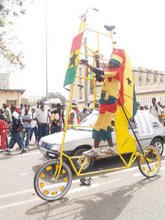
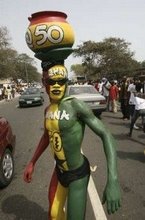
The most striking aspect of Ghana's independence celebrations was the ubiquity of three colours - red, gold and green.
The hues, which along with a black star make up the nation's flag, can be seen virtually everywhere.

Flags have been draped from most buildings, across car bonnets and on lampposts, while the three hues can also be seen on wristbands, trees, T-shirts, and, in some cases, face and body paint.
Amidst this multi-coloured backdrop, revellers took to the streets to welcome the country's birthday at midnight on 6 March and Kumasi was not left out.


Celebrations


President Kufuor inspecting a guard of honour at the independence square on March 6, 2007


Picture shows Chieftaincy Affairs Minister, Sampson Kwaku Boafo (right) and Odeneho Gyapong Ababio, Omanhene of Sefwi Bekwai and President of the National House of Chiefs.

Friday, February 23, 2007

Abuakwa formulation plant


Workers of the Abuakwa Formulation Plant Limited in Kumasi, packagers of confidor, a chemical used in the mass cocoa spraying exercise, have appealed to the government to intervene and cause the institution of proper investigations into the operations of the company before allowing it to be closed down.
According to the workers, the government should further intervene and suspend a proposed signing of a final termination of a joint-venture agreement on February 28, 2007 between the Cocobod and Bayer Crop Science, a German company which manages the formulation plant.
This, they said, would help forestall the immediate closure of the formulation plant for proper procedures to be followed.
Bayer Crop Science Limited from Germany currently holds 51percent shares in the Abuakwa Formulation Plant while the Cocobod holds the remaining 49 percent shares.
According to the workers, they had information that there had been a decision to close down the plant for another company, Wienco Limited, to bring in finished products from abroad for the mass spraying exercise to which they were yet to be officially informed eventhough there had been a decision to sign a final termination of the joint-venture agreement on February 28, 2007.
In a statement signed by Mr Charles K. Boateng and Mr John Ayisih-Henaku, Union and Senior Staff Association Chairmen respectively, the workers stated that they felt that the transaction was being schemed to favour Wienco, which used to be an agent for Bayer Crop Science in the importation of confidor.
Bayer as managers of the formulation plant used Wienco as an agent in the importation of confidor in 200 litre drums, which the plant in turn refilled into one litre bottles through controlled machines in controlled and restricted environment.
The workers said they felt there was a ploy to eventually eliminate the formulation plant so as to enable Wienco to bring in finished products so as to maximise profits and even added that Wienco had even started importing the finished products in one litre bottles.
They indicated that when this was allowed to go on, it would defeat government’s drive to create employment particularly in the rural areas.
The workers stated that although they were yet to be informed officially about the happenings, they had information that the Environmental Protection Agency (EPA) has written a report that the plant had been highly contaminated and needed to be closed down.
“We vehemently protest the report of the (EPA) with the reasons that the first time we saw an EPA official at the plant was somewhere in December last year, when the official who was on his way to Sunyani, passed through the plant and indicated that Cocobod had approached their outfit to conduct a future environmental assessment of the plant.
“We even asked him when they were to come to the plant to conduct the test and he said emphatically that Cocobod was yet to provide them with the things to look out for so he would come later when directed to do so”, the workers stated.
They emphasised that the said EPA report was hollow and porous as there had not been any formal test conducted at the plant.
“What were the parameters considered? We the host were not shown any letter from Cocobod. Neither have we received any instruction from neither Cocobod or EPA on this matter. Again they never took samples or measurements from the plant as normal test are conducted”, they said.
The workers said neither the Cocobod nor Bayer Crop Science had officially informed the workers of the intention to close down the place and that the only time Cocobod officially wrote to the plant was on a request for information on the list of staff, their designations and their date of employment.
They said a decision by Bayer Crop Science to remove some machines from the plant to Germany to ostensibly de-contaminate them was a ploy to kill the plant totally.
Again, the workers questioned why the buildings were to be decontaminated here in Ghana with some of the machinery while certain vital portions of the machines are to be sent to Germany for decontamination.
They said the machines were in a better position to formulate, fill and package any liquid insecticide and herbicides so removal of any part of the machines would render the rest incapable of sustaining the functions of formulating - filling and packaging.
According to the workers, the whole plant machinery constitute an asset to attract future investors so removal of any part would defeat that basic principle.
They said the agent, Wienco and Bayer are familiar with the operations of the of plant and know that the removal of any vital machines here would strengthen its resolve to bring in already filled and packaged finished products which Wienco is already importing from a sister company of Bayer.
“We feel that the removal of the vital machines to Germany to decontaminate was a ploy by Bayer to offer employment to one of its factories, which is already formulating the confidor in Europe”.
They said the Cocobod had absolute right and authority to change the product (confidor) at its convenience in the light of the demise of the joint venture agreement between it and Bayer as it would be more convenient for the Cocobod to invite investors while the plant was still working.
The workers called on the management of the Cocobod not to hastily sign the already prepared termination agreement but investigate further before taking a decision.
They said if Bayer and Cocobod agree with the EPA that the plant was really heavily contaminated then the staff were equally worried about their health since they had been working there since 1988, eating and spending eight hours daily there.
They then insisted that the staff should therefore be equally sent to overseas for thorough tests and subsequent treatment.
When contacted, the General Manager of the Abuakwa Formulation Plant, Mr Charles Boakye corroborated the story of the workers and said he was equally worried about the development.
He said as a General Manager of the plant, he had been sidelined in many of the dealings of the plant and even wondered why Bayer decided to use Wienco as an agent in the importation of the product.

KNUST and AGI signs MOU to promote technical cooperation


Pix. Vice Chancellor of the KNUST, Professor K. K. Adarkwa (right) and the President of the AGI, Mr Tony Oteng Gyasi (left), appended their signatures to the MOU at the university in Kumasi today (Friday).
The Association of Ghana Industries (AGI) and the Kwame Nkrumah University of Science and Technology have signed a Memorandum of Understanding (MOU) to build capacity and develop technical cooperation.
The move is to help foster a relationship that would see to the training of graduates at the KNUST for requisite industrial needs.
Under the agreement, the AGI is to create a forum that would enable its membership to make an input into the KNUST’s curriculum development process as a way of enhancing mutual benefit.
The AGI is also to facilitate the identification of and financial support for continuing engineering education needs of its membership that can be provided by the KNUST.
The Vice Chancellor of the KNUST, Professor K. K. Adarkwa and the President of the AGI, Mr Tony Oteng Gyasi, appended their signatures to the MOU at the university in Kumasi today (Friday).
The agreement came at the time members of the public had on numerous occasions raised concerns as to why the universities were not collaborating effectively with industry for their mutual benefit.
There has also been instances where engineering students had graduated from the KNUST without getting the opportunity to have an industrial experience.
This, according to Mr Oteng Gyasi was an anomaly, which needed to be rectified hence he said the AGI would facilitate educational visits of KNUST staff and students to AGI member establishments.
With the signing of the MOU, the KNUST as a technology university would be better placed to train graduates to solve engineering problems of AGI members either on the basis of consultancy or sponsored research as well as from time to time bring to attention of AGI members the resources and capabilities of the university.
The AGI is also to promote and facilitate short-term attachment of KNUST teaching staff to AGI member establishments for the purpose of helping to keep abreast with developments in Ghanaian industry.
Under the agreement the AGI would also encourage its members to identify consultancy assignments for KNUST staff and to sponsor research work at the KNUST and also facilitate the identification of engineering problems of AGI members and bring these problems to the attention of the KNUST..
The AGI President said the intent of the agreement was to provide a mechanism for KNUST and AGI to cooperate in mutually progressive and supportive activities, which would not compromise either party or their relationship with other parties.
The MOU is to continue for a period of five years and may be renewed by mutual consent by both institutions.
Mr Oteng Gyasi said the industrial sector felt that its major collaborator had to be the KNUST since already a lot of products from the university were working in the sector.
He said it was a shame that some students graduated with a degree in engineering without having experience in an industrial environment.
He said although it was true that the numbers of the students were growing larger and all could not fit into industries for attachment, the focus should not only be on big companies like VALCO. Rather the Small and Medium Enterprises (SME) should also be considered since that sector even offered more challengers for students to be able to impart the little they learnt in school.
The AGI President said apart from students’ industrial attachment, they ought to focus on how to address industrial problems with the collaboration of the KNUST.
He said most of the time when problems arose in industries, the speed with which responses came locally were not encouraging, thus most industrialists tend to look abroad for assistance.
The Vice Chancellor of the KNUST, Prof Adarkwa, said with the signing of the MOU, the university would now focus attention on tackling industrial problems.

Thursday, February 22, 2007

Illegal water connections uncovered


THE Ghana Water Company Limited (GWCL) has uncovered a deal in which farmers operating along the company’s distribution lines from the Barekese headworks had illegally connected pipelines to the main water lines supplying water to the Kumasi metropolis.
An exercise carried out by the Ashanti Regional Management of Aqua Vitens Rand Limited, acting for and on behalf of the GWCL, revealed that the farmers used the treated water purposely meant for domestic, commercial and industrial uses, for full-scale irrigation of their private farms.
The farmers have illegally connected long PVC pipes and water hoses with sprinklers to the distribution pipelines to water vegetable and citrus farms.
The Ashanti Regional Chief Manager of the GWCL, Mr Obeng Manu, said the practice was greatly affecting the company’s ability to supply potable water to the Kumasi metropolis.
He gave the names of the areas where the farmers had illegally connected to the main pipelines as Akropong, Tabre, Nketia, Fufuo, Barekuma and Adankwame, all in the Atwima Nwabiagya District in Ashanti Region.
The company has since seized a large quantity of PVC pipes from those farms but the owners are on the run.
Mr Obeng Manu said the areas mentioned were close to the headworks and were connected to the main transmission pipelines, hence water was drawn at very high pressures.
“The implications are that these illegal activities reduce the pressure of water flow in our pipelines and reduce the quantity of water reaching central Kumasi for distribution to consumers”, the Chief Manager said.
He said the habit contributed to depriving the company the needed revenue and pointed out that “we cannot allow this behaviour to go unpunished”.
Mr Manu said the company was collaborating with the police to arrest all those people and that anybody arrested would be made to pay for the cost of water used over the period plus a penalty. He said they would also forfeit the items seized.
He appealed for assistance from the communities, especially from chiefs, assembly members and unit committee members, to help track down all those who have done the illegal connections since their activities could affect water supply to the communities.
The Chief Manager said people should bear in mind that treated water was not meant for irrigation purposes and that all those engaged in such activities should stop forthwith or would be forced to stop.

Progress of National Health Insurance Scheme in Ashanti

The implementation of the National Health Insurance Scheme (NHIS) in the Ashanti region is progressing steadily despite some problems the scheme faced at its initial stages.
Presently about 38 percent of the population in the region had been covered by the scheme, according to Dr Joe Bonney, a Deputy Director for Clinical Care at the Ghana Health Service and Ashanti Regional Co-ordinator of the NHIS.
He explained that the scheme had achieved some significant successes as almost all health facilities in the region had signed contracts with the various mutual health insurance schemes (MHIS) to provide service to registered clients.
Information gathered indicates that the percentage coverage by the scheme is greater in the districts of the region than in the Kumasi metropolis probably due to apathy in the city.
However, only about 68 percent of registered clients have been utilising the services of the scheme due to the delay in the issuance of membership identification cards (ID) and the serving of probation period of three to six months before cards are issued to enable clients benefit from the scheme.
In an interview with Dr Bonney, he said there seemed to be an over utilisation of health facilities by some registered members of the NHIS simply because they were conscious that the scheme would take care of their medical bills.
He, however, described the situation as a good sign since it could be interpreted as, “people are gradually becoming conscious of their health and resorting to medical attention before their cases become complicated”.
But this has been described as an abuse of the system by some of the scheme managers, who think that people unnecessarily go to the hospital just to test the scheme while others do that just to ensure that they utilise the scheme before the term of their premium expires in a particular year.
Mr Francis Atta-Poku, Scheme Manager of the Subin Mutual Health Insurance Scheme told the Daily Graphic that most people unnecessarily go to the hospital especially getting to the latter part of the year when they feel they have not utilised their cards and their premiums were about expiring with the end of the year.
He said he had witnessed a case where a man sent four of his kids to the Children’s Hospital in Kumasi at a go with the explanation that the kids looked dull the previous day while they watched television but when the man was probed further, it came to light that he only wanted to utilise the scheme since he felt his premium for the year was about expiring at a time none of the family members had attended hospital.
Aside the successes of the scheme, it had been experiencing some challenges such as the delay in the issuance of the Identification Cards (ID).
Many people the Daily Graphic spoke to randomly in Kumasi, expressed their frustration with the delayin the issuance of the cards and called on the scheme managers to do something about the situation.
The delay in the issuance of the cards had been partly attributed to the of lack of the requisite human resource and equipment needed to process the cards.
Others have been attributed to the reluctance of registered members to go to the offices of various schemes to demand for their cards.
Most of the identification cards (ID) were locked up in the offices of the various schemes as people who have registered with the schemes have not gone for them.
At the offices of the Subin Mutual Health Insurance Scheme (MHIS) in Kumasi for instance, a large number of ID cards were yet to be collected and according to the Scheme Manager, Mr Atta-Poku, because they are many, it makes it cumbersome for staff at the office to go through them and give them out, anytime a person comes to demand for his card.
Beside that there are other problems such as lack of human resource and limited space at the various health facilities providing health service to people.
According to Dr Bonney, the introduction of the NHIS had resulted in an increase in the attendance of hospitals but most of the health facilities have limited staff and space to cater for the increase.
He said that was militating against the successful implementation of the NHIS as the limited space have been resulting in congestion at the Out Patient Departments (OPD) of most facilities and thus making it uncomfortable for patients.
He also explained that the payment of claims presented by health providers to various schemes had not been honoured on time and since most of the health facilities operate on internally generated funds (IGF) the delays in the payment of their claims have been affecting their operations.
He said the Manhyia Hospital for instance rendered services to clients of the Manhyia Scheme amounting to about ¢956million in year 2006 but only $582million had been paid as of the end of the year.
This anomaly, Dr Bonney said, needed to be worked on in order to help make the scheme sustainable.
The Scheme Managers on their part have explained that the subsidies from the National Health Insurance Council (NHIC) had not been forthcoming on time, which sometimes result in the delay.
Aside that they explain that the health facilities do not also submit their claims on time.
Mr Atta Poku of the Subin Scheme for instance explained that his outfit receives an average subsidy of about ¢400million from the NHIC on quarterly basis with which the scheme support it with premiums collected to settle claims, hence the payment of claims are bound to be delayed sometimes.
For instance, he said, in 2006 his outfit paid a total claim of ¢1.5billion while it was able to mobilise ¢1.7billion as premium.
He said a total of 69,000 people had been registered as of the end of 2006.
In trying to find lasting solutions to the difficulties associated with the implementation of the scheme, Dr Bonney suggested that the sensitisation and educational campaigns should be intensified and called for the need for people to see the hiccups in the implementation of the scheme as a social problem and shouldn’t leave the blame only on the scheme managers alone.
He also called for the need to try and get rid of the politicisation of the scheme and try to accelerate the networking of the system to help improve communication between the various schemes and service providers.
Presently most of the schemes offices are partly computerised.
Dr Bonney said the GHS, on its part, was also going all out to help ensure that drugs listed on the NHIS Drug list were available at provider facilities and added that the scheme was highly beneficial hence more people should be encouraged to register as things would be better as the scheme moves forward.

Enforce building regulations - Asamoah-Boateng

The Minister of Local Government, Rural Development and Environment, Mr Stephen Asamoah-Boateng, has asked building inspectors in Metropolitan, Municipal and District Assemblies to strictly enforce building regulations to help stem the tide of shoddy works on buildings and their attendant collapse.
He said from hence building inspectors together with their various district, municipal and metropolitan engineers with whose jurisdiction a building collapses could be held liable.
The Minister said there was the need to ensure that the right thing was being done in the building industry.
Mr Asamoah Boateng said this when he met staff of the Kumasi Metropolitan Assembly (KMA) at the beginning of a two-week official tour of the Ashanti Region.
The tour would enable him inspect ongoing government projects and programmes and projects.
In December, last year, a five-storey building belonging to the OA Travel and Tours at Asafo in Kumasi collapsed and resulted in the death of two people.
In early 2006, another storey building at Bantama opposite the Komfo Anokye Teaching Hospital (KATH) also collapsed and resulted in some fatalities.
Mr Asamoah Boateng said the Ministry was very much concerned about the spate of the collapses and charges building inspectors to constantly go out and check the state of buildings.
He asked them not to hesitate to demolish any building which had no building permit.
Mr Asamoah Boateng inspected a number of projects in the Metropolis, which included the City Hotel complex, Asafo Interchange, Kumasi Landfill site, Asafo Market, Jackson Park and Kwadaso market.
The Minister said he had four priorities which he intended to implement to the letter at the Ministry.
This included service delivery, Sanitation, decentralisation and team work.
He said his ministry was working on making some changes in various by-laws at the districts to ensure effective compliance.
"For example were exact fines are quoted in the by-laws, we want to change it to penalty points so that the fines don't depreciate with inflation", he said.
Mr Asamoah Boateng also paid a courtesy call on the Ashanti Regional Minister, Mr E. A. Owusu Ansah.
Mr Owusu Ansah appealed to Mr Asamoah Boateng to concentrate more on feeder roads in the region.
He said the feeder roads in the region were in very deplorable state and needed to be worked on since rural communities depended on those roads so much in getting foodstuffs to urban centres.

Ecofest and Opemsoo Festival

The second Opemsoo festival, with the aim of honouring the founder of the Asante Nation, King Osei Tutu I has been launched in Kumasi.
It is expected to be held alongside this year’s Ecotourism Festival which would be staged at Kokofu-Anyinam in the Bosomtwe-Atwima-Kwanwoma District of Ashanti from September 1-6.
The theme for the celebration is, “Celebrating the Golden Jubilee for people, nature and culture”.
Opemsoo is an appellation for the first King of the Asante Nation, King Osei Tutu I who was born at Kokofu-Anyinam and that the festival is to help bring to the limelight the birth place of the great King as well as help to harness the Ecotourism potential in the area.
The birth place of the great King and infact the place where his umbilical cord was buried at the time of his birth in early 1700 had been preserved and regarded as a sacred place.
All persons including the Asantehene visit the place bare footed.
At the launching ceremony, Nana Kwasi Donkor, a Deputy Director at the Centre for National Culture (CNC) said the festival was to be used as a stepping stone to woo tourists to the birth place of the great King.
“Just as Christians go to Jerusalem to see the birth place of Jesus Christ and Muslims go to Mecca to also see the birth place of Muhammed, we would also want Asantes and people from all corners of the earth to come to Kokofu-Anyinam to see the birth place of King Osei Tutu I, the founder of the Asante Nation”, he said.
He said the mother of King Osei Tutu, Madam Gyamfuaa Manu, who was a royal at Kokofu was on her way to her hometown at Esiease when she suddenly went into labour on the way and since she could not continue the journey to her hometown, she branched to Esiease where she gave birth to the great King and stayed there for 40 days before moving away.
Among activities lined up for the festival includes general cleaning exercise in villages in the Kokofu area, a tree planting exercise to improve upon the greenery in the area, a quiz competition for school children, a football gala competition, cultural display and an international seminar on the topic harnessing the ecotourism potential of Lake Bosomtwe.
Mr Ben Anane Nsiah, Ashanti Regional Manager of the Ghana Tourist Board in an address said tourism was now a major catalyst for growth in many small communities in the country.
He said in the last two decades stringent measures had been instituted to make ecotourism fruitful since tourism was the fourth major foreign exchange earner for the country..
Currently about 400,000 tourists come to Ghana annually since the country was rich in a strong and an unadulterated culture.
Mr Nsiah said the Opemsoo and Ecotourism Festival therefore were an opportunity to hipe and promote tourism potentials in the country.

Wednesday, February 14, 2007

pollution of water bodies in Kumasi


Picture shows polythene and other waste materials choking up some water bodies at Suame.
The continued pollution of water bodies in the Kumasi metropolis has been a major problem environmentalists have been trying to uproot.
There has been a massive pollution of water bodies in the Kumasi metropolis in the last few years as people dump filth and human excreta into rivers haphazardly at all areas in the metropolis.
Some have even connected their sewerage pipes directly into rivers where excreta from their homes are directly deposited into the rivers which drain into the Owabi and Barekese dams, which provides water supply for Kumasi and other surrounding areas.
Although the Ghana Water Company Limited (GWCL) and the Environmental Health Department of the Kumasi Metropolitan Assembly (KMA) have on numerous occasions embarked on campaigns to call on people to desist from such activities, the practice seems to be on the increase.
Save Our Waters Ghana (SOWG), a non governmental organisation in Kumasi has taken a giant step in fighting the canker but its efforts would come to nothing if residents don’t change their attitude towards pollution.
Ghana has been highlighted to become one of the water stress countries in Africa in a few years to come. The recent rationing of pipe borne water by the Ghana Water Company Limited (GWCL), felling of trees along river banks and destruction of forest reserves at dam catchments, developing water bodies for settlements, dumping of refuse at the catchments of water supply and outbreak of water related diseases are all issues which point to a near future water stress in Ghana.
Water shortage causes a lot of problems ranging from domestic, industrial and in government circles as well.
In view of this, it is about time that people became conscious about saving water bodies in order to help avert any water crisis in future.

KNUST E-Campus Network commissioned. Students to benefit from Broadband Wireless Internet

A Broadband wireless Internet and voice telephony facility has been inaugurated on the campus of the Kwame Nkrumah University of Science and Technology (KNUST).
Known as the KNUST E-Campus Network, the facility has the potential of transforming the mode of teaching and learning on campus, as it would provide members of the university community with in-room and on-campus wireless Internet and voice telephony.
The provision of the service is a joint venture between Universal Telephone Exchange Limited and Engineering Systems and Services Limited, in collaboration with the KNUST.
The project is the first phase of a comprehensive Information Communication Technology (ICT), which is aimed at integrating all educational institutions into the global ICT network with KNUST as the hub.
The Vice-Chancellor of the KNUST, Professor Kwasi Kwafo Adarkwa, explained that the services would be provided at an affordable rate to enable all subscribers benefit from the innovation.
He said with the innovation, students and lecturers could have access to the Internet service from any location on campus for research and recreational purposes at their convenience.
Aside that, he said students would be able to manage their time more efficiently with affordable telephone service .
The vice-chancellor said the commutative effect of the benefits could result in improved academic performance of students enrolled at the university.
It was also expected that the current range of services provided under the KNUST E-Campus project would be complemented with distance learning, which would leap KNUST into the frontiers of educational excellence, the vice-chancellor said.
He said the network would eventually be interlinked with similar networks in Ghana and beyond to enable members of the university community share resources with other educational institutions to create a serene environment for education and research.
The Chief Executive of Engineering Systems and Services Limited, Mr Ben Adu, in an address, said university teaching and learning was becoming increasingly challenging in the face of limited resources and increasing demand for enrolment.
Mr Adu said physical facilities and lecturers were in short supply, and that access to quality learning and educational resources were limited.
He stressed that the gap between quality of education in the developed economies and the one in the developing countries would further widen if steps were not taken to address the problem.
Mr Adu said distance education and e-learning could help to ameliorate the situation, but without equal access to quality communications infrastructure, distance education would not be able to deliver its promise.
A Broadband wireless Internet and voice telephony facility has been inaugurated on the campus of the Kwame Nkrumah University of Science and Technology (KNUST).
Known as the KNUST E-Campus Network, the facility has the potential of transforming the mode of teaching and learning on campus, as it would provide members of the university community with in-room and on-campus wireless Internet and voice telephony.
The provision of the service is a joint venture between Universal Telephone Exchange Limited and Engineering Systems and Services Limited, in collaboration with the KNUST.
The project is the first phase of a comprehensive Information Communication Technology (ICT), which is aimed at integrating all educational institutions into the global ICT network with KNUST as the hub.
The Vice-Chancellor of the KNUST, Professor Kwasi Kwafo Adarkwa, explained that the services would be provided at an affordable rate to enable all subscribers benefit from the innovation.
He said with the innovation, students and lecturers could have access to the Internet service from any location on campus for research and recreational purposes at their convenience.
Aside that, he said students would be able to manage their time more efficiently with affordable telephone service .
The vice-chancellor said the commutative effect of the benefits could result in improved academic performance of students enrolled at the university.
It was also expected that the current range of services provided under the KNUST E-Campus project would be complemented with distance learning, which would leap KNUST into the frontiers of educational excellence, the vice-chancellor said.
He said the network would eventually be interlinked with similar networks in Ghana and beyond to enable members of the university community share resources with other educational institutions to create a serene environment for education and research.
The Chief Executive of Engineering Systems and Services Limited, Mr Ben Adu, in an address, said university teaching and learning was becoming increasingly challenging in the face of limited resources and increasing demand for enrolment.
Mr Adu said physical facilities and lecturers were in short supply, and that access to quality learning and educational resources were limited.
He stressed that the gap between quality of education in the developed economies and the one in the developing countries would further widen if steps were not taken to address the problem.
Mr Adu said distance education and e-learning could help to ameliorate the situation, but without equal access to quality communications infrastructure, distance education would not be able to deliver its promise.


Work at Kumasi Sports Stadium Progresses


Work at Kumasi Sports Stadium Progresses