Baba Yara Stadium is now ready for CAN 2008.


Monday, March 12, 2007

Fire outbreak at Kumasi Central Market


Picture shows a trader going through the debris after the outbreak
Fire gutted parts of the Kumasi Central Market on Friday night and destroyed property estimated at billions of cedis.
The extent of the destruction caused by the blaze was generally considered as unprecedented in the history of fire outbreaks associated with the central market.
The fire, which started at about 9:30pm on Friday, left in its trail nothing but ashes.
Although the Fire Service officers got to the scene on time, they could not fight the fire due because they could not get access to the fire scene.
Picture shows Deputy Ashanti Regional Minister, Osei Assibey-Antwi (in green cup) and Kumasi Metropolitan Chief Executive, Patricia Appiagyei(in black cup and shirt). This was when they visited the burnt area of the market together with other officials of the metropolitan assembly to sympathise with the victims of the fire outbreak.


They eventually had to clear structures (other shops) to be able to get to the scene and
it took them a whole night to bring the fire under control.
The cause of the fire was yet to be determined as the security services were still investigating the outbreak.
Looters had a field day as the fire raged on but the police managed to arrest six people who have been placed in custody.
The security officers, however, had a hectic time trying to control a large crowd, which gathered at the scene. Some of them were traders who had rushed from their homes with the intention of salvaging their goods.
Pix. Traders going through the debris after the outbreak.
The Deputy Ashanti Regional Minister, Mr Osei Assibey-Antwi, the Kumasi Metropolitan Chief Executive, Madam Patricia Appiagyei, and other officials visited the market to console the victims.
The hardest hit areas were leather dealers, shoe makers and pepper sellers.
One young man, Kwame Alfred told the Daily Graphic that he had lost his investment of about ¢10million and had no idea of how he was going to get back into business.
Others, mostly young men, also complained of losing investments running into hundreds of millions of cedis.
Those who did not hear of the fire outbreak in the night but only went to the market on Saturday morning with the intention of going to do business broke down in tears upon seeing what had happened.

The issue of failure to insure businesses had come up for discussion in the metropolis in recent times, and the general consensus was that people must insure their businesses.

Getting access to the market in times of fire outbreaks had also been a major topic of concern and the KMA had been persistently urged to take up the matter.
Some traders accused the market manager of allowing certain traders to use tables in certain areas which blocked access routes.
The Deputy Ashanti Regional Minister expressed concern about the number of highly inflammable equipment in the market, which was a contributory factor to the fire outbreak.Picture shows Osei Assibey-Antwi (in green cup) with Patricia Appiagyei (in black shirt and black cup) at the burnt area in the market.

Thursday, March 08, 2007

Ghana hosts 50th birthday party

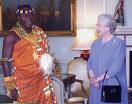
President of National House of Chiefs and Omanhene of Sefwi Bekwai Traditional Area, Odeneho Gyapong Ababio II (extreme left) and other chiefs at the Independence Square.

The most striking aspect of Ghana's independence celebrations was the ubiquity of three colours - red, gold and green.
The hues, which along with a black star make up the nation's flag, can be seen virtually everywhere.

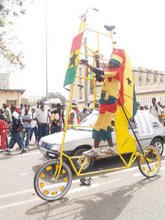
Flags have been draped from most buildings, across car bonnets and on lampposts, while the three hues can also be seen on wristbands, trees, T-shirts, and, in some cases, face and body paint.
Amidst this multi-coloured backdrop, revellers took to the streets to welcome the country's birthday at midnight on 6 March and Kumasi was not left out.


Celebrations


President Kufuor inspecting a guard of honour at the independence square on March 6, 2007


Picture shows Chieftaincy Affairs Minister, Sampson Kwaku Boafo (right) and Odeneho Gyapong Ababio, Omanhene of Sefwi Bekwai and President of the National House of Chiefs.

Friday, February 23, 2007

Abuakwa formulation plant


Workers of the Abuakwa Formulation Plant Limited in Kumasi, packagers of confidor, a chemical used in the mass cocoa spraying exercise, have appealed to the government to intervene and cause the institution of proper investigations into the operations of the company before allowing it to be closed down.
According to the workers, the government should further intervene and suspend a proposed signing of a final termination of a joint-venture agreement on February 28, 2007 between the Cocobod and Bayer Crop Science, a German company which manages the formulation plant.
This, they said, would help forestall the immediate closure of the formulation plant for proper procedures to be followed.
Bayer Crop Science Limited from Germany currently holds 51percent shares in the Abuakwa Formulation Plant while the Cocobod holds the remaining 49 percent shares.
According to the workers, they had information that there had been a decision to close down the plant for another company, Wienco Limited, to bring in finished products from abroad for the mass spraying exercise to which they were yet to be officially informed eventhough there had been a decision to sign a final termination of the joint-venture agreement on February 28, 2007.
In a statement signed by Mr Charles K. Boateng and Mr John Ayisih-Henaku, Union and Senior Staff Association Chairmen respectively, the workers stated that they felt that the transaction was being schemed to favour Wienco, which used to be an agent for Bayer Crop Science in the importation of confidor.
Bayer as managers of the formulation plant used Wienco as an agent in the importation of confidor in 200 litre drums, which the plant in turn refilled into one litre bottles through controlled machines in controlled and restricted environment.
The workers said they felt there was a ploy to eventually eliminate the formulation plant so as to enable Wienco to bring in finished products so as to maximise profits and even added that Wienco had even started importing the finished products in one litre bottles.
They indicated that when this was allowed to go on, it would defeat government’s drive to create employment particularly in the rural areas.
The workers stated that although they were yet to be informed officially about the happenings, they had information that the Environmental Protection Agency (EPA) has written a report that the plant had been highly contaminated and needed to be closed down.
“We vehemently protest the report of the (EPA) with the reasons that the first time we saw an EPA official at the plant was somewhere in December last year, when the official who was on his way to Sunyani, passed through the plant and indicated that Cocobod had approached their outfit to conduct a future environmental assessment of the plant.
“We even asked him when they were to come to the plant to conduct the test and he said emphatically that Cocobod was yet to provide them with the things to look out for so he would come later when directed to do so”, the workers stated.
They emphasised that the said EPA report was hollow and porous as there had not been any formal test conducted at the plant.
“What were the parameters considered? We the host were not shown any letter from Cocobod. Neither have we received any instruction from neither Cocobod or EPA on this matter. Again they never took samples or measurements from the plant as normal test are conducted”, they said.
The workers said neither the Cocobod nor Bayer Crop Science had officially informed the workers of the intention to close down the place and that the only time Cocobod officially wrote to the plant was on a request for information on the list of staff, their designations and their date of employment.
They said a decision by Bayer Crop Science to remove some machines from the plant to Germany to ostensibly de-contaminate them was a ploy to kill the plant totally.
Again, the workers questioned why the buildings were to be decontaminated here in Ghana with some of the machinery while certain vital portions of the machines are to be sent to Germany for decontamination.
They said the machines were in a better position to formulate, fill and package any liquid insecticide and herbicides so removal of any part of the machines would render the rest incapable of sustaining the functions of formulating - filling and packaging.
According to the workers, the whole plant machinery constitute an asset to attract future investors so removal of any part would defeat that basic principle.
They said the agent, Wienco and Bayer are familiar with the operations of the of plant and know that the removal of any vital machines here would strengthen its resolve to bring in already filled and packaged finished products which Wienco is already importing from a sister company of Bayer.
“We feel that the removal of the vital machines to Germany to decontaminate was a ploy by Bayer to offer employment to one of its factories, which is already formulating the confidor in Europe”.
They said the Cocobod had absolute right and authority to change the product (confidor) at its convenience in the light of the demise of the joint venture agreement between it and Bayer as it would be more convenient for the Cocobod to invite investors while the plant was still working.
The workers called on the management of the Cocobod not to hastily sign the already prepared termination agreement but investigate further before taking a decision.
They said if Bayer and Cocobod agree with the EPA that the plant was really heavily contaminated then the staff were equally worried about their health since they had been working there since 1988, eating and spending eight hours daily there.
They then insisted that the staff should therefore be equally sent to overseas for thorough tests and subsequent treatment.
When contacted, the General Manager of the Abuakwa Formulation Plant, Mr Charles Boakye corroborated the story of the workers and said he was equally worried about the development.
He said as a General Manager of the plant, he had been sidelined in many of the dealings of the plant and even wondered why Bayer decided to use Wienco as an agent in the importation of the product.

KNUST and AGI signs MOU to promote technical cooperation


Pix. Vice Chancellor of the KNUST, Professor K. K. Adarkwa (right) and the President of the AGI, Mr Tony Oteng Gyasi (left), appended their signatures to the MOU at the university in Kumasi today (Friday).
The Association of Ghana Industries (AGI) and the Kwame Nkrumah University of Science and Technology have signed a Memorandum of Understanding (MOU) to build capacity and develop technical cooperation.
The move is to help foster a relationship that would see to the training of graduates at the KNUST for requisite industrial needs.
Under the agreement, the AGI is to create a forum that would enable its membership to make an input into the KNUST’s curriculum development process as a way of enhancing mutual benefit.
The AGI is also to facilitate the identification of and financial support for continuing engineering education needs of its membership that can be provided by the KNUST.
The Vice Chancellor of the KNUST, Professor K. K. Adarkwa and the President of the AGI, Mr Tony Oteng Gyasi, appended their signatures to the MOU at the university in Kumasi today (Friday).
The agreement came at the time members of the public had on numerous occasions raised concerns as to why the universities were not collaborating effectively with industry for their mutual benefit.
There has also been instances where engineering students had graduated from the KNUST without getting the opportunity to have an industrial experience.
This, according to Mr Oteng Gyasi was an anomaly, which needed to be rectified hence he said the AGI would facilitate educational visits of KNUST staff and students to AGI member establishments.
With the signing of the MOU, the KNUST as a technology university would be better placed to train graduates to solve engineering problems of AGI members either on the basis of consultancy or sponsored research as well as from time to time bring to attention of AGI members the resources and capabilities of the university.
The AGI is also to promote and facilitate short-term attachment of KNUST teaching staff to AGI member establishments for the purpose of helping to keep abreast with developments in Ghanaian industry.
Under the agreement the AGI would also encourage its members to identify consultancy assignments for KNUST staff and to sponsor research work at the KNUST and also facilitate the identification of engineering problems of AGI members and bring these problems to the attention of the KNUST..
The AGI President said the intent of the agreement was to provide a mechanism for KNUST and AGI to cooperate in mutually progressive and supportive activities, which would not compromise either party or their relationship with other parties.
The MOU is to continue for a period of five years and may be renewed by mutual consent by both institutions.
Mr Oteng Gyasi said the industrial sector felt that its major collaborator had to be the KNUST since already a lot of products from the university were working in the sector.
He said it was a shame that some students graduated with a degree in engineering without having experience in an industrial environment.
He said although it was true that the numbers of the students were growing larger and all could not fit into industries for attachment, the focus should not only be on big companies like VALCO. Rather the Small and Medium Enterprises (SME) should also be considered since that sector even offered more challengers for students to be able to impart the little they learnt in school.
The AGI President said apart from students’ industrial attachment, they ought to focus on how to address industrial problems with the collaboration of the KNUST.
He said most of the time when problems arose in industries, the speed with which responses came locally were not encouraging, thus most industrialists tend to look abroad for assistance.
The Vice Chancellor of the KNUST, Prof Adarkwa, said with the signing of the MOU, the university would now focus attention on tackling industrial problems.

Thursday, February 22, 2007

Illegal water connections uncovered


THE Ghana Water Company Limited (GWCL) has uncovered a deal in which farmers operating along the company’s distribution lines from the Barekese headworks had illegally connected pipelines to the main water lines supplying water to the Kumasi metropolis.
An exercise carried out by the Ashanti Regional Management of Aqua Vitens Rand Limited, acting for and on behalf of the GWCL, revealed that the farmers used the treated water purposely meant for domestic, commercial and industrial uses, for full-scale irrigation of their private farms.
The farmers have illegally connected long PVC pipes and water hoses with sprinklers to the distribution pipelines to water vegetable and citrus farms.
The Ashanti Regional Chief Manager of the GWCL, Mr Obeng Manu, said the practice was greatly affecting the company’s ability to supply potable water to the Kumasi metropolis.
He gave the names of the areas where the farmers had illegally connected to the main pipelines as Akropong, Tabre, Nketia, Fufuo, Barekuma and Adankwame, all in the Atwima Nwabiagya District in Ashanti Region.
The company has since seized a large quantity of PVC pipes from those farms but the owners are on the run.
Mr Obeng Manu said the areas mentioned were close to the headworks and were connected to the main transmission pipelines, hence water was drawn at very high pressures.
“The implications are that these illegal activities reduce the pressure of water flow in our pipelines and reduce the quantity of water reaching central Kumasi for distribution to consumers”, the Chief Manager said.
He said the habit contributed to depriving the company the needed revenue and pointed out that “we cannot allow this behaviour to go unpunished”.
Mr Manu said the company was collaborating with the police to arrest all those people and that anybody arrested would be made to pay for the cost of water used over the period plus a penalty. He said they would also forfeit the items seized.
He appealed for assistance from the communities, especially from chiefs, assembly members and unit committee members, to help track down all those who have done the illegal connections since their activities could affect water supply to the communities.
The Chief Manager said people should bear in mind that treated water was not meant for irrigation purposes and that all those engaged in such activities should stop forthwith or would be forced to stop.

Progress of National Health Insurance Scheme in Ashanti

The implementation of the National Health Insurance Scheme (NHIS) in the Ashanti region is progressing steadily despite some problems the scheme faced at its initial stages.
Presently about 38 percent of the population in the region had been covered by the scheme, according to Dr Joe Bonney, a Deputy Director for Clinical Care at the Ghana Health Service and Ashanti Regional Co-ordinator of the NHIS.
He explained that the scheme had achieved some significant successes as almost all health facilities in the region had signed contracts with the various mutual health insurance schemes (MHIS) to provide service to registered clients.
Information gathered indicates that the percentage coverage by the scheme is greater in the districts of the region than in the Kumasi metropolis probably due to apathy in the city.
However, only about 68 percent of registered clients have been utilising the services of the scheme due to the delay in the issuance of membership identification cards (ID) and the serving of probation period of three to six months before cards are issued to enable clients benefit from the scheme.
In an interview with Dr Bonney, he said there seemed to be an over utilisation of health facilities by some registered members of the NHIS simply because they were conscious that the scheme would take care of their medical bills.
He, however, described the situation as a good sign since it could be interpreted as, “people are gradually becoming conscious of their health and resorting to medical attention before their cases become complicated”.
But this has been described as an abuse of the system by some of the scheme managers, who think that people unnecessarily go to the hospital just to test the scheme while others do that just to ensure that they utilise the scheme before the term of their premium expires in a particular year.
Mr Francis Atta-Poku, Scheme Manager of the Subin Mutual Health Insurance Scheme told the Daily Graphic that most people unnecessarily go to the hospital especially getting to the latter part of the year when they feel they have not utilised their cards and their premiums were about expiring with the end of the year.
He said he had witnessed a case where a man sent four of his kids to the Children’s Hospital in Kumasi at a go with the explanation that the kids looked dull the previous day while they watched television but when the man was probed further, it came to light that he only wanted to utilise the scheme since he felt his premium for the year was about expiring at a time none of the family members had attended hospital.
Aside the successes of the scheme, it had been experiencing some challenges such as the delay in the issuance of the Identification Cards (ID).
Many people the Daily Graphic spoke to randomly in Kumasi, expressed their frustration with the delayin the issuance of the cards and called on the scheme managers to do something about the situation.
The delay in the issuance of the cards had been partly attributed to the of lack of the requisite human resource and equipment needed to process the cards.
Others have been attributed to the reluctance of registered members to go to the offices of various schemes to demand for their cards.
Most of the identification cards (ID) were locked up in the offices of the various schemes as people who have registered with the schemes have not gone for them.
At the offices of the Subin Mutual Health Insurance Scheme (MHIS) in Kumasi for instance, a large number of ID cards were yet to be collected and according to the Scheme Manager, Mr Atta-Poku, because they are many, it makes it cumbersome for staff at the office to go through them and give them out, anytime a person comes to demand for his card.
Beside that there are other problems such as lack of human resource and limited space at the various health facilities providing health service to people.
According to Dr Bonney, the introduction of the NHIS had resulted in an increase in the attendance of hospitals but most of the health facilities have limited staff and space to cater for the increase.
He said that was militating against the successful implementation of the NHIS as the limited space have been resulting in congestion at the Out Patient Departments (OPD) of most facilities and thus making it uncomfortable for patients.
He also explained that the payment of claims presented by health providers to various schemes had not been honoured on time and since most of the health facilities operate on internally generated funds (IGF) the delays in the payment of their claims have been affecting their operations.
He said the Manhyia Hospital for instance rendered services to clients of the Manhyia Scheme amounting to about ¢956million in year 2006 but only $582million had been paid as of the end of the year.
This anomaly, Dr Bonney said, needed to be worked on in order to help make the scheme sustainable.
The Scheme Managers on their part have explained that the subsidies from the National Health Insurance Council (NHIC) had not been forthcoming on time, which sometimes result in the delay.
Aside that they explain that the health facilities do not also submit their claims on time.
Mr Atta Poku of the Subin Scheme for instance explained that his outfit receives an average subsidy of about ¢400million from the NHIC on quarterly basis with which the scheme support it with premiums collected to settle claims, hence the payment of claims are bound to be delayed sometimes.
For instance, he said, in 2006 his outfit paid a total claim of ¢1.5billion while it was able to mobilise ¢1.7billion as premium.
He said a total of 69,000 people had been registered as of the end of 2006.
In trying to find lasting solutions to the difficulties associated with the implementation of the scheme, Dr Bonney suggested that the sensitisation and educational campaigns should be intensified and called for the need for people to see the hiccups in the implementation of the scheme as a social problem and shouldn’t leave the blame only on the scheme managers alone.
He also called for the need to try and get rid of the politicisation of the scheme and try to accelerate the networking of the system to help improve communication between the various schemes and service providers.
Presently most of the schemes offices are partly computerised.
Dr Bonney said the GHS, on its part, was also going all out to help ensure that drugs listed on the NHIS Drug list were available at provider facilities and added that the scheme was highly beneficial hence more people should be encouraged to register as things would be better as the scheme moves forward.

Enforce building regulations - Asamoah-Boateng

The Minister of Local Government, Rural Development and Environment, Mr Stephen Asamoah-Boateng, has asked building inspectors in Metropolitan, Municipal and District Assemblies to strictly enforce building regulations to help stem the tide of shoddy works on buildings and their attendant collapse.
He said from hence building inspectors together with their various district, municipal and metropolitan engineers with whose jurisdiction a building collapses could be held liable.
The Minister said there was the need to ensure that the right thing was being done in the building industry.
Mr Asamoah Boateng said this when he met staff of the Kumasi Metropolitan Assembly (KMA) at the beginning of a two-week official tour of the Ashanti Region.
The tour would enable him inspect ongoing government projects and programmes and projects.
In December, last year, a five-storey building belonging to the OA Travel and Tours at Asafo in Kumasi collapsed and resulted in the death of two people.
In early 2006, another storey building at Bantama opposite the Komfo Anokye Teaching Hospital (KATH) also collapsed and resulted in some fatalities.
Mr Asamoah Boateng said the Ministry was very much concerned about the spate of the collapses and charges building inspectors to constantly go out and check the state of buildings.
He asked them not to hesitate to demolish any building which had no building permit.
Mr Asamoah Boateng inspected a number of projects in the Metropolis, which included the City Hotel complex, Asafo Interchange, Kumasi Landfill site, Asafo Market, Jackson Park and Kwadaso market.
The Minister said he had four priorities which he intended to implement to the letter at the Ministry.
This included service delivery, Sanitation, decentralisation and team work.
He said his ministry was working on making some changes in various by-laws at the districts to ensure effective compliance.
"For example were exact fines are quoted in the by-laws, we want to change it to penalty points so that the fines don't depreciate with inflation", he said.
Mr Asamoah Boateng also paid a courtesy call on the Ashanti Regional Minister, Mr E. A. Owusu Ansah.
Mr Owusu Ansah appealed to Mr Asamoah Boateng to concentrate more on feeder roads in the region.
He said the feeder roads in the region were in very deplorable state and needed to be worked on since rural communities depended on those roads so much in getting foodstuffs to urban centres.

Ecofest and Opemsoo Festival

The second Opemsoo festival, with the aim of honouring the founder of the Asante Nation, King Osei Tutu I has been launched in Kumasi.
It is expected to be held alongside this year’s Ecotourism Festival which would be staged at Kokofu-Anyinam in the Bosomtwe-Atwima-Kwanwoma District of Ashanti from September 1-6.
The theme for the celebration is, “Celebrating the Golden Jubilee for people, nature and culture”.
Opemsoo is an appellation for the first King of the Asante Nation, King Osei Tutu I who was born at Kokofu-Anyinam and that the festival is to help bring to the limelight the birth place of the great King as well as help to harness the Ecotourism potential in the area.
The birth place of the great King and infact the place where his umbilical cord was buried at the time of his birth in early 1700 had been preserved and regarded as a sacred place.
All persons including the Asantehene visit the place bare footed.
At the launching ceremony, Nana Kwasi Donkor, a Deputy Director at the Centre for National Culture (CNC) said the festival was to be used as a stepping stone to woo tourists to the birth place of the great King.
“Just as Christians go to Jerusalem to see the birth place of Jesus Christ and Muslims go to Mecca to also see the birth place of Muhammed, we would also want Asantes and people from all corners of the earth to come to Kokofu-Anyinam to see the birth place of King Osei Tutu I, the founder of the Asante Nation”, he said.
He said the mother of King Osei Tutu, Madam Gyamfuaa Manu, who was a royal at Kokofu was on her way to her hometown at Esiease when she suddenly went into labour on the way and since she could not continue the journey to her hometown, she branched to Esiease where she gave birth to the great King and stayed there for 40 days before moving away.
Among activities lined up for the festival includes general cleaning exercise in villages in the Kokofu area, a tree planting exercise to improve upon the greenery in the area, a quiz competition for school children, a football gala competition, cultural display and an international seminar on the topic harnessing the ecotourism potential of Lake Bosomtwe.
Mr Ben Anane Nsiah, Ashanti Regional Manager of the Ghana Tourist Board in an address said tourism was now a major catalyst for growth in many small communities in the country.
He said in the last two decades stringent measures had been instituted to make ecotourism fruitful since tourism was the fourth major foreign exchange earner for the country..
Currently about 400,000 tourists come to Ghana annually since the country was rich in a strong and an unadulterated culture.
Mr Nsiah said the Opemsoo and Ecotourism Festival therefore were an opportunity to hipe and promote tourism potentials in the country.

Wednesday, February 14, 2007

pollution of water bodies in Kumasi


Picture shows polythene and other waste materials choking up some water bodies at Suame.
The continued pollution of water bodies in the Kumasi metropolis has been a major problem environmentalists have been trying to uproot.
There has been a massive pollution of water bodies in the Kumasi metropolis in the last few years as people dump filth and human excreta into rivers haphazardly at all areas in the metropolis.
Some have even connected their sewerage pipes directly into rivers where excreta from their homes are directly deposited into the rivers which drain into the Owabi and Barekese dams, which provides water supply for Kumasi and other surrounding areas.
Although the Ghana Water Company Limited (GWCL) and the Environmental Health Department of the Kumasi Metropolitan Assembly (KMA) have on numerous occasions embarked on campaigns to call on people to desist from such activities, the practice seems to be on the increase.
Save Our Waters Ghana (SOWG), a non governmental organisation in Kumasi has taken a giant step in fighting the canker but its efforts would come to nothing if residents don’t change their attitude towards pollution.
Ghana has been highlighted to become one of the water stress countries in Africa in a few years to come. The recent rationing of pipe borne water by the Ghana Water Company Limited (GWCL), felling of trees along river banks and destruction of forest reserves at dam catchments, developing water bodies for settlements, dumping of refuse at the catchments of water supply and outbreak of water related diseases are all issues which point to a near future water stress in Ghana.
Water shortage causes a lot of problems ranging from domestic, industrial and in government circles as well.
In view of this, it is about time that people became conscious about saving water bodies in order to help avert any water crisis in future.

KNUST E-Campus Network commissioned. Students to benefit from Broadband Wireless Internet

A Broadband wireless Internet and voice telephony facility has been inaugurated on the campus of the Kwame Nkrumah University of Science and Technology (KNUST).
Known as the KNUST E-Campus Network, the facility has the potential of transforming the mode of teaching and learning on campus, as it would provide members of the university community with in-room and on-campus wireless Internet and voice telephony.
The provision of the service is a joint venture between Universal Telephone Exchange Limited and Engineering Systems and Services Limited, in collaboration with the KNUST.
The project is the first phase of a comprehensive Information Communication Technology (ICT), which is aimed at integrating all educational institutions into the global ICT network with KNUST as the hub.
The Vice-Chancellor of the KNUST, Professor Kwasi Kwafo Adarkwa, explained that the services would be provided at an affordable rate to enable all subscribers benefit from the innovation.
He said with the innovation, students and lecturers could have access to the Internet service from any location on campus for research and recreational purposes at their convenience.
Aside that, he said students would be able to manage their time more efficiently with affordable telephone service .
The vice-chancellor said the commutative effect of the benefits could result in improved academic performance of students enrolled at the university.
It was also expected that the current range of services provided under the KNUST E-Campus project would be complemented with distance learning, which would leap KNUST into the frontiers of educational excellence, the vice-chancellor said.
He said the network would eventually be interlinked with similar networks in Ghana and beyond to enable members of the university community share resources with other educational institutions to create a serene environment for education and research.
The Chief Executive of Engineering Systems and Services Limited, Mr Ben Adu, in an address, said university teaching and learning was becoming increasingly challenging in the face of limited resources and increasing demand for enrolment.
Mr Adu said physical facilities and lecturers were in short supply, and that access to quality learning and educational resources were limited.
He stressed that the gap between quality of education in the developed economies and the one in the developing countries would further widen if steps were not taken to address the problem.
Mr Adu said distance education and e-learning could help to ameliorate the situation, but without equal access to quality communications infrastructure, distance education would not be able to deliver its promise.
A Broadband wireless Internet and voice telephony facility has been inaugurated on the campus of the Kwame Nkrumah University of Science and Technology (KNUST).
Known as the KNUST E-Campus Network, the facility has the potential of transforming the mode of teaching and learning on campus, as it would provide members of the university community with in-room and on-campus wireless Internet and voice telephony.
The provision of the service is a joint venture between Universal Telephone Exchange Limited and Engineering Systems and Services Limited, in collaboration with the KNUST.
The project is the first phase of a comprehensive Information Communication Technology (ICT), which is aimed at integrating all educational institutions into the global ICT network with KNUST as the hub.
The Vice-Chancellor of the KNUST, Professor Kwasi Kwafo Adarkwa, explained that the services would be provided at an affordable rate to enable all subscribers benefit from the innovation.
He said with the innovation, students and lecturers could have access to the Internet service from any location on campus for research and recreational purposes at their convenience.
Aside that, he said students would be able to manage their time more efficiently with affordable telephone service .
The vice-chancellor said the commutative effect of the benefits could result in improved academic performance of students enrolled at the university.
It was also expected that the current range of services provided under the KNUST E-Campus project would be complemented with distance learning, which would leap KNUST into the frontiers of educational excellence, the vice-chancellor said.
He said the network would eventually be interlinked with similar networks in Ghana and beyond to enable members of the university community share resources with other educational institutions to create a serene environment for education and research.
The Chief Executive of Engineering Systems and Services Limited, Mr Ben Adu, in an address, said university teaching and learning was becoming increasingly challenging in the face of limited resources and increasing demand for enrolment.
Mr Adu said physical facilities and lecturers were in short supply, and that access to quality learning and educational resources were limited.
He stressed that the gap between quality of education in the developed economies and the one in the developing countries would further widen if steps were not taken to address the problem.
Mr Adu said distance education and e-learning could help to ameliorate the situation, but without equal access to quality communications infrastructure, distance education would not be able to deliver its promise.


Work at Kumasi Sports Stadium Progresses


Work at Kumasi Sports Stadium Progresses

Tuesday, February 13, 2007

SAD END OF SAMUEL ENIN


LAST Friday the Regional Chairman of the Ghana Journalists Association (GJA), Mr Samuel Enin, was callously shot and killed under inexplicable circumstances in Kumasi.
We are not sure of what might have prompted the perpetrators of the heinous crime to do it and we do not want to believe that it is because of his work as a journalist that might have offended someone who decided to take a revenge on him.
Even though indications are that Enin had political ambitions and wanted to become a District Chief Executive or Member of Parliament for his constituency, we do not think that should be grounds for his murder. As a Ghanaian, Enin had an inalienable right to stand or contest any public office for which he qualified.
We do not want to jump to any conclusion but we join the Ashanti regional branch of the GJA in calling for a speedy investigation into the cause of the dastardly act.
Journalists by their work are expected to expose ills in society and inform the public about events that take place every day.
We are servants of the people and we exercise our function to serve as a bridge between rulers and the ruled and in the discharge of their duties , they might step on the toes of some other people.
Assuming that Enin did that, it was expected that the offender would resort to the options available and allow the rule of law to take its course.
Journalists should not lose their lives because their assailants have the power to do that. Intolerance should not blind any right thinking people to the extent that they would want to take the life of any one who might disagree with us on any issue.
We must have big hearts to absorb some of the unpalatable things others may say about us. But when we feel strongly about any baseless and disparaging remark that anybody might have made against us, we do not have to take the law into our hands and kill the person.
It is important that our compatriots come to appreciate that we are not in a jungle but live in a period where the rule of law allows the institutions to work.
We are confident that the police would rise up to the occasion and bring the murderers to book because journalists do not want to be targeted and murdered by miscreants and deviants.
We express our profound condolence to the bereaved family of Enin at this time when they are going through a lot of pain.

Komfo Anokye Hospital successfully carries out 1st major surgery to treat a patient with bladder abnormality


THE Komfo Anokye Teaching Hospital (KATH) has successfully carried out its first major surgery to treat a patient with bladder abnormality.
A seven member team of Urologists from the International Volunteers in Urology (IVU) from the United States, led by Dr Bob Hiep Nguyen, together with their Ghanaian counterparts led by Dr Ken Aboah, Head of the Urology Unit at KATH successfully carried out the surgery which involved the complete removal of the patient’s bladder and the creation of a new one using the patient’s small intestines.
The KATH story followed an earlier one carried out by the Korle Bu Teaching Hospital a few days ago on a bladder cancer patient, giving hope to other patients with such condition.
While that of the Korle Bu Hospital was done on a 35-year-old woman, that of KATH was done on a 12-year-old girl.
Hitherto, the patient as well as others with bladder abnormality either had their urinary tract re-channelled to their rectum or a bag was attached to the skin to contain the urine.
Dr Aboah told the Daily Graphic that the child was born with an abnormality in her bladder, which was partially formed as well as a severe malformation in her external genital, which was also reconstructed.
The team from IVU who visited KATH between February 1 and 7, 2007 also attended to about 40 cases of Hermaphrodites, Bladder Extrophy, Intersex, Hypospadia, Epispadia, Posterior Urethral Valves and Mayer-Rotatanski-Hauster Syndrome.
The hermaphrodites had their sex organs reconstructed.
The team also donated urology equipment valued at US$31,000 to KATH to help assist in health delivery at the hospital.
The equipment included a Uroflowmeter, Telescopes and Paediatric Cystoscope and an Artificial Spincter.
Dr Anthony Nsiah Asare, Chief Executive of the hospital expressed appreciation about the successful surgery on the bladder abnormality patient as well as the genital reconstruction feats saying the move was helping the hospital to achieve its vision of becoming a centre of excellence.
He said the hospital intended to put up a Urology Centre and that KATH would continuously collaborate with IVU to assist in the training of Urologists.
GJA chairman killed (courts and crime)

Samuel Enin's brutal murder - Police pick 1st lead - Car suspected to be have been used by assailants abandoned at Ash Town


An abandoned car at Ashanti New Town in Kumasi may provide a clue to policemen pursuing Friday’s killers of the Ashanti Regional chairman of the Ghana Journalists’ Association (GJA), Mr Samuel Enin.
Seventy-two hours into the bloody affair at Pankrono in Kumasi, the police yesterday impounded the white VW Jetta saloon car suspected to have been used by the assailants of the journalist.
As the search intensifies, a team of investigators has been dispatched from Accra to strengthen the efforts of their colleagues in Kumasi.
The vehicle with registration number AS 5598 W, was said to have been abandoned at Ashanti New Town at about 11 p.m. last Friday.
Deputy Commissioner of Police (DCOP) Frank Adu Poku, the Ashanti Regional Police Commander assured the Daily Graphic that efforts were being made to enable the police to make a definite decision on the vehicle.
Eyewitnesses at the shooting scene had claimed that they saw the killers flee in a white saloon car but could not identify the make or number of the vehicle.
Further to the police efforts, the administration has put up a ¢20 million reward for anyone with information leading to the arrest of the killers while the Member of Parliament for Old Tafo Pankrono and a Deputy Minister of Finance and Economic Planning, Dr Anthony Akoto-Osei, has offered ¢10 million.
That brings to ¢40 million the amount so far set aside for such information, the GJA having earlier on, made a pledge of ¢10 million.
DCOP Adu-Poku stated that they had put in place an effective machinery to track the killers and consequently urged the public to assist the police in that respect.
The Regional Commander, who later addressed a news conference attended by a large number of journalists wearing red bands, said three people had been questioned and released on bail.
They included Janet Boadi, the caretaker of the drinking spot where the act took place, Seth Affram and Kwadwo Fosu, who were both with Mr Enin before the murder.
Mr Adu-Poku stated that the attackers took away the mobile phones of Janet, Fosu and Elizabeth Yankey, the girlfriend of Fosu.
He refuted reports that a large amount of money belonging to Mr Enin was found at the Libra World Drinking Spot where the act took place and said this might confirm an eyewitness’ account that he saw the attackers struggle with Mr Enin over a polythene bag.
While condemning the killing in no uncertain terms, Mr Adu-Poku called on the media and the public to desist from speculations about the motive for the attack.
“It is too early to assign any reason for the killing so let us all be patient and allow the investigators to do their work without any impediment”, he added.
Among the speculations were that the journalist was murdered by thugs, was a target of perceived enemies, the killing was politically motivated, and robbery.
The regional commander further urged radio presenters to stop interviewing witnesses and friends of the late Mr Enin since it could distort police investigations.
“It may also endanger lives of compatriots since the reason for his killing is not yet established,” he said.
He asked anybody with information on the killing to call at his office.
He urged journalists in the region to feel free to do their work and have nothing to fear because the police would do everything to protect them.
On the other hand, media practitioners should also ensure some level of personal protection by being careful about where they sit and when.
Meanwhile, members of the Ashanti Regional branch of the GJA led by their Patron, Mr George Ayisi-Boateng, have visited the widow and family to console them over the death of Mr Enin, while red flags were flying at the offices of all media houses in the city.
Mr Ayisi-Boateng urged the family to take consolation in the fact that Mr Enin lived a worthy life as a journalist and gave the assurance that the association would assist the family in the organisation of a fitting funeral for the late regional chairman.
Announcing the ¢20 million police ransom, the administration asked any member of the public with information on the incident to report to the nearest Police Station or call 024-4326538 or 051-23484, reports Albert K. Salia
A statement issued by the Police Administration assured the GJA that the police would co-operate with the association to ensure the safety of journalists in the discharge of their duties.
Enin was shot in the abdomen by two gunmen at a drinking spot at Old Tafo, near the Pankrono Estate.
So far, one person, suspected to be an armed robber in the locality, has been arrested by the police.
The Deputy Inspector-General of Police in-charge of Operations, Dr K. K. Manfo, said the Police Administration attached so much importance to the matter that it would want it resolved as early as possible.
He expressed the hope that with the support of the high-powered investigation team from the CID Headquarters to the Kumasi police, who were already on the ground, the police would resolve the matter quickly.
Dr Manfo said it was too early for anyone to describe the shooting incident as an assassination.
He explained that initial reports indicated that the gunmen demanded the mobile phones of the people at the bar and it was only after they resisted that the armed men shot at the victims.
According to Dr Manfo, in such circumstances, it would be dangerous to draw the conclusion that it was an assassination.
He, therefore, urged the public to exercise circumspection in their discussions on the matter until the police completed their investigations.
Dr Manfo assured the nation and journalists in particular, that the police would do everything in their power to unmask the persons behind the dastardly act.

Samuel Enin's death


THE police in Kumasi have intensified the search for two gunmen suspected of killing the Ashanti Regional Chairman of the Ghana Journalists Association (GJA), Mr Samuel Enin, last Friday.
Eyewitnesses said the slain journalist was attacked by his assailants at a drinking spot at Old Tafo, near the Pankrono Estate, and shot in the abdomen. The gunmen quickly fled the scene, having snatched a number of mobile phones from some people.
No motive has yet been established for the dastardly act but in a reaction, the regional branch of the association has called on the police to widen its scope of investigations, noting that “it is an open secret to members of the GJA and other media practitioners in Kumasi and beyond that Mr Enin was interested in becoming either the Member of Parliament (MP) for Odotobri or the district chief executive for his district”, that is, Amansie Central.
“However, if the crime was committed by criminals in the course of their daily activities, the police, known very well for unravelling the mysteries surrounding murders of this nature, can do it once again,” it added.
In January, this year, Mr Enin was said to have resigned as the News Editor of Ashh FM in Kumasi, with the objective of going private.
At the time of the attack, he was said to be carrying a bag which contained a substantial amount of money but the killers took neither the bag nor the money which he had in his pocket.
Mr Enin, 39, who bled profusely from the gunshot wounds, later died at the Komfo Anokye Teaching Hospital (KATH), where he had been rushed for medical attention.
His body has since been deposited at the KATH mortuary for autopsy.
Mr Enin was said to be in the company of three people — Kojo Fosu, a driver of the radio station, Seth Afranie, a former worker of Ashh FM, and Yaa Janet, a lady friend of Kojo Fosu’s — when the incident occurred.
Fosu, who sustained some bruises in the ensuing attack by the gunmen, has since been treated and discharged from KATH.
Another person who was also at the drinking spot and identified only as Kofi also sustained some gunshot wounds on the cheek and is receiving treatment at KATH.
Kofi was sitting at a different place at the drinking spot when a stray bullet hit him on the cheek.
No arrest had been made as of the time of going to press but, according to the Ashanti Regional Police Commander, DCOP Frank Adu Poku, the police had begun investigations into the case and gave the assurance that they would definitely get to the bottom of the matter.
Fosu told the Daily Graphic that Mr Enin invited him and Seth for a drink at the Libra World Drinking Spot where they normally met after work every day.
He explained that the spot was owned by one Cindy, a former worker of Ash FM.
Fosu said after they had taken some drinks and were about to disperse, the two “killers”, who were dressed in ordinary attire and wearing caps, arrived.
According to him, the “killers” first seized Janet’s mobile phone and fired a warning shot.
He said when he enquired from them as to why they had seized the lady’s phone, a confrontation ensued and in the process the gunmen bundled him onto the floor, rendering him unconscious.
He said he did not see anything again until he was resuscitated at the hospital.
On his part, Afranie explained that he had just stepped out of their sitting place to buy food from a nearby food vendor when he heard two gunshots from where they were sitting.
He said he rushed to the place, only to see Mr Enin bleeding from the midsection, after which he helped to carry the victim to a vehicle for the hospital.
Other eyewitnesses told the Daily Graphic that they saw the killers arrive at the place in a white vehicle but they could not determine the type of vehicle.
They said they also saw the gunmen entering the drinking spot after going round the place for a while and that they saw some exchanges between the killers and another person where Mr Enin was sitting before one of them fired at Mr Enin.
According to the eyewitnesses, just after the act, the two men quickly rushed to the waiting car and fled.
Twice voted the Ashanti Regional Chairman of the GJA, Mr Enin was very instrumental in the uplift of the image of the association in the region.
A native of Jacobu in the Ashanti Region, Mr Enin was a 1991 graduate of the Ghana Institute of Journalism (GIJ).
He had stints with the Free Press newspaper where he was the Ashanti Regional correspondent, and Shaft FM, where he was the News Editor.
His voice was one of the most popular on radio in Kumasi during the mornings, being a panellist for the morning newspaper review on Ash FM. He left behind a wife and two children
Meanwhile, the Ashanti Region branch of the GJA has called on the security agencies to step up their investigative machinery and track down the perpetrators.
The association, in a statement signed by the Vice-Chairman, Nana Yaw Osei, said it had confidence in the police to pursue the criminals and bring them to justice.
“While not being pre-emptive, the Ashanti GJA urges the police to spread its investigative tentacles wider and pursue every lead which might emerge in the course of their investigations into the matter,” the statement said.
It said it wondered why somebody would want to carry out such a barbaric and beastly act on its chairman and condemned in no uncertain terms the actors behind the dastardly act.
It expressed shock and disgust at the killing of the chairman and said the Ashanti GJA was of the view that if the murder was politically motivated, then, apart from looking at the perceived political opponents of the late Mr Enin, his home constituency and district must also engage the attention of the police.
“It could have been done by anybody,” the statement said.
Meanwhile, the killing of the Ashanti Regional GJA chairman has received widespread condemnation from members of the public in Kumasi who expressed concern about security for journalists.

Thursday, January 18, 2007

W-H-A-A-T!! ¢500 MILLION DEAL 4 KUMASI RADIO PRESENTERS?

WITH amounts ranging between ¢500million and ¢100 million being dangled before some top radio presenters in Kumasi as enticement fees, two tycoons have plunged the radio industry in Kumasi into the biggest poaching exercise ever to hit the Garden City.
The two men, Mr Kennedy Agyapong, Member of Parliament (MP) for Assin North and Mr Kwaku Oteng, Managing Director of Angel Group of Companies, have purchased Ashh FM and Mett FM respectively and are set to turn them into formidable stations in the coming weeks.
Ashh FM is being rechristened Time Radio while Mett FM becomes Angel Radio.
The enticement fees are so attractive that the presenters involved are said to be seriously rethinking their next moves.
Names that have cropped up include Kwame Adinkra of Fox FM's morning show, Fox Morning Drive. A source disclosed to Graphic Showbiz that he has been offered a whopping ¢500million to move to Angel Radio. Joe Laka of the sports desk of Kessben FM, the source said, has also been offered ¢400million to transfer to Angel Radio.
Other names being bandied about include Tweneboa Kodua, Sampson K. Nyamekye, Nana Asabre and Kwabena Bobie Ansah all of Hello FM, Kwadwo Marfo of Kapital Radio, Otwinoko of Nhyira FM, Eugene Adu Poku and Chief Bekoe a.k.a. Star Boy of Kapital Radio. They are all said to be on the lists of the new moguls. The source said the least enticement fee being offered is ¢100 million.
Some of them contacted by Showbiz declined to comment, one of them only stating that we are still at the talking stage.
Owners of the two new stations however appear determined to change the fortunes of their various acquisitions and build huge broadcast businesses out of them, hence the juicy enticement fees.
Mr Agyapong purchased Ashh FM from Mr Wilson Arthur, the brother of the owner of Skyy Power in Takoradi. Mr Agyapong is said to be making feverish preparations to move his new property from Pankrono Estate to Amakom, near the former Edward Nassar Buscuit Company premises. Mr Oteng has also began putting things together for Angel Radio to be housed at Abrepo junction at the former premises of Radio Mercury.
The source disclosed that some presenters have already tendered in their resignation letters to their former employers and are poised to join the new ones. The source was, however, unable to name the presenters who have resigned.
Kwame Adinkra, for instance, went off-air for the Christmas holidays and has not been heard again since on Fox FM.
It was gathered that he is currently on holidays in South Africa and that one of the new employers facilitated the travel to prevent others from contacting him.
On the part of Joe Laka of Kessben FM, it was gathered that he is keen to leave Kessben FM but the stationÕs management is reluctant to let him go because his contract elapses in about five months time. Laka was poached from Fox FM to Kessben FM about two years ago and sources say he was offered about ¢150million by the management of Kessben as an enticement fee at that time.
News of the emerging moguls and their intent to poach good presenters from existing stations have sent shivers down the spines of some owners of existing stations.
Some of them, it was gathered, have already sent various delegations including chiefs to Mr Kwaku Oteng of Angel Radio to ask him to stay away from their presenters.
Two years ago when Hello FM and Kessben FM joined the radio scene in Kumasi, a similar scenario emerged. At that time, station owners who did not want their presenters to leave increased their incentives for them.
The Managing Director of Fox FM, Mr Francis Poku a.k.a. Afro, for instance, had to pay huge incentives to presenters such as Kwame Adinkra and Sometimer Otuo Acheampong for them to stay on.
Despite that, Fox FM lost presenters such as Ohene Djan and Tweneboa Kodua to Kessben FM and Hello FM respectively.

KMA TO DECONGEST CENTRAL BUSINESS DISTRICT OF KUMASI

Trading activities along the streets and pavements of the Kumasi metropolis is now a brisk business.
Street trade, which hitherto was restricted to only the Central Business District (CBD) of Adum now occur in different parts of the entire metropolis.
Most traders locate themselves at strategic points with heavy human traffic, while others walk from one place to the other.
They locate themselves along main roads and streets especially at intersections where there are traffic lights, near shopping centres and offices or at corners where they can be seen easily by pedestrians and motorists.
The traders settle in streets spontaneously without any official allocation. There are some informal methods used in locating and operating within a particular site, especially on the pavements.
A few traders consult the owners of neighbouring yard, while others negotiate with acquaintances and share with friends and colleagues.
Most street vendors in Kumasi have no authorised sites of operation, which results in incidences of confrontation and brutality between them and city authorities.
The authorities do not want to encourage trading on pavements and streets, especially within the Central Business District (CBD) because of lack of space and the resultant congestion.
Again, the Kumasi Metropolitan Assembly (KMA) views vending and hawking on streets as illegal and view vendors as responsible for making the city dirty, obstructing traffic and therefore a public nuisance but has on numerous occasions failed to eject them from the streets as a way of enforcing its by-laws.
Rather, the traders have severally been allocated trading sites outside the CBD and in satellite markets in the metropolis but they have rejected to move there, arguing that they are not accessible to customers.
The traders deal in a number of commodities such as foodstuffs, both fresh and processed, fabrics/clothes, shoes, cosmetics, flowers, hardware, electrical appliances and general merchandise such as office stationary, school supplies, books, sweets, brooms and newspapers among others in different locations of the city.
Those on the pavements use different structures, including tables, racks, wheel barrows and handcarts to display their goods.
Others display their goods on the ground over a mat while others especially those who trade on the streets simply carry their commodities on their hands, heads and shoulders.
There are also those that hang their goods such as clothes on walls, trees, fences and an advanced group that construct temporary shades with stands for displaying their goods.
This type of trade is very common on the road between the Kumasi Club and the High Court building, where a few traders started displaying cloths on the walls along the road but has been joined by more traders in the course of time with the city authorities not doing anything about it, making the area to turn into a large market place.
This manner of expanding street trading has been the order of the day in most areas in the metropolis but surprisingly anytime the KMA have had to initiate a move to eject them from there, the assembly is confronted with the issue of finding an alternative place for them to relocate, forgetting that the KMA did not play any role in settling them on streets.
Some residents have blamed city officials for not having the political will to be firm on ejecting traders from the streets.
They have therefore called on the assembly to be upstanding and always try to nib the canker in the bud at its initial stages the moment an area starts to develop into a market centre, rather than waiting for the area to amass more traders before moving in to eject them.
While the KMA view vending sites as temporary, the vendors view them as permanent and that some confrontations have arisen anytime the assembly initiates a move to sack them from the streets.
Kumasi is notably the commercial hub linking the Northern and Southern parts of Ghana. The largest market, the Kumasi Central Market is located at the heart of the city.
As a result almost every trader wants to trade in the heart of the city resulting in congestion at the city centre since there are a lot of products that account for the prosperity of commercial activities in Kumasi.
Because of the persistent harassment by city authorities for them to leave the streets in the CBD, they have developed a new strategy of moving away from the CBD and not to the satellite markets in the metropolis, rather to the periphery of the CBD, especially on roads leading to the CBD.
Although it has been argued that vending attracts those who have limited opportunities for obtaining formal employment and prestigious business, and also minimises chances of social exclusion and marginalisation, street vending is increasingly becoming an option for many citizens.
It is no longer limited to the lower social groups, especially the underprivileged who carve out a living in an environment full of harassment by city authorities.
It would therefore be better for the Kumasi Metropolitan Assembly to institute stringent measures to check street trading in order to help avoid possible confrontations with traders in future.
PICTURE SHOWS
The sprawling clothing market on the road in between the Kumasi Club and the High Court in Kumasi

Boost 4 Aquaculture

The Ministry of Fisheries has entered into an agreement with Luye Fisheries in China for assistance in the production of male tilapia fingerlings for distribution to fish farmers in Ghana.
The move is aimed at helping to make high yielding fingerlings always available to fish farmers so as to serve as a boost to aquaculture in the country.
Consequently, the Ministry had allocated the Aquaculture Adaptive Trials Centre at Nkawie in the Atwima District of Ashanti to be used as a pilot station for the development of what they termed, the Super Male Tilapia in the country.
Mrs Gladys Asmah, Minister of Fisheries, on Wednesday, led a team from Luye Fisheries in China to inspect the Aquaculture Adaptive Trials Centre at Nkawie to enable them have first hand information before the project commences.pictture shows-Mrs Asmah (in cap) conducting the Chinese team round the Aquaculture Adaptive Trials Centre at Nkawie.
The male tilapia is noted for growing faster than the female and that it could attain the weight of about 750 grammes within seven months, for harvesting. Hence it is profitable to use male fingerlings instead of female fingerlings in fishfarming.
Mrs Asmah stressed that the government was determined to ensure that aquaculture developed in the Ghana to make the country a major exporter of fish in Africa.
Luye Fisheries in China is one of the biggest tilipia producing companies in the world and was noted for growing the super male tilapia, producing about one billion fingerlings each year for distribution to fishfarmers across China.
Mrs Asmah said aquaculture development in the country was a priority of the Ministry of Fisheries and that having a proper fish seed could help make the country achieve its aim of becoming a major exporter of fish.
She said the tilapia in China originated from Ghana and that after the creation of the Ministry of Fisheries, the Chinese Embassy in Ghana was contacted to assist in the development of an aquaculture base in Ghana for export.
She said as a result, an arrangement was made for some officials from the Ministry including herself to visit China to have first hand information.
She said Luye had pledged to assist Ghana to export about 400,000 metric tonnes of tilapia each year and that with the commencement of the pilot project, the Chinese would teach Ghanaians the technology of producing the super male fingerlings.
The Minister said having just one point of fingerlings production was not enough and added that the project was expected to be extended to other parts of the country.
The leader of the Chinese team, Mr Chen Jianhua, who is from the China National Fisheries Corporation said the climate in Ghana was suitable for tilapia production and noted that there was plenty water bodies in the country suitable for tilapia production.
He said Luye would assist the government to promote aquaculture in the country to help make Ghana a major exporter of tilapia in Africa.
PICTURE SHOWS
Mrs Asmah (in cap) conducting the Chinese team round the Aquaculture Adaptive Trials Centre at Nkawie.

Thursday, January 04, 2007

Uniqueness of Ashanti

The Ashanti region is one of the ten administrative regions of Ghana. For political and administrative purposes, Ghana is divided into 10 regions with each headed by a Regional Minister.
It has a total land area of approximately 25000 square kilometres representing about 10 percent of the total land area of Ghana.
Apart from its unique placement in the middle of the country, the region has other significant features such as sharing borders with four regions of the country, Brong Ahafo, Western, Central and Eastern regions. All the other regions shares borders with either three or two regions.
Most of the region’s inhabitants are Asante people, one of country’s major ethnic groups. Majority of Ghana’s cocoa is grown in the region. Aside that, the region is a major site of Ghana’s gold-mining industry as Anglogold Ashanti (AGA), which is regarded as the biggest gold mine in Africa and second to Newmont in the world, is located in the region at Obuasi.
Ashanti is the most populous region in the country with a population of 3,612,950 representing 19.1 percent of the national total of 18.9million, according to the 2000 Demographic Survey of Ghana.
Kumasi the regional capital is centrally located within the national context making the region unique among the other regions.
The region is subdivided into 21 administrative districts, the highest among all the country’s regions. This includes the Kumasi Metropolitan Area, which is Ghana’s second largest metropolis with a resident population of over 1.1million people.
The others are Adansi North, Adansi South, Afigya Sekyere, Ahafo Ano North, Ahafo Ano South, Amansie Central, Amansie East, Amansie West, Asante Akim North and Asante Akim South.
The rest are Atwima Mponua, Atwima Nwabiagya, Bosomtwe Atwima Kwanwoma, Ejisu-Juaben, Ejura Sekyedumasi, Kwabre, Obuasi Municipal, Offinso, Sekyere East and Sekyere West districts.
Politically, the region has 39 constituencies and indeed has the largest representation in Parliament to articulate the aspirations of the constituents. This should be expected since this is the most populous region in the country.
Like other areas in the country, the institution of chieftaincy is very pronounced in the Ashanti region and plays a significant role in its administration.
The region has 33 traditional council areas each headed by a paramount chief and comprising several divisional chiefs, all of whom owe allegiance to the Asantehene. The Asantehene, who is the President of the Asanteman Council is seated at the Manhyia Palace in Kumasi.
Manyhia Palace is a traditional showpiece which over the years had attracted local and international attention. All the history about the Kings of Ashanti and their works can be found in the Manhyia Museum.
Even though the Asanteman Council extends beyond the borders of the Ashanti Region, the chiefs in the other regions who are deemed to be part of the Asanteman Council all owe allegiance to the Asantehene, a feature which is not existent in other areas of the country, thus making the Ashanti Region unique among the others.
The homogeneity of the people of Ashanti, speaking only one dialect facilitates smooth administration of the area. Through the traditional courts of the Asantehene, chieftaincy issues and land litigations are tackled.
Indeed Ashanti Region’s near central location within the country makes it a nerve centre for commercial and social development.
The region has abundant, skilled manpower and relatively better social and economic infrastructure. The people of the region have high business acumen, which makes Kumasi one of the major commercial centres in the West African sub region.
Ashanti region is perhaps the best endowed region of Ghana in terms of its abundant natural and human resources available for investors.

4 perish in fire in Kumasi


A 45-YEAR-OLD woman at Kwadaso, Kumasi, who had persistently threatened to commit suicide finally carried out her brutal intentions at dawn yesterday, taking with her 14-year-old son, four-year-old grandson and 75-year-old mother. She also allegedly caused the death of the four year-old grandson of her mother.
Residents of the Kwadaso Estate woke up to the fire, which the suicidal woman employed in the bizarre incident and with which the woman, only identified as Konadu, set the family bedroom on fire, killing herself and her JSS Two son in the process.
The fire also killed her mother, identified as Maame Asantewaa, and Maame Asantewaa’s four-year-old KG One grandson, Paa Kwesi, who was attending school at Bethel Preparatory in Kumasi.
The 14-year-old JSS boy, identified as Yaw Anin, was also attending school at Bethel JSS in Kumasi.
Konadu, who was said to be diabetic, asthmatic, hypertensive and an ulcer patient, was alleged to have accused her mother, Maame Asantewaa, as being the principal cause of her woes and had threatened to commit suicide on countless occasions but had been advised by family members to desist from such an action.
According to family sources, Konadu had also threatened that she would also kill her 14-year-old son anytime she committed suicide to prevent him from suffering from any social and financial problems.
She carried out her intentions when she set their two-bedroom apartment at Kwadaso Estate on fire, locked the doors and concealed the keys to prevent anybody from entering to rescue them.
When her 75-year-old mother saw that they had been trapped and had no means of escaping, she attempted to push the four-year-old boy through the windows but he was also trapped in the iron bars in the windows, making it impossible for the rescue team outside to help.
When help finally came, the four-year-old boy, together with Maame Asantewaa, Anin and the arsonist had been burnt beyond recognition.
Their bodies have been deposited at the Komfo Anokye Teaching Hospital (KATH) mortuary for autopsy.
The police have also initiated investigations into the incident.
Briefing the Daily Graphic on the incident, the landlady, Madam Akua Afriyie, said Maame Asantewaa had been her in-law who had been taking care of their grandson, Paa Kwesi.
She explained that both Paa Kwesi’s father, who is her son, and his wife, have travelled abroad and so catering for the young boy became Maame Asantewaa’s responsibility.
She said two years ago, Konadu started visiting her mother, Maame Asantewaa, in the house at Plot 39, Block A, Kwadaso Estate, and not long afterwards, she started quarrelling with her mother, accusing her of being the cause of her ailment.
She explained that Konadu was at that time suffering from various diseases, including diabetes, ulcer, hypertension and asthma, and was, therefore, hospitalised on countless occasions.
Madam Afriyie said just last Tuesday Konadu again threatened to commit suicide so family members advised her against the threat. But she carried out her threat by setting their family bedroom ablaze.
Explaining, Madam Afriyie said at about 1:30 a.m. on Wednesday, she heard some people shouting and banging the doors that the house was on fire.
She said when the tenants assembled at the main house, they got to know that the four deceased persons had been trapped, since their main bedroom was on fire with the doors locked and the keys removed.
According to the landlady, when the tenants attempted to rescue the deceased family, Maame Asantewaa, who was then alive, shouted that it was Konadu who had set the room ablaze and concealed the keys to prevent any of them from escaping.
She said at that time Maame Asantewaa attempted to push her four-year-old grandson through the windows to prevent him from burning but he was also trapped in the iron bars.
She said by the time personnel from the Ghana National Fire Service arrived on the scene to put out the fire all the four persons had been burnt beyond recognition.
Meanwhile Nana Yaw Barimah reports that the Ashanti Regional Minister, Mr Emmanuel Owusu-Ansah accompanied by his Deputy, Mr Osei Assibey Antwi, led the Ashanti Regional Security committee (RESEC) to visit the scene of the trragedy.
The Ashanti Regional Minister was moved when he learnt that the four year-old child who made frantic efforts to escape was later burnt by the fire.
Mr Owusu-Ansah on behalf of the government expressed his condolences to the bereaved family and assured them that the police and personnel of the Ghana National Fire Service would investigate the circumstances that led to the incident.