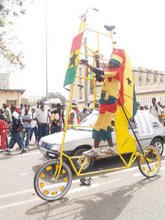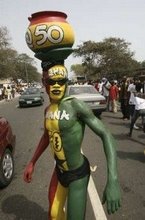
Baba Yara Stadium is now ready for CAN 2008.


Thursday, January 04, 2007

Uniqueness of Ashanti

The Ashanti region is one of the ten administrative regions of Ghana. For political and administrative purposes, Ghana is divided into 10 regions with each headed by a Regional Minister.
It has a total land area of approximately 25000 square kilometres representing about 10 percent of the total land area of Ghana.
Apart from its unique placement in the middle of the country, the region has other significant features such as sharing borders with four regions of the country, Brong Ahafo, Western, Central and Eastern regions. All the other regions shares borders with either three or two regions.
Most of the region’s inhabitants are Asante people, one of country’s major ethnic groups. Majority of Ghana’s cocoa is grown in the region. Aside that, the region is a major site of Ghana’s gold-mining industry as Anglogold Ashanti (AGA), which is regarded as the biggest gold mine in Africa and second to Newmont in the world, is located in the region at Obuasi.
Ashanti is the most populous region in the country with a population of 3,612,950 representing 19.1 percent of the national total of 18.9million, according to the 2000 Demographic Survey of Ghana.
Kumasi the regional capital is centrally located within the national context making the region unique among the other regions.
The region is subdivided into 21 administrative districts, the highest among all the country’s regions. This includes the Kumasi Metropolitan Area, which is Ghana’s second largest metropolis with a resident population of over 1.1million people.
The others are Adansi North, Adansi South, Afigya Sekyere, Ahafo Ano North, Ahafo Ano South, Amansie Central, Amansie East, Amansie West, Asante Akim North and Asante Akim South.
The rest are Atwima Mponua, Atwima Nwabiagya, Bosomtwe Atwima Kwanwoma, Ejisu-Juaben, Ejura Sekyedumasi, Kwabre, Obuasi Municipal, Offinso, Sekyere East and Sekyere West districts.
Politically, the region has 39 constituencies and indeed has the largest representation in Parliament to articulate the aspirations of the constituents. This should be expected since this is the most populous region in the country.
Like other areas in the country, the institution of chieftaincy is very pronounced in the Ashanti region and plays a significant role in its administration.
The region has 33 traditional council areas each headed by a paramount chief and comprising several divisional chiefs, all of whom owe allegiance to the Asantehene. The Asantehene, who is the President of the Asanteman Council is seated at the Manhyia Palace in Kumasi.
Manyhia Palace is a traditional showpiece which over the years had attracted local and international attention. All the history about the Kings of Ashanti and their works can be found in the Manhyia Museum.
Even though the Asanteman Council extends beyond the borders of the Ashanti Region, the chiefs in the other regions who are deemed to be part of the Asanteman Council all owe allegiance to the Asantehene, a feature which is not existent in other areas of the country, thus making the Ashanti Region unique among the others.
The homogeneity of the people of Ashanti, speaking only one dialect facilitates smooth administration of the area. Through the traditional courts of the Asantehene, chieftaincy issues and land litigations are tackled.
Indeed Ashanti Region’s near central location within the country makes it a nerve centre for commercial and social development.
The region has abundant, skilled manpower and relatively better social and economic infrastructure. The people of the region have high business acumen, which makes Kumasi one of the major commercial centres in the West African sub region.
Ashanti region is perhaps the best endowed region of Ghana in terms of its abundant natural and human resources available for investors.

4 perish in fire in Kumasi


A 45-YEAR-OLD woman at Kwadaso, Kumasi, who had persistently threatened to commit suicide finally carried out her brutal intentions at dawn yesterday, taking with her 14-year-old son, four-year-old grandson and 75-year-old mother. She also allegedly caused the death of the four year-old grandson of her mother.
Residents of the Kwadaso Estate woke up to the fire, which the suicidal woman employed in the bizarre incident and with which the woman, only identified as Konadu, set the family bedroom on fire, killing herself and her JSS Two son in the process.
The fire also killed her mother, identified as Maame Asantewaa, and Maame Asantewaa’s four-year-old KG One grandson, Paa Kwesi, who was attending school at Bethel Preparatory in Kumasi.
The 14-year-old JSS boy, identified as Yaw Anin, was also attending school at Bethel JSS in Kumasi.
Konadu, who was said to be diabetic, asthmatic, hypertensive and an ulcer patient, was alleged to have accused her mother, Maame Asantewaa, as being the principal cause of her woes and had threatened to commit suicide on countless occasions but had been advised by family members to desist from such an action.
According to family sources, Konadu had also threatened that she would also kill her 14-year-old son anytime she committed suicide to prevent him from suffering from any social and financial problems.
She carried out her intentions when she set their two-bedroom apartment at Kwadaso Estate on fire, locked the doors and concealed the keys to prevent anybody from entering to rescue them.
When her 75-year-old mother saw that they had been trapped and had no means of escaping, she attempted to push the four-year-old boy through the windows but he was also trapped in the iron bars in the windows, making it impossible for the rescue team outside to help.
When help finally came, the four-year-old boy, together with Maame Asantewaa, Anin and the arsonist had been burnt beyond recognition.
Their bodies have been deposited at the Komfo Anokye Teaching Hospital (KATH) mortuary for autopsy.
The police have also initiated investigations into the incident.
Briefing the Daily Graphic on the incident, the landlady, Madam Akua Afriyie, said Maame Asantewaa had been her in-law who had been taking care of their grandson, Paa Kwesi.
She explained that both Paa Kwesi’s father, who is her son, and his wife, have travelled abroad and so catering for the young boy became Maame Asantewaa’s responsibility.
She said two years ago, Konadu started visiting her mother, Maame Asantewaa, in the house at Plot 39, Block A, Kwadaso Estate, and not long afterwards, she started quarrelling with her mother, accusing her of being the cause of her ailment.
She explained that Konadu was at that time suffering from various diseases, including diabetes, ulcer, hypertension and asthma, and was, therefore, hospitalised on countless occasions.
Madam Afriyie said just last Tuesday Konadu again threatened to commit suicide so family members advised her against the threat. But she carried out her threat by setting their family bedroom ablaze.
Explaining, Madam Afriyie said at about 1:30 a.m. on Wednesday, she heard some people shouting and banging the doors that the house was on fire.
She said when the tenants assembled at the main house, they got to know that the four deceased persons had been trapped, since their main bedroom was on fire with the doors locked and the keys removed.
According to the landlady, when the tenants attempted to rescue the deceased family, Maame Asantewaa, who was then alive, shouted that it was Konadu who had set the room ablaze and concealed the keys to prevent any of them from escaping.
She said at that time Maame Asantewaa attempted to push her four-year-old grandson through the windows to prevent him from burning but he was also trapped in the iron bars.
She said by the time personnel from the Ghana National Fire Service arrived on the scene to put out the fire all the four persons had been burnt beyond recognition.
Meanwhile Nana Yaw Barimah reports that the Ashanti Regional Minister, Mr Emmanuel Owusu-Ansah accompanied by his Deputy, Mr Osei Assibey Antwi, led the Ashanti Regional Security committee (RESEC) to visit the scene of the trragedy.
The Ashanti Regional Minister was moved when he learnt that the four year-old child who made frantic efforts to escape was later burnt by the fire.
Mr Owusu-Ansah on behalf of the government expressed his condolences to the bereaved family and assured them that the police and personnel of the Ghana National Fire Service would investigate the circumstances that led to the incident.

Wednesday, January 03, 2007

Accident


These past weeks found me taking abbreviated breaks at work due to extreme business volume combined with my damn near insane work ethic or no break at all.
I took my annual leave from work and went into hiding (hibernation). I fast forward to a ravenous version of me arriving at work on December 27 2006.
I did not celebrate the Christmas in a good mood at all because someone smashed my car on December 24, 2006. I escaped from an injury narrowly but ended up with the car damaged.
The fellow (lady), a learner driver in an attempt to overtake my car because of inexperience lost control over her wheel and banged into my car, scaring the hell out of me, since I never saw her coming.
By God’s grace, I escaped unhurt and doing well but the irony was that, I never had my car to celebrate the holidays since it had to go to the workshop. By God’s grace, I’m ok now and work has resumed and in full gear after the holidays.

Thursday, November 23, 2006

City Hotel undergoes rehabilitation


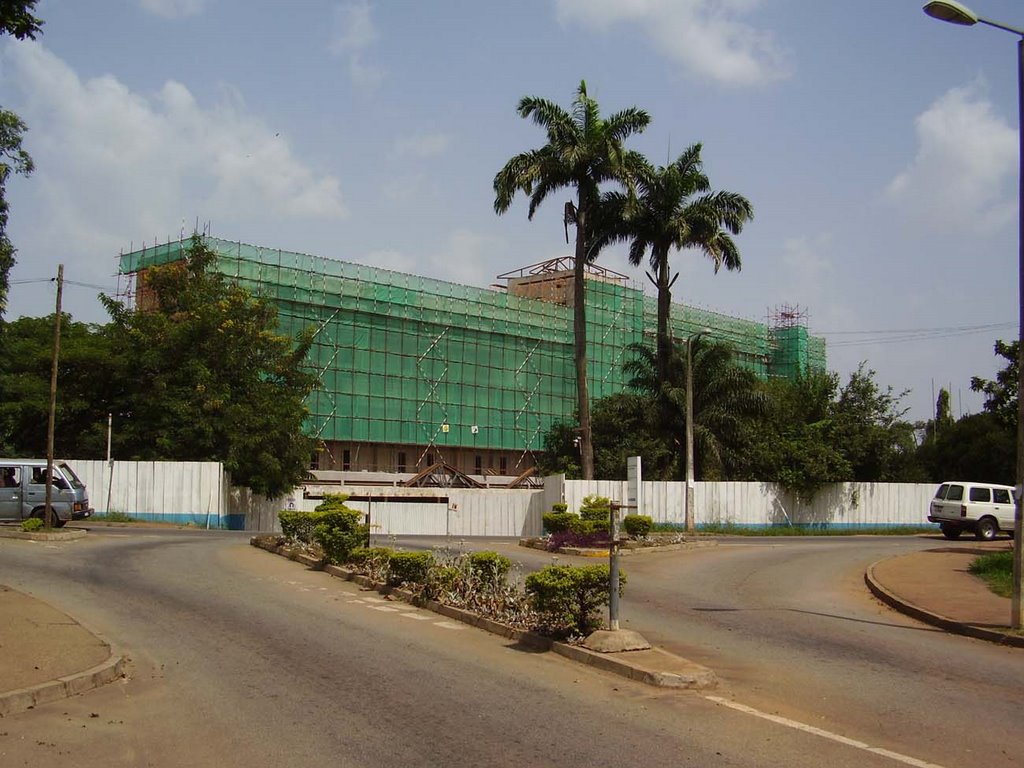
The City Hotel Complex in Kumasi currently undergoing rehabilitation in readiness for CAN 2008. The government finally decided to rehabilitate the hotel after several years of abandonement.
Picture shows the front view of the hotel with scaffolds and safety net around it as construction works go on.

Wednesday, November 15, 2006

OLD SKUUL REUNION IN KUMASI

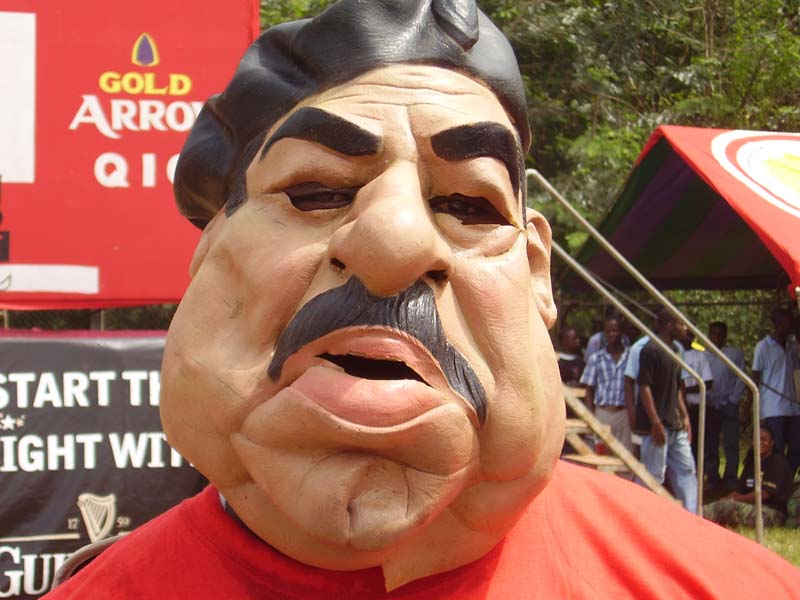
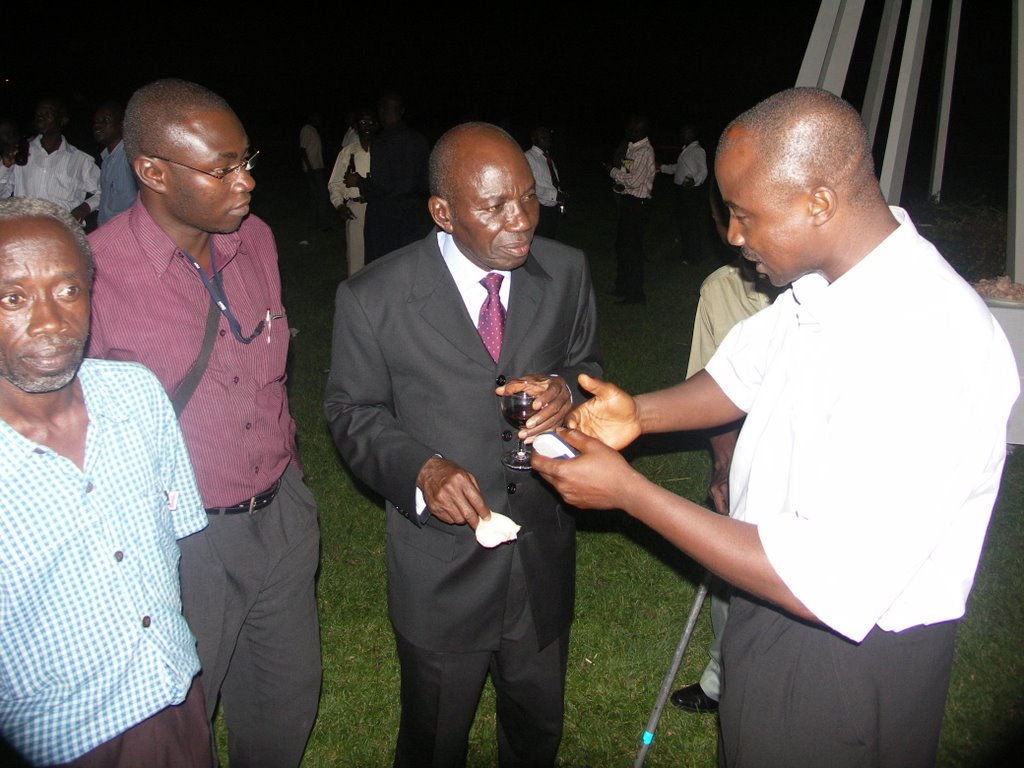
(Picture shows left - Asanka Boyoyo, middle- Otwinoko, right- Kofi Adu Domfeh all of Luv FM. This was taken at the old students reunion held at the Ridge Park.
If the maiden edition of the Old Schools Reunion in Kumasi last year was great then this year’s second edition organised at the weekend was something quite greater.The event, which was organised through a collaborative effort of Luv FM and Guinness, was not only a success but also an excitement.More than 50 old students associations of various schools across the country whose number greatly surpassed that of the previous year converged on the Kumasi Ridge Park as early as 8:00am for the fun-filled event. In the previous year’s event, however, only about 30 old students associations participated.This year, there were competitions in various games which evoked memories of participants’ secondary school days. What made the schools’ reunion a good fun was the intensity and the recall of the rivalry that existed among some particular schools in those days.
Most of the old students who gathered at the event sang their schools anthem and the popular “jama” songs during their stay in school.
The participating old students associations were eager and determined to outdo their counterparts in almost every event which included High Jump, 50-metre hurdles, 50- metre dash, gari soaking, a five-aside football gala, table tennis, tag of war, “jama” and dancing competitions. (Picture Shows: Lord Kenya on stage entertaining the crowd)
The Rap Heavy Weight Champion, as he describes himself, Lord Kenya as well as Okyeame Kwame and his Braders were there to give fans renditions from their songs.
Students of the Kwame Nkrumah University of Science and Technology from Unity and Katanga Halls respectively, who appeared on the scene in the nude, also engaged in stone and bottle throwing at each other during the “jama” competition, thus resulting in some injuries which brought proceedings to a temporary halt around mid-day.
But that was short-lived when the five-aside football gala was ushered in.
An exciting aspect of the whole event was the side attraction which saw a coterie of guys gathering at various spots to admire ladies who were in dresses that exposed parts of their bodies. There was also shortage of alcoholic drinks and the organisers had to work out quickly to replenish their stocks.
Many were those who met their old-time school friends whom they never met after school. Prior to the games on Saturday and in studio interactions with various old students associations in the weeks leading to the games, we witnessed scintillating performances from old school folks who seemed not to have forgotten their secondary school days. (Picture shows Anita Akua Kyerewaa of Luv FM)
Old students of Mampong Technical Training College showed their prowess in the “jama” competition to place first, followed by T. I. AMASS, Kumasi, and the Armed Forces Secondary placed at the second and third positions respectively.
Kumasi High came first in the 50-metre hurdles, followed by the Ghana National College (Cape Coast) and Mampong Technical Training.
Kumasi High again came first In the 50-metre dash, followed by Prempeh College and the Armed Forces Secondary. Technology Secondary was first in the table tennis, followed by Kumasi Technical Institute (KTI) and Osei Tutu Secondary School at the second and third positions respectively.
Ghana National College (Cape Coast) came first in the High Jump, followed by St James Seminary Sec. (Sunyani) and Mampong Technical Training, while KTI was first in gari soaking and was followed by Mampong Technical Training and Koforidua Secondary Technical.
OLA Secondary School (Ho) was first in the dancing competition, followed by Anglican Secondary School and Yaa Asantewaa Girls, while Anglican Secondary School again came first in the tug-of-war followed by Prempeh Collegeand Pope John Sec. School (POJOBA).

Wednesday, November 08, 2006

Kejetia Lorry Terminal deteriorates


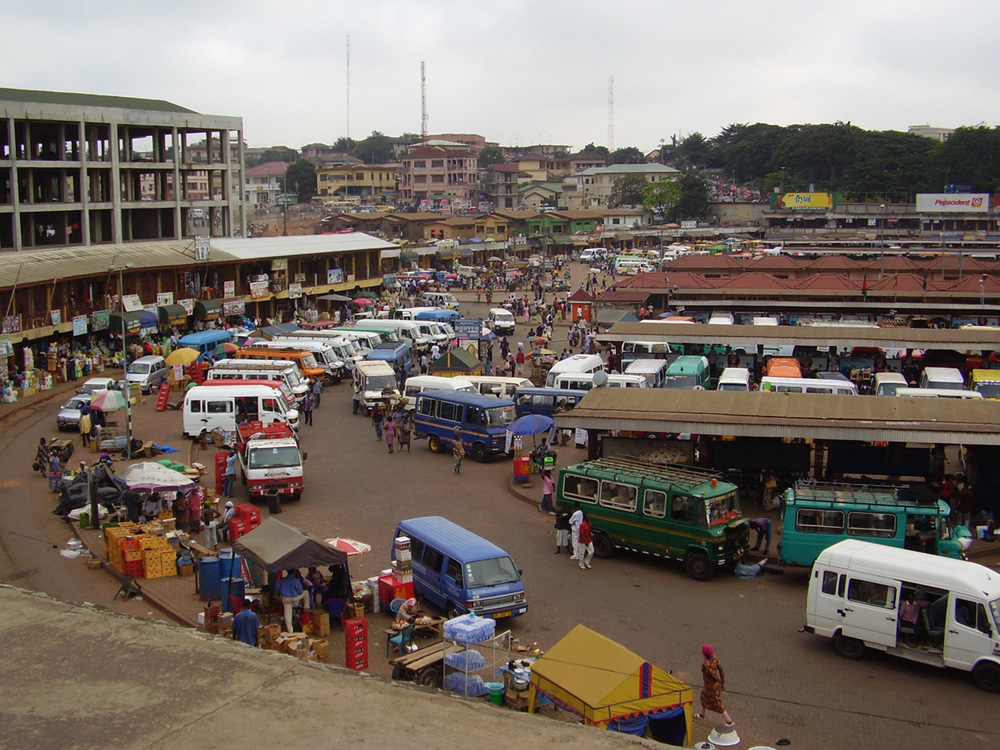
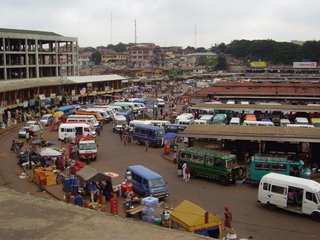
Picture shows an aerial view of the Kejetia Lorry Terminal

Kejetia is one name so dear to the hearts of residents in the Kumasi metropolis, visitors and tourists, such that, when the government decided to rehabilitate it some years back, the decision was greeted with so much joy by all stakeholders.

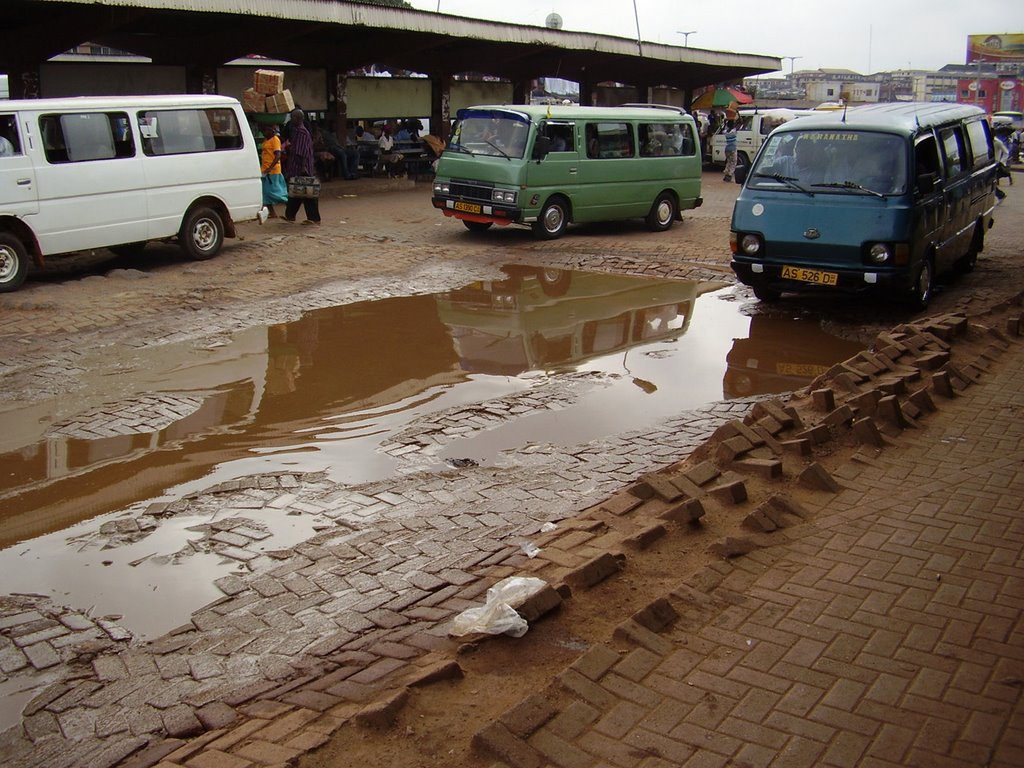
But barely four years after its rehabilitation, facilities at the place, especially pavement blocks have started deteriorating under the very eyes of the managers of the lorry terminal. F. D. Freko Limited.

A number of the pavement blocks have been dented and there seem to be no plan to get the deteriorated pavement blocks rehabilitated inspite of numerous calls by the public to get them repaired.

The situation becomes worse during rainy periods as pedestrians have to meander through floods to board and alight from vehicles.

Big buses, especially the double decker ones belonging to the Metro Mass Transit (MMT) move about in dislocated pavement blocks under dangerous conditions.
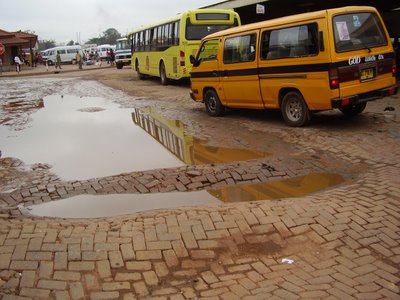
Picture shows dislocated pavement blocks at the Kejetia Lorry Terminal with vehicles trying to move through stagnant waters at the place.

In giving out the management of the lorry terminal to a private company, Mr. Maxwell Kofi Jumah, the then Metropolitan Chief Executive of the Kumasi Metropolitan Assembly (KMA) explained that the management of the lorry terminal was going to be on contract basis and gave a long list of what was to be expected at Kejetia.

This included the registering of special potters at the place and clothing them for easy identification, a thorough cleaning and monitoring of the infrastructure at the place as well as routine maintenance of the infrastructure.

The managers were to ensure that hawking was not entertained at the place but the direct opposite of what was outlined is being experienced at the place currently.

Employees of managers of the place, F. D. Freko, allegedly take bribes from certain hawkers and allow them to ply their trade at the place.

Aside the deteriorating nature of the place is the present crop of vehicular congestion at the place.

The government decided to rehabilitate the lorry terminal with the intention to find a lasting solution to the problem of the heavy pedestrian population, which competed with vehicular traffic resulting in the confusion in the area as a result of the heavy “go-slow” that engulfed the area then and sprang to the centre of Kumasi.

The idea was to find a solution to the problem once and for all whilst at the same time maintain the natural beauty of the area, thereby separate the market, and the cars from the pedestrian.

It looks as if the problem that existed at the place earlier on is being allowed to repeat itself with the construction of more market stores at the place thus limiting parking and loading points for vehicles.

There is congestion all over the place at Kejetia presently as vehicles struggle to get access to the terminal, which temporarily block traffic to Adum, Ashanti New Town and Manhyia creating confusion at the place.

Indeed no project had ever attracted so much controversy in the history of Kumasi as the Kejetia terminal, and this could be attributed to the secrecy that surrounded the award of the contract at that time.

A clause in the agreement at the time of the rehabilitation debarred the contractor from talking about the project except with the client.

Officials at the Urban Roads Department, which was the client, at that time, referred anyone who needed information on the project to Accra.

It was therefore not surprising that many people read several interpretations into the project until the Roads and Transport Ministry finally intervened and went public.

In its explanation, the Ministry pointed out that the project was in phases- the Kejetia Development Project proper and the Kejetia Lorry Terminal.

The Kejetia Development Project involved the re-alignment of the roads to and from Kejetia, which re-directed vehicular traffic from the roundabout as well as the development of an infrastructure at the Central Market.

Messrs Limex Bau Limited, a German company, executed the Kejetia Development project proper while Messrs G. K. Appiah handled the Kejetia Lorry Terminal project, which involved the rehabilitation of the lorry park.

The two projects were therefore considered as one, which was going to help Kumasi regain its past glory.

Under the terminal project no provision was made for shops in the original plan of 1990.

The design included the reconstruction of the lorry park, passenger sheds, offices, a plaza area around the roundabout with pedestrian alleys and shopping areas for the sale of artifacts.

But what do we see today? New developments and construction of market stores are springing up all over the place.

It would be recalled that a controversy ensued in 1999 between the Kejetia Traders Association who tried to construct market stores at the place and the Ashanti branch of the Ghana Private Road Transport Union (GPRTU).

The controversy bordered on the authorisation by Nana Akwasi Agyemang, the then Metropolitan Chief Executive for the construction of stores by the traders association.

Kumasi drivers also bared their teeth and threatened fire and brimstone if the buildings were not demolished.

The GPRTU in their argument said the lorry park was already too small to accommodate the heavy vehicular population in Kumasi hence the construction of the stores was not necessary and in any case that was not in the original plan.

The KMA later demolished and prevented the traders association from constructing an 84-shop complex at the terminal following the GPRTU’s objection, claiming that the building was being constructed in the middle of the terminal and would therefore reduce parking spaces.

The KMA stopped the project after it had given the permission for the construction of the shops for displaced members of the Kejetia Traders Association who were affected by the Kejetia project.

The Regional Security Council (REGSEC) later ruled that the building was not properly sited and that it should be demolished and a suitable place allocated to the Association for the construction of a new building.

But it looks as if lessons from the controversies that ensued in 1999 over the construction of the market stores at Kejetia have soon been forgotten.
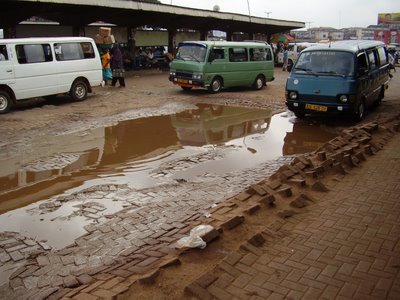
Picture shows dislocated pavement blocks at the Kejetia Lorry Terminal with vehicles trying to move through stagnant waters at the place

A visit to the area reveals that places designed for taxi ranks have been taken over by stores, which has contributed to limiting parking and loading points for vehicles.

The Kejetia Traders Association in 2004 repeated a call for the Kumasi Metropolitan Assembly to explain the rational behind the decision to allow a private developer to construct market stores at the terminal after the Assembly had demolished and prevented the association from putting up similar stores at the terminal in 1999 with the excuse that the stores was going to limit parking spaces at the place.

Surprisingly, there was no response to that effect and the building project, is almost complete, standing on the same foundation, which was ruled as unfit for construction earlier on.

This is only one of the constructions going on at the place, apart from other ones, which have already been completed.

Before the project was implemented various studies were done by the Building Research and Road Institute (BRRI). Several designs, which included the construction of flyovers (interchange), were also considered.

The study by the BRRI indicated that the use of flyover at the area was good, but it was going to be expensive to construct hence the idea of flyover was abandoned.

The final basis for the selection of the present design (without a flyover) was to find optimal solution to the problem of pedestrian and vehicular congestion at the place thereby maximising the use of the available space to improve pedestrian and vehicular movement in view of the limited resources.

Various options were therefore put before the financiers of the project who were the World Bank and OPEC Fund and the present design was selected based on availability of resources.

Traffic from Adum through the then roundabout to Ashanti New Town and Manhyia were diverted through the Children’s Hospital area and the Zoo with the aim to help reduce congestion.

It was later announced that even though the project was being executed nothing prevents the construction of flyovers when funds were available, but how can that be done, with the present market stores construction if there is a decision to construct flyovers.

Due to the central location of Kumasi in the country, most road networks linking the country pass through Kumasi and for that matter Kejetia, which happens to be in the centre of the city.

Studies by the Building and Road Research Institute (BRRI) in 1999 showed that the Kejetia area was the busiest spot in the whole of West Africa.

According to the studies, as many as 13,000 people shuttle between the Kejetia Lorry park and the Mampong road in an hour whilst 18,000 cross over from the lorry park to the central market.

This heavy pedestrian population competed with vehicular traffic resulting in the confusion in the area, which accounted for heavy “go-slow” in the centre of Kumasi.

The intention of government was therefore to find a solution to that problem once and for all whilst at the same time maintain the natural beauty of the area, thereby separate the market, and the cars from the pedestrian.

It looks as if the problem that existed at the place earlier on is being allowed to repeat itself with the construction of more market stores at the place.

If nothing was done about it, the problem would be compounded and it would mean the more market shops, the more human congestion at the place.

Are we to wait and observe our cherished Kejetia lorry terminal deteriorate and get back to the bad state in which it was before the rehabilitation or has the focus for reducing vehicular traffic and human congestion at the place changed?


Tuesday, November 07, 2006

MESSING UP WATER BODIES BIG TIME IN KUMASI


Picture shows polythene and other waste materials choking up some water bodies at Suame.
The continued pollution of water bodies in the Kumasi metropolis has been a major problem environmentalists have been trying to uproot.
There has been a massive pollution of water bodies in the Kumasi metropolis in the last few years as people dump filth and human excreta into rivers haphazardly at all areas in the metropolis.
Some have even connected their sewerage pipes directly into rivers where excreta from their homes are directly deposited into the rivers which drain into the Owabi and Barekese dams, which provides water supply for Kumasi and other surrounding areas.
Although the Ghana Water Company Limited (GWCL) and the Environmental Health Department of the Kumasi Metropolitan Assembly (KMA) have on numerous occasions embarked on campaigns to call on people to desist from such activities, the practice seems to be on the increase.
Save Our Waters Ghana (SOWG), a non governmental organisation in Kumasi has taken a giant step in fighting the canker but its efforts would come to nothing if residents don’t change their attitude towards pollution.
Ghana has been highlighted to become one of the water stress countries in Africa in a few years to come. The recent rationing of pipe borne water by the Ghana Water Company Limited (GWCL), felling of trees along river banks and destruction of forest reserves at dam catchments, developing water bodies for settlements, dumping of refuse at the catchments of water supply and outbreak of water related diseases are all issues which point to a near future water stress in Ghana.
Water shortage causes a lot of problems ranging from domestic, industrial and in government circles as well.
In view of this, it is about time that people became conscious about saving water bodies in order to help avert any water crisis in future.

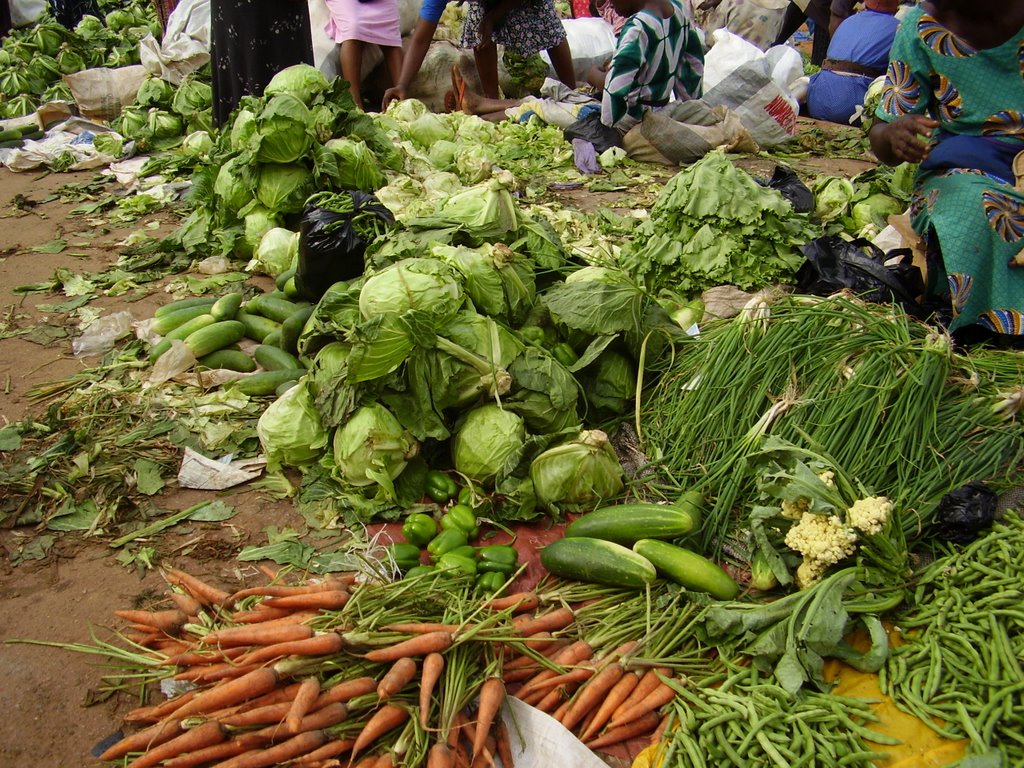
Vegetables on ground for sale


Picture shows market women selling vegetables and fruits on the bare ground and close to stagnant water and gutters infested with filth at the Dunkirk area in Kumasi near the Asafo Market-UTC Interchange, which is under construction.
This picture depicts an example of conditions under which food stuffs especially vegetables and fruits, most of which are eaten raw are sold on the bare ground in market places across the country.
There have been numerous calls from members of the public for market women to desist from such practices but the calls seem to be falling on deaf ears.
At a recent matriculation ceremony of the Kwadaso Agricultural College in Kumasi, the Principal of the College, Mr Anthony Appiah proposed that District Assemblies should enact bye-laws to compel vegetables and fruit sellers to at least sell on tables.
Such, a move he said would help make vegetables and fruits hygienic for human consumption.

Monday, November 06, 2006

Asafo Market-UTC Interchange Project in Kumasi


The much talked about Asafo Market-UTC interchange project in Kumasi is gradually taking shape. The contractors have given the assurance to complete the project by December this year. It is expected to help ease traffic congestion between Adum and Asafo. The project, which commenced about 24months ago is behind schedule. Residents of Kumasi are upbeat expecting to see the completion of the project so as to help ease congestion.

PICTURE SHOWS - Workmen of Sarrouch Granulati J. V. the contractors executing the project on site.

Welcome to Kumasi


Welcome. Hence I shall be writing about
developments in Kumasi, the second capital city of
Ghana and otherwise referred to as the Garden City of
Africa. I would also try to provide pictures on the
developments as well as feed you on issues in the metropolis. Kumasi is gradually
expanding and a lot more suburbs are spranging up.

Friday, November 03, 2006

THE HISTORY OF KUMASI


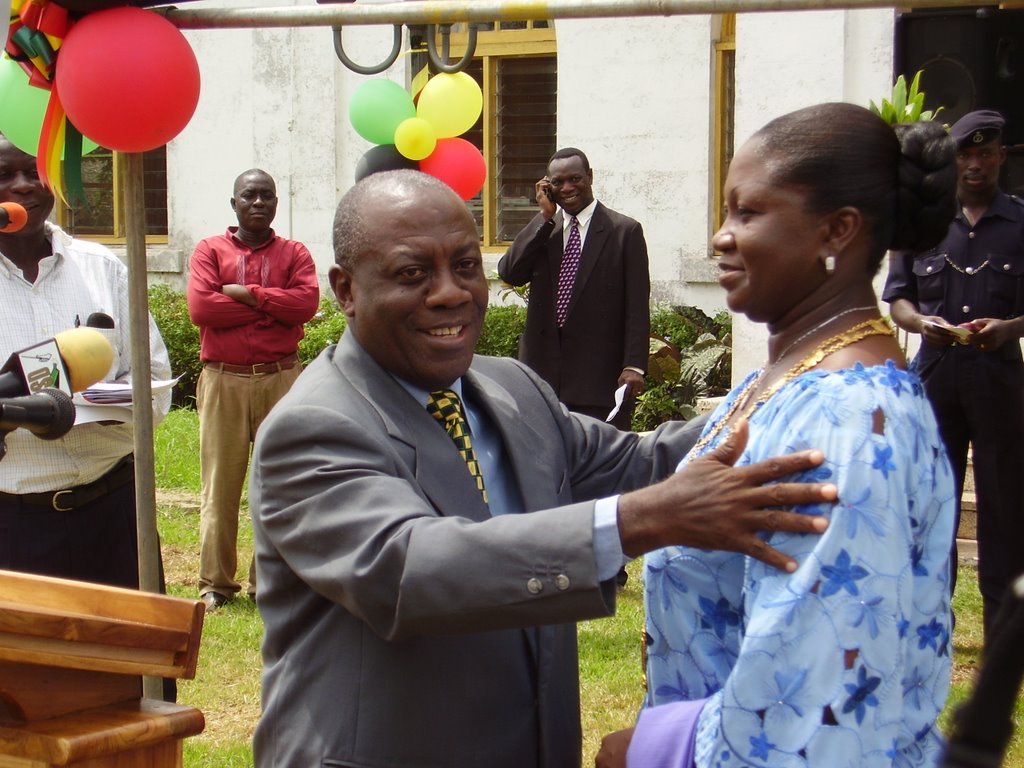
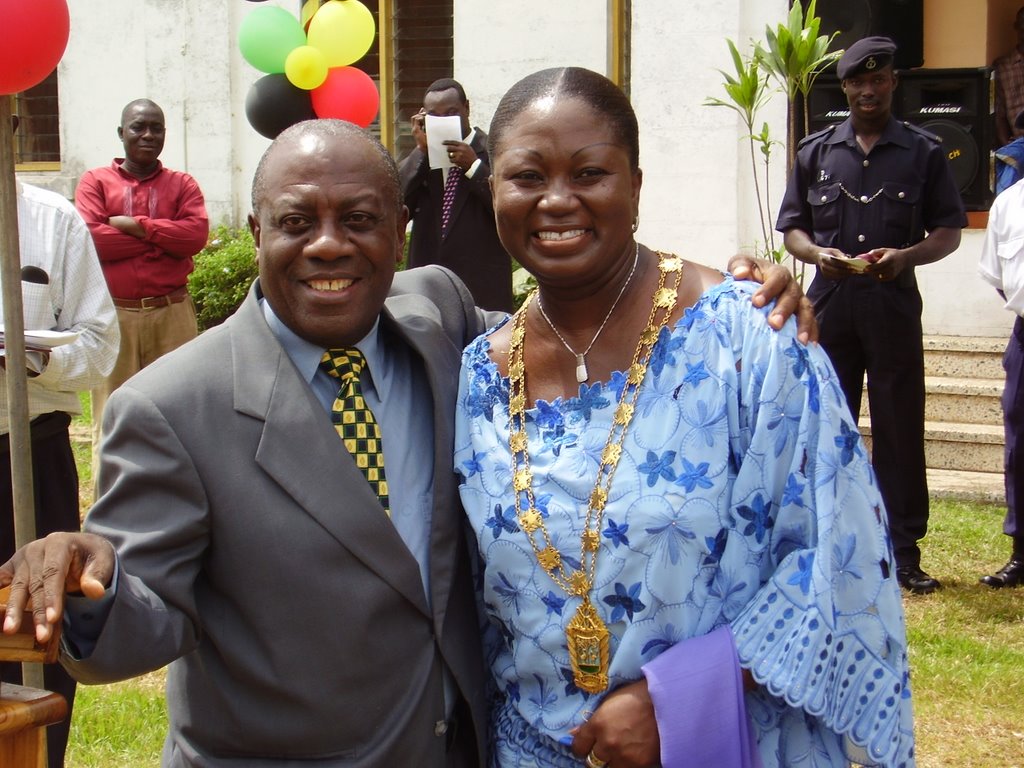
Picture Shows Madam Patricia Agyei (right) Kumasi Metropolitan Assembly Chief Executive during her swearing in to office by Mr S. K. Boafo, former Ashanti Regional Minister.


THE HISTORY OF KUMASI
Kumasi, the capital city of the Ashanti region is located in the rain forest region of Ghana and is popularly known as "The Garden City" because of its various species of flowers and plants.It is the second-largest city in Ghana, located in the south-central part of the country, about 250 km from Accra.
Queen Elizabeth II of England gave Kumasi the name Garden City of Africa when she visited the area in the 1960s because of the varied plant life in the area.


Lake Bosomtwe, the largest natural lake in Ghana, which empties into the Atlantic Ocean, is located approximately 32 km south of Kumasi.
While the terrain surrounding Kumasi is relatively flat, the countryside is lush with tropical vegetation.
With over 2.5 million citizens, the city spans a radius of about 18 to 20 miles.
Picture shows: Mr E. A. Owusu Ansah (in tie), current Ashanti Regional Minister in an interaction with pressmen a month after assuming office as Ashanti Regional Minister. On the extreme left is Nana Yaw Osei, Vice Chairman, Ashanti GJA, on the Minister's left is Enoch (myself) and Adu Poku of GNA-Kumasi
The largest ethnic group is the Asantes, but other ethnic groups are growing in size.
Approximately 80 percent of Christians and 20 percent Muslims, with a smaller number of adherents to traditional beliefs.
The city rose to prominence in 1695 when it became capital of the Asante Confederacy due to the activities of the then ruler, King Osei Tutu I.
King Osei Tutu I was known as the Kumasihene and he served as ruler of the Asante Confederacy.
Parts of the city, including the Royal Palace, known as Manhyia were destroyed by British troops in the Fourth Anglo-Ashanti War of 1874.
A relatively young city, Kumasi was founded in the early 19th century by King Osei Tutu. The king named the city after the Kum tree, which he planted as a symbol of victory for the Asante Empire over the British. The Asante region has been independent since 1875 even though Ghana itself only declared independence in 1957. A descendant of King Osei Tutu, Nana Osei Tutu II, is King of the Asantes today, receiving allegiance from the people within the democracy of Ghana. He is said to be the richest King on Africa's West Coast.The King resides in Kumasi, and his home, the Manhyia Palace, is one of the city's most spectacular sights. The city holds an important place in the history of the Asante people as legend has it that a golden stool in the palace descended from heaven, and Okomfo Anokye, an ancient priest received the Golden stool, which signifies an embodiment of the soul of the Asante nation.
Near the palace grounds a copper sword was said to have been driven into the ground by Okomfo Anokye, which no one has been able to remove by any means.
Kumasi remains a royal city, the role of the King has been mainly symbolic. Due to large gold deposits that have been mined in the area, Kumasi has been among the wealthier cities in Ghana. Today's major exports are timber and cocoa. Kumasi has 50 percent of the timber industry in Ghana, with more than 4,000 employed in the business.
Trade, commerce, farming and mining are leading industries in Kumasi. In addition, its region boasts a rich cultural heritage particularly evident in smaller surrounding towns. Other riches abound, with wealth derived from substantial gold deposits and agricultural products. Cocoa and high-quality hardwood (timber) are other major exports
Features of the city include the large Kumasi Central Market, Fort Kumasi (built by the British in 1896 to replace an Asante fort and now a museum) and the Kumasi Hat Museum (Built by the late Nana Kofi Genfi.

Picture Shows Madam Patricia Agyei (right) Kumasi Metropolitan Assembly Chief Executive during her swearing in to office by Mr S. K. Boafo, former Ashanti Regional Minister.
Royal Asante attractions include the Kumasi National Cultural Centre (including the Prempeh II Jubilee Museum with various Asante regalia including a reproduction of the golden stool), the Okomfo Anokye Sword being hosted at the Komfo Anokye Teaching Hospital, the Asantehene's Palace (built in 1972), and the Manhyia Palace, dating from 1925, now a museum.
Along with history and legend, Kumasi is a fast-growing, contemporary city. It is filled with avid sports enthusiasts who are especially proud of the soccer team, the Kumasi Asanti Kotoko. The team has won numerous national and continental awards
Kumasi is also home to a zoo, the Kumasi Zoological Gardens, which is next to the Centre of National Culture (CNC), the Kwame Nkrumah University of Science and Technology of Ghana (formerly the Kumasi College of Technology).
The Kumasi area has one public hospital (Komfo Anokye Teaching Hospital, 736 beds), five public clinics and 57 private clinics (1992 figures).
The city's most famous child is the current general-secretary of the United Nations, Kofi Annan. The local football (soccer) team, the Kumasi Asante Kotoko has won several national and continental awards. The Kumasi Sports Stadium was built in 1959 and renovated in 1978 with a seating capacity of 80,000 the largest in the country. It is currently undergoing another renovation in readiness for CAN 2008, which is being hosted in Ghana.
Kumasi is home to numerous educational institutions, including the University of Science and Technology, one of Ghana's premiere facilities of higher learning. English is the official language of Kumasi, and its native language is Asanti (TWI).

Monday, May 22, 2006

Highway slaughter in Kumasi, as 35 perish in motor accident

IN what could best pass as a national tragedy, thirty-four souls perished last Monday night in the worst accident in the Ashanti Region in recent times when an Inter City STC Bus collided head-on with a Mercedez 207 passenger bus at the Akropong Junction on the Kumasi-Sunyani road.
It was a Black Monday night for the Catholic Church in general and the Abuakwa Parish in particular as all but three of the dead, were members of the Parish.
The church members most of whom were choristers were on their way to attend the funeral of their deceased Reverend Father of the Parish at Akwaboa, some five kilometers away when they met their tragic death.
The remaining three included the drivers of the two vehicles, and an officer of the Customs Excise and Preventive Service (CEPS) who was on board the STC bus.
This morning, the scene at the Komfo Anokye Teaching Hospital where the bodies were sent, was shocking and pathetic.
Relatives, church members and friends tried to identify the bodies of their departed ones as the bodies were lined up at the mortuary.
Some of the bodies were badly mutilated, and the scene sent people wailing uncontrollably.
The Accra-bound Inter-City STC bus with registration number … was said to be traveling from Burkina Faso.
The Akropong junction accident was a near carbon copy of what took place at Santasi last year when 17 members of the Deeper Life Bible Ministry on board a similar 207 bus returning from a funeral lost their lives.
Monday’s accident was said to have occurred a few minutes after 10pm when the driver of the 207 bus, attempted to overtake a Tico taxicab.
Eyewitnesses said the 207 driver lost control and went into a head-on collision with the oncoming Inter-City STC bus.
The STC bus dragged the 207 bus along for some distance killing all on board.
Some of the church members told the Graphic that the Abuakwa Parish of the Catholic Church selected the choir members from various societies within the Parish and that the vehicle moved from society to society to pick them for the wake-keeping.
Police sources said they suspected the 207 bus was overloaded.
Fire Service personnel who responded quickly to the accident spent the whole night trying to cut through the wreckage to remove both the dead and injured persons.
The driver of the STC bus for instance was found dead with the head handing downwards in the bus when the bus was cut open, according to eyewitnesses.
The number of injured persons who were rushed to the Intensive Care Unit (ICU) of the Komfo Anokye Teaching Hospital (KATH) could not readily be ascertained as hospital staff were busy trying to save lives.
The badly mutilated bodies of the deceased, 17 males and 17 females have since been deposited at KATH morgue for autopsy.
Those identified included the driver of the 207 bus, Kwame Acheampong.
Others were Georgina Tiwaa, John Baptish Amosi, Kwadwo Asiedu, Vice Chairman of the Tanoso Union Choir, Cecilia Nyamekye from Tanoso, Eric Boakye, Lawrence Addai Munumkum, a catechist of the Abuakwa Parish, Sister Agyeiwaa, Mary Mensah from Apatrapa, John Mensah, Sepaase Choir master, Sister Alice and Bernard Mensah.
When the Graphic visited the KATH morgue this morning (Tuesday), it was a horrific scene as a large crowd had besieged the morgue’s premises trying to help identify the deceased.
The Member of Parliament for Atwima Nwabiagya, Mr Benito Bioh within whose constituency the accident occurred was at the morgue to show concern for the lost souls and the bereaved families.
The Police were yet to officially comment on the accident.

Tuesday, May 02, 2006

ANOTHER fatal accident in the Ashanti Region, Ghana

ANOTHER fatal accident in the Ashanti Region within two weeks, once again involving 207 Mercedes Benz passenger buses, has claimed fourteen lives on the spot at Kwadwo Kwapia on the Obuasi - Dunkwa-on-Offin.Eighteen others received various degrees of injuries some very serious.Both the dead and the injured were sent to the Government Hospital at Dunkwa-On-Offin.The accident occurred last Friday when both vehicles were said to be speeding on the road. The accident came at a time accidents involving Mercedez 207 buses had become a source of concern to both the police and other concerned groups and individuals.Just around Easter 14 people were killed at Dadieso on the Accra-Kumasi road, apart from other minor accidents.Police report on the Kwadwo Kwapia accident was not detailed enough.However, eyewitnesses said one of the vehicles, which was bound for Tarkwa tried to overtake another resulting in the head-on collision.According to the eyewitnesses, people within the area of the accident constituted themselves into rescue teams to help remove the dead and injured from the wreckage before sending them to Dunkwa.Among the dead were the drivers of both vehicles.Police named the deceased drivers as Kwasi Owusu and Emmanuel Teye.The identities of the 12 others who were killed in the accident as well as the injured were not immediately known.Deputy Superintendent of Police (DSP) James Sarfo-Peprah, the Commanding Officer of the Police Motor Traffic and Transport Unit of the Ghana Police, who briefed the Daily Graphic today said Owusu was driving the vehicle with registration number AS 5731 W, from Kumasi to Tarkwa while Teye was using the bus with registration number AS 3508 W from Tarkwa to Kumasi.On reaching a section of the road near Kwadwo Kwapia the two vehicles collided killing the 14 on the spot.

NIGHT life in Kumasi is dying

SOMETHING is happening in Kumasi before the eyes of all residents, and which is a huge eyesore but very few people seem to talk about it.
It looks like nobody not even the city authorities care about the malfunctioning of streets lights in the metropolis as virtual darkness engulf the streets in the night.
Clearly one of the factors that go into making life in a community especially in the city interesting and worth living is the availability of electric power on the streets.
Street lighting goes to bring life to the community and check crime among other benefits .
Without power many activities cannot go on effectively and the residents and visitors would be the eventual losers.
Quite disturbingly Kumasi is gradually being driven into this situation and the big question is why the authorities look on unconcerned as the situation worsens day after day.
Just take a drive in the city in the night and you will realize the sort of mess that Kumasi finds itself.
The first time visitor to the Garden City in the night would definitely be dumbfounded.
I recently overhead two gentlemen discussing the way night life in Kumasi gad gone dead.
They alluded the situation to a number of reasons including armed robbery and poor lighting system on the streets among others.

Friday, April 28, 2006

official openingexchanging pleasantries after the official openning

Powered by Castpost

group pictureICT

Powered by Castpost

one of the sessionsparticpants during one of the sessions

Powered by Castpost

Thirty Ghanaian journalists attend ICT training programme in Accra


Powered by Castpost

Thirty Ghanaian journalists attend ICT training programme in Accra
A group photograph of participants with the President of the GJA, the French Ambasador to Ghana and Mr D.A. Kwapong, Acting Director, Ministry of Information.

The French Ambassador to Ghana, Mr Pierre Jacquemot has stressed the need for local Ghanaian journalists to acquire knowledge of trends and developments in Information Communicaiton Technlogies (ICTs), so as to help improve the quality of their work.
This, he said was critical in helping to accelerate Ghana’s development as well as its integration into the global Information Society.Speaking at the opening of a three-day training workshop to help improve the capacity of Ghanaian journalists on ICTs in Accra, Mr Jacquemot said ICTs have become a powerful means of development and social change for the economic and social development of the world.The training programme was designed by PenPlusBytes, an International Institute of ICT Journalism, with the view to introduce the journalists to new ICT tools and make maximum use of the tools that local media practitioners are already familiar with.The workshop was on the theme, ‘Training Ghanaian journalists for the Information Society".
About 30 journalists from all over Ghana.attended the course.Topics such as Ghana’s ICT for Accelerated Development Policy, Knowledge Management for the Media, Afrocentric Content on the Internet and ICT Journalism were treated at the course.Ms Ajoa Yeboah-Afari, out-going President of Ghana Journalists Association (GJA) said the training programme was timely because many of the country’s media houses have prioritised ICT development and staff training but are hampered by a lack of the necessary resources including funds.She noted that the national desire for accelerated development and its achievement is intricately linked to how well journalists understand and use these technologies in their work.
"If we are to quicken the pace of our country’s development then we need to build the capacity of Ghanaian journalists in this very important sector (ICT)", she said. Mr. D.A. Kwapong, Acting Director, Ministry of Information, speaking on behalf of the Information Minister said, "the globalised world demands that the journalist is a leader in Information Society issues. It is in this light that I consider this course as invaluable. It also confirms the complementarity of private sector initiatives to the achievements of one of the three policy areas of government – Human Resource Development." Indeed, although Ghana is one of the most wired countries in Africa, there is a noticeable low use of new media technologies and poor reporting of ICTs in general, he said and added that presently not all Ghanaian media houses are connected to the Internet for example and that those that are even connected are under-utilising the ICTs to enhance their work.Mr Kwami Ahiabenu II, President of PenPlusBytes expressed the hope that participants will acquire new essential tools and skills to improve the quality, content and the relevance of their work to the public. The Accra workshop was sponsored by the French Embassy in Ghana and Ghana Information Network for Knowledge Sharing (GINKS).
The training programme for journalists is the sixth of such training courses designed and delivered by PenPlusBytes across sub-Saharan Africa over the last three years.PenPlusBytes is currently pioneering the first ever online course on ‘Introduction to ICT Journalism’ in Africa. 43 journalists from nine countries spread across three continents (Africa, Asia and Europe) are attending the eight week course which started on March 20, 2006.

enochkenteenochkente

Powered by Castpost

Thursday, April 27, 2006

Penplusbytes training workshop to enhance capacity of Ghanaian jourmalists in ICTS

PRESS RELEASE
Penplusbytes training workshop to enhance capacity of Ghanaian jourmalists in ICTS

Thirty Ghanaian journalists attendICT training programmeU in AccraA three-day training workshop to improve the capacity of Ghanaian journalists on Information Communication Technologies (ICTs) is currently underway in Accra.The International Institute of ICT Journalism’s (PenPlusBytes’) training programme is designed to introduce the journalists to new ICT tools and make maximum use of the tools that local media practitioners are already familiar with.Launching the workshop themed ‘Training Ghanaian Journalists for the Information Society’, the French Ambassador to Ghana, Mr. Pierre Jacquemot, said ICTs have become a powerful means of development and social change for the economic and social development of the world.It is thus critical, Mr. Jacquemot added, for local journalists to acquire knowledge of trends and developments in ICTs to improve the quality of their work and to help accelerate Ghana’s development as well as its integration into the global Information Society.The course is being attended by 30 print and electronic journalists from all over Ghana.The course outline for the programme which started on Wednesday, April 26 includes topics such as ‘Ghana’s ICT for Accelerated Development Policy’, ‘Knowledge Management for the Media’, ‘Afrocentric Content on the Internet’ and ‘ICT Journalism’.Ms Ajoa Yeboah-Afari, out-going President of Ghana Journalists Association (GJA) said the training programme was timely because many of the country’s media houses have prioritized ICT development and staff training but are hampered by a lack of the necessary resources including funds.Ms Yeboah-Afari also noted that the national desire for accelerated development and its achievement is intricately linked to how well journalists understand and use these technologies in their work. “If we are to quicken the pace of our country’s development then we need to build the capacity of Ghanaian journalists in this very important sector (ICT)”. Mr. D.A. Kwapong, Acting Director, Ministry of Information, speaking on behalf of the Minister said, “the globalized world demands that the journalist is a leader in Information Society issues. It is in this light that I consider this course as invaluable. It also confirms the complementarity of private sector initiatives to the achievements of one of the three policy areas of government – Human Resource Development.” Indeed, although Ghana is one of the most wired countries in Africa, there is a noticeable low use of new media technologies and poor reporting of ICTs in general. Presently not all Ghanaian media houses are connected to the internet for example. Even those connected are under-utilizing the ICTs to enhance their work.Mr. Kwami Ahiabenu II, the president of PenPlusBytes, expressed the hope that participants will acquire new essential tools and skills to improve the quality, content and the relevance of their work to the public. The Accra workshop is being sponsored by the French Embassy in Ghana and Ghana Information Network for knowledge Sharing. The training programme for journalists is the sixth of such training courses designed and delivered by PenPlusBytes across sub-Saharan Africa over the last three years.PenPlusBytes is currently pioneering the first ever online course on ‘Introduction to ICT Journalism’ in Africa. 43 journalists are from nine countries spread across three continents (Africa, Asia and Europe) are attending the eight week course which started on March 20, 2006.In 2005 PenPluBytes organized two regional training programmes for journalists in West Africa and East Africa. The West Africa regional programme in January 2005 attracted sixteen (16) participants from seven countries including Ghana. The rest were Benin, Burkina Faso, Cote d’Ivoire, Gambia and Togo. The East African training programme held in Nairobi, Kenya, from June 25-26 attracted seventeen (17) participants from the region.

Thirty Ghanaian journalists attend ICT training programme in Accra

Thirty Ghanaian journalists attend ICT training programme in Accra

The French Ambassador to Ghana, Mr. Pierre Jacquemot has stressed the need for local Ghanaian journalists to acquire knowledge of trends and developments in Information Communicaiton Technlogies (ICTs), so as to help improve the quality of their work.
This, he said was critical in helping to accelerate Ghana’s development as well as its integration into the global Information Society.Speaking at the opening of a three-day training workshop to help improve the capacity of Ghanaian journalists on ICTs in Accra,
Mr Jacquemot said ICTs have become a powerful means of development and social change for the economic and social development of the world.The training programme wa designed by PenPlusBytes, an International Institute of ICT Journalism, with the view to introduce the journalists to new ICT tools and make maximum use of the tools that local media practitioners are already familiar with.The workshop was on theme, ‘Training Ghanaian journalists for the Information Society".
About 30 journalists from all over Ghana.attended the course.Topics such as Ghana’s ICT for Accelerated Development Policy, Knowledge Management for the Media, Afrocentric Content on the Internet and ICT Journalism were treated at the course.Ms Ajoa Yeboah-Afari, out-going President of Ghana Journalists Association (GJA) said the training programme was timely because many of the country’s media houses have prioritised ICT development and staff training but are hampered by a lack of the necessary resources including funds.She noted that the national desire for accelerated development and its achievement is intricately linked to how well journalists understand and use these technologies in their work.
“If we are to quicken the pace of our country’s development then we need to build the capacity of Ghanaian journalists in this very important sector (ICT)”, she said. Mr. D.A. Kwapong, Acting Director, Ministry of Information, speaking on behalf of the Information Minister said, “the globalised world demands that the journalist is a leader in Information Society issues. It is in this light that I consider this course as invaluable. It also confirms the complementarity of private sector initiatives to the achievements of one of the three policy areas of government – Human Resource Development.” Indeed, although Ghana is one of the most wired countries in Africa, there is a noticeable low use of new media technologies and poor reporting of ICTs in general, he said and added that presently not all Ghanaian media houses are connected to the Internet for example and that those that are even connected are under-utilising the ICTs to enhance their work.Mr Kwami Ahiabenu II, President of PenPlusBytes expressed the hope that participants will acquire new essential tools and skills to improve the quality, content and the relevance of their work to the public. The Accra workshop was sponsored by the French Embassy in Ghana and Ghana Information Network for Knowledge Sharing (GINKS).
The training programme for journalists is the sixth of such training courses designed and delivered by PenPlusBytes across sub-Saharan Africa over the last three years.PenPlusBytes is currently pioneering the first ever online course on ‘Introduction to ICT Journalism’ in Africa. 43 journalists from nine countries spread across three continents (Africa, Asia and Europe) are attending the eight week course which started on March 20, 2006.

Friday, March 31, 2006

Dagbon nearing peace

Story: Enoch Darfah Frimpong, Kumasi
TWO days of deliberations between the two gates of Dagbon to find a solution to the contentious issues of regent for the Dagbon skin and the burial of the Late Ya Naa Yakubu Andani came to an end with both sides agreeing on a common ground as the Committee of Eminent Chiefs directed that the burial of late Ya Naa Yakubu should take place on Monday April 10, 2006.
They also directed that the burial should be done in consultation and active participation of a seven member Council of Elders and his regent to be appointed shortly in accordance with Dagbon customs and traditions.
They said the burial of the Ya Naa should be performed in the royal mausoleum at Yendi and that all other purposes connected to his burial should be performed at the temporary palace in Yendi.
A statement issued by the Committee of Eminent Chiefs at the Manhyia Palace after the deliberations, directed that after the burial of the Ya Naa Yakubu Andani, the Andani and Abudu gates should meet again with the Committee of Eminent Chiefs to work out a programme for the funeral rites of the Naa Mahamadu and Naa Yakubu Andani.
The Eminent Chiefs pointed out that they shall agree upon a time frame with all the parties within which the respective funerals of the late Yaa Nas shall be performed stressing that they would continue to engage with the parties on the way forward until a New Ya Naa was enskined.
They explained that since Naa Mahamadu died before Naa Yakubu, his funeral should be performed first and directed the Kuga Naa to act as the father of all the two gates and be impartial of his activities to ensure the full participation of the Abudu family in all matters relating to the burial of the Naa Yakubu Andani and the management of the Dagbon State.
They further directed that the installation of a regent of Ya-Naa Yakubu Andani should take precedence over the installation of the Naa Mahamadu Abudulai’s regent because Naa Yakubu died in office and added that Dagbon custom did not contemplate a situation where there would be two sitting Ya Nas or regents at the same time.
Hence, they directed that a seven member of Council of Elders, comprising three representatives each from the Andani and Abudu families should be constituted immediately to act in concert with the Kuga-Naa and the regent of Naa Yakubu Andani to handle all traditional arrangements from the date of burial of Naa Yakubu Andani, and the performance of funeral rites of both late Ya Nas to the installation of a new Ya Naa.
The Council of Elders is to be comprised of the Sung Lana Abdulai Mahama, Kunkon Lana Fuseini Ziblim and the Kpan Naa M. B. Bawah from the Andani side.
The Mion Lana is to be the leader of the Abudu family on the Council of Elders, and he is expected to consult with other members of the family to submit two additional names to the Kuga Naa on or before Saturday April 1, 2006 and notify the Eminent Chiefs as soon as possible.
The Eminent Chiefs said the powers of the regent should be limited because of the peculiar circumstances in Dagbon currently.
In that context, the regent should not have powers to appoint any chiefs or alienate any lands or other resources belonging to the Dagbon state, they said and added that the regent with the concurrence of the Kuga Naa and the Council of Elders should appoint chiefs to vacant skins whose role would be crucial to the performance of the funeral rites of the Naa Mahamadu and Naa Yakubu Andani.
They directed that there can only be one palace in Dagbon kingdom and that the temporary palace was constructed following the unfortunate incidents of 2002.
In this connection, the old Gbewaa palace should remain free of occupation or any activity until a date is set for the performance of the funeral rites of Naa Mahamadu.
The Chiefs pointed out that the agreements reached did not represent a victory to any side and therefore urged the parties to continue in the spirit of accommodation, compromise and oneness.
That, they said constituted the foundation for the agreement and to avoid any confusion in the state.
All the parties pledged to abide by the roadmap to peace and to encourage their supporters to continue to keep the peace.
The statement was signed by the Asantehene, Otumfuo Osei Tutu II, Nayiri Mahami Abdulai Naa Bohugu, Yagbonwura Bawah Doshie and for the Andani Gate Tsung Lana Mahama, Kpan Bawah Mahamadu and for the Abudu Gate Kworli Gbanlana Mahama, Nyoligu Lana Mahami Adam for the Kuga Naa and Mr Boniface Abu-Bakar Sadiqque, Northern Regional Minister.

Asantehene made Chancellor of KNUST

Story: Enoch Darfah Frimpong, Kumasi
THE penchant of the Asantehene, Otumfuo Osei Tutu II to contribute to educational development came to a full glare when he pledged a donation of ¢1bilion as a seed money to the Kwame Nkrumah University of Science and Technology (KNUST) for the establishment of an Endowment Fund for the development of the university.
He announced the pledge after he was installed as the first ever Chancellor of the KNUST at a ceremony at the Great Hall of the university in Kumasi on Saturday.
An education fund which was established by Otumfuo Osei Tutu in the year 2000 after his installation as Asantehene had so far yielded ¢3billion and benefited 700 students at the tertiary level, 1,300 students at the second cycle and 450 pupils at the basic school level.
President J. A. Kufuor as well as former President of the World Bank, James Wolfensonn and his wife were among high profile dignitaries who attended the ceremony.
The rich culture of Asantes was also displayed with the blowing of Mpintin and Ntahara (traditional horns), recital of appellations and poetry and throwing of ekyem (traditional shields).
A large number of the academia and traditional rulers who were dressed in rich kente cloth as well as the clergy and people from all walks of life who witnessed the ceremony also gave colour to the occasion.
The occasion also brought to the fore, the friction, which sometimes exists between culture and modernisation. Otumfuo was decorated with an academic gown over his rich kente cloth by Nana Otuo Serebour II, Chairman of the University Council assisted by the Vice Chancellor, Professor K. A. Andam.
The attempt by Nana Otuo Serebour to decorate Otumfuo with an academic hat was not successful because the hat would not fit into Otumfuo’s head, which was already decorated with a red traditional headgear.
In the circumstance, the Otumfuo had to abandon the academic hat and handed it over to the Mamponghene, Daasebre Osei Bonsu to keep it in the meantime.
Otumfuo was unanimously selected by a Search Party, which was constituted by the University Council of KNUST to make recommendations for the appointment of a Chancellor for the university. Under the 1992 Constitution, the head of state ceased to be the chancellor of the university. Status 10 (ten) of the mandate of the KNUST empowers the University Council to appoint a chancellor for the university.
The University Council, which made the final appointment based on the recommendation of the Search Party, took into consideration the national and international status of the Otumfuo, his contribution to educational development and the fact that his office could be used to mobilise resources for the development of the university.
In his acceptance speech after the investiture, Otumfuo said the dependency of universities on national subvention was total and absolute and that any shortfall in subvention plunged them into nightmares and near bankruptcies.
He said after 50 years, the universities needed to be on their own and that they needed to be proactive and resource driven.
“They need to find new ways of doing business, of creating wealth and of generating a greater proportion of their resources and needs internally. They need to change the face of university education and funding”.
The Asantehene said one of the ways by which he would assist the university was through the establishment of endowment fund for the KNUST and pledged to donate ¢1 billion as seed money for the endowment fund.
He said he also invited the former President of the World Bank Mr Wolfensonn to attend the investiture ceremony to look at the development efforts being made by the university authorities and what he could do to assist them.
The Asantehene said he considered it an honour to be given the privilege to serve the university as a Chancellor.
“I am mindful of and proud of the long rich traditions, achievements and values of this highly respected institution”, he said.
“I have come to serve and to contribute to the next generation of ideas, innovation and creativity already simmering in the stew of this university”, the Otumfuo said.
He said he had followed the scientific discoveries that had been announced in the university and pledged to encourage and inspire even a lot more.
The Asantehene said he shared in the vision of the KNUST to be globally recognised as the premier centre of excellence in Africa for teaching science and technology for development and for producing high caliber graduates with knowledge and expertise to support the industrial and socio-economic development of Ghana and Africa.
Otumfuo said Ghana and most parts of Africa were battling the repercussions of belonging to a global entity and that huge sacrifices continue to be made by people but the returns were not commensurate with the sweat and toil of the people.
“On another terrain, loss of self confidence, laziness, lack of respect for time management, ignorance and sheer mediocrity have combined to sap the creative energies of the people, thereby making reaching the goals of excellence a mere dream,” he said.
He said universities needed to challenge themselves, government and all stakeholders of what it meant to provide and promote quality and purposeful higher education for national development.
“We need to modernise, rejuvenate and re-invent the wheels of the universities” the Asantehene said.
He said a long range plan of action, by way of Endowment Funds, joint acquisitions and investments, linkages and partnerships, internally generated resources through diversification of programmes as well as dialogue and negotiation with stakeholders on the way forward for strategies for sustainable funding of tertiary education should be the growth and development of the universities.
Besides, Otumfuo Osei Tutu said high-powered representations to government on issues of pragmatic and far reaching policies on financing higher education should become a way forward to a systematic, sustainable and secured future for the growth and development of the universities.
Congratulating Otumfuo on his investiture, President J. A. Kufuor said the Asantehene’s appointment was not a government appointment, rather it was recommended by a Search Party representing all constituent parts of the university, including staff, students and alumni.
He said government could only commend the University Council for following its own processes to come by a unanimous choice.
“I have no doubt that the role of the Chancellor as the titular head and Vice Chancellor as the executive head of the university is quite clear to all who do business with the university”, he said.
The President said the nation’s expectation was that the Otumfuo would bring his wealth of experience and wisdom to bear on the direction of the university.
He advised the authorities of the KNUST to take counsel with leadership of the other universities to claim the place of the universities in the comity of global universities.
Vice Chancellor Professor Kwesi Akwansah Andam said the KNUST had arrived at the ranks of the big league universities of the world with the investiture of a Chancellor.
“We have attained this status through a lot of hard work and vision in recent years”, he said.
The Vice Chancellor said the KNUST could now be described as a truly unique, modern university with its restructured academic units made up of compact and focused six colleges.
He commended the government for improving the remuneration of the university teaching staff and said the pay now was far better than what it was three years ago and three decades ago.
However, Professor Andam asked the government to maintain the momentum of what government and the University Teachers Association had acquired over last three years to keep to the roadmap that would ultimately enhance the remuneration of the university teachers to the level that had been agreed on.
Explaining the process by which the Asantehene was selected as the Chancellor, Nana Otuo Serebour II, Chairman of the University Council said the university constituted a Search Party to make recommendations to the University Council for the appointment of the Chancellor.
He said the Search Party after consultations with different constituents of the university community came out with a report in which Otumfuo Osei Tutu II was unanimously recommended by the constituents of the university as the Chancellor of the university.
This, Nana Otuo Serebour said made the task of appointing a Chancellor by the University Council very easy.
The Minister of Education and Sports, Mr Yaw Osafo Marfo said the government’s capitation grant would not be successful without support from traditional authorities.
He therefore appealed for from traditional authorities to ensure that the capitation policy was successful and that the governments aim to promote mathematics, science and information communications technologies (ICT) in schools was successful.
After the investiture, the dignitaries who were present took turns to congratulate Otumfuo.
END

Wednesday, March 01, 2006

Wednesday, October 12, 2005

MY PICTURE

GHANA, THE CHAINSAW MENACE IN GHANA: WHY ARE THE CHAINSAW OPERATORS NOT RETREATING

GHANA
THE CHAINSAW MENACE IN GHANA: WHY ARE THE CHAINSAW OPERATORS NOT RETREATING

BY ENOCH DARFAH FRIMPONG, DAILY GRAPHIC

The forest resources of Ghana, which covered over 8 million hectares at the turn of the 20th century in the High Forest Zone (HFZ) have been decimated to less than 1.63 million hectares to date.
The causative factors, which have led to this sad state of affairs among others, include clearance for agriculture, wildfires, charcoal production, surface mining and more recently chainsawing and uncontrolled logging.
It is noted that, out of 2.7 million cubic meters of timber, which is harvested annually from the forests, illegal chainsaw operations alone account for 1.5 million cubic meters (MLF, 2003).
It follows from the above that chainsaw activities play a significant role in the declining of our forest resources.
In fact, the activities of chainsaw operators in the forests pose a myriad of problems that appear difficult to solve.
Most of the perpetrators are valiant, and undoubtedly the Forestry Commission (FC) staffs are beset with difficulties, which make them unequal to the task of curbing the menace of chainsaw operations.
Some of these chainsaw operators operate deep in the night and since they are usually armed to the teeth the FC staff sometimes have no option than to look on helplessly for the perpetrators to grab their booty with impunity.
The application of laws to bring the situation under control has been fraught with difficulties, which have had implications socially, politically, economically and environmentally.
No matter how one looks at it the problem still exists and the perpetrators are in serious business.
It is therefore prudent that the chainsaw menace is discussed dispassionately to let future resource managers know of the threats on the ground and also offer the opportunity for others to contribute their quota for a common solution.
It is on record that out of the total reserved area of (1.6 million hectares) in the High Forest Zone (HFZ) only 719,300 hectares (45percent) has been designated as Production forests from which timber could be harvested.
The rest are either under Permanent Protection or Temporary Protection (Convalescence) whilst the much degraded portions have been earmarked for conversion to Forest Plantations.
Protection areas as the name suggests are areas set aside to cater for biodiversity conservation, watershed management and it must be mentioned that illegal chainsaw operations are not limited only to Production areas but also in the Protection areas.
The Ashanti Regional Forestry Manager, Mr Attah Owusu, in a recent presentation on the chain saw menace to the Renewable Natural Resources Students Association 21st celebrations in Kumasi stated that within a period of 13years (1988-2002), the effective area under timber production had reduced from about 1.2 million hectares to approximately 719,300 hectares (58percent) with corresponding reduction in stock value from 14,435m3/km2 (based on 66 species) to 13,731m3/km2 (based on 82 species).
The reasons for the reduction, he said were attributable to annual wildfires, the chainsaw menace, and illegal logging, among others and added that there was loss of desirable economic species due to creaming of targeted species by chainsaw operators and illegal loggers.
According to him until 1980, chainsaw machines were only used to fell and crosscut trees into logs. However, when their use shifted to the production of lumber for commercial purpose, which intensified in the late 1980s, the government was compelled to legalise chainsaw operations with the promulgation of the Trees and Timber (chainsaw operations) Regulation 1991 (L.I. 1518).
This law required District Assemblies (DAs) to register chainsaw machines and permits acquired for felling and sawing trees by applying through the then District Forestry Officer to the District Assembly.
Upon receipt of the application the District Assembly (DA) then directed the District Forestry Officer (DFO) to conduct inspection and submit his recommendations to the DA.
The DA, upon receipt of the recommendation then directed the DFO to issue a permit for a fee fixed by resolution of the DA.
The idea, Mr Owusu said was to help alleviate the problem of wood requirements for roofing and other purposes especially in the rural areas where there were no mills.
In the end, however, the purpose was defeated since the then Forestry Department did not have sufficient staff to monitor the operations and this led to a lot of abuse.
He said the DAs could either not assist in monitoring and even in some cases some of the then District Secretaries issued permits directly to the applicants.
Another weakness was the fact that the Lands Department was handling trees in the off-reserve areas.
According to Mr Attah Owusu as a result of that, the L.I. 1518 was revoked by Section 42 of the Timber Resources Management Regulations 1998 (L.I. 1649), since prime species were being creamed, permits being photocopied and used several times.
Besides, he said barons in the cities, who were the main sponsors of the chainsaw operations, directed the products to the cities as destination points thereby depriving the rural folks of lumber supply. He added that there was also a lot of wastage as recovery was very low usually less than 20% as undersized trees were being felled.
The operators defaulted payment of royalty, rent and other taxes.
Because section 31 (1) of the Timber Resources Management Regulations 1998, LI 1649 only talks about prohibition of use of chainsaw to convert timber into lumber for sale, there appears to be a grey area because the question is what if the lumber so produced with chainsaw is neither sold nor exchanged nor used for any commercial purpose?
The law states that, (1) “No person shall use a chainsaw whether registered or unregistered to convert timber into lumber or other products for sale, exchange or any commercial purpose” and that (2) “No person shall sell or buy timber products to which (1) applies’’.
The question that arises is ,if a permit is say issued for a tree meant for community project, can a chainsaw be used in processing it or not?
Again Section 34 of L.I. 1649 says “No land owner shall permit any person to use an unregistered chainsaw for felling a tree or sawing timber on his land”.
If the land owner defaults he/she is sanctioned under Section 41(1) h.
So does it mean if the chainsaw is registered the land owner should allow sawing?
In accordance with Section 36 of L.I. 1649, the then Minister of Lands and Forestry directed that all milling companies should supply 20 percent of their lumber production to the domestic market as part of a government policy to address the supply of lumber to the local market.
Also in the Kumasi area alone 27 selected mills were granted Timber Utilization Permits (TUP) to supply their products (100 percent) to the local market but why are the millers not supplying the local market?
A number of reasons such as the increase in illegal chainsaw operations attributed to high cost of timber products from sawmills compared with the price of chainsawn products.
Sawmillers pay taxes and stumpage fees and their overhead costs are relatively higher.
They therefore sell at higher prices, which local consumers cannot afford.
Again sawmillers prefer to export their products to enable them get back their investment cost and it is on record that whereas export prices average US $95 (about ¢870,000) per cubic meter of log, the same amount fetches only between ¢35,000 and ¢45,000 on the local market.
Besides most of the selected mills are not active and the active ones usually complain about quota allocation while some of the Timber Utilization Permit (TUP) holders prefer to sell the raw materials to the bigger companies instead of processing for the local market.
Some claim their TUPs are not stocked with the desired species and that it could be argued that the export of lumber products by the sawmills has left a yawning gap on the local market, which the illegal chainsaw operators conveniently fill, eventually gaining monopoly.
This probably may be one of the causative factors why the chainsaw operators are not retreating. Chainsawing is a very quick way of making money. The law enforcing agencies are usually unco-operative. Operators usually operate deep in the night. They are most of the time armed to the teeth whereas FC staff are not armed. They convey their booty through unapproved routes to avoid detection by FC staff and Security Personnel. Farmers prefer to release trees on their farms to Chainsaw Operators rather than Loggers because of the relatively lower extraction damage to their farms. Court fines are ridiculously low and undeterrent. The unwillingness of the judiciary to apply the law is quite disturbing. For instance, though Section 17(3) of the Timber Resources Management Act, 1997 (Act 547) and its subsequent amendment, Timber Resources Management (Amendment) Act, 2002 (Act 617) prescribe “the confiscation to the state any tool, equipment and machinery used in the commission of timber related offences (including chainsawing)” the courts always release the vehicles involved to their owners.
For example, according to Mr Attah Owusu, the Regional Forestry Manager, in the Ashanti Region alone, from 2002 to date 37 vehicles involved in timber offences were all released to their owners by the courts.
Revelations in the print and electronic media in recent times and casual observation around the country in general and Kumasi in particular reveal that there is proliferation of retail outlets of chainsawn lumber.
Notorious places like the Timber markets in Accra and Takoradi, Anloga and Ehwiaa in Kumasi, Techiman and Agona Swedru could be cited.
The situation became so disturbing such that the Forestry Commission had no option than to intensify its monitoring system within its limited resources.
There were however, frequent instances where personnel of the Forestry Commission and other collaborators were brutalized by valiant chainsaw operators and this led to the Government’s intervention by institutionalising, Regional Timber Task Forces comprising the Military, Police and staff of the FC to help stem the tide.
Even though some successes have been chalked the cost incurred cannot be overlooked.
The activities of illegal chainsaw operators and the unflinching attempts by the FC to stem the tide have incurred inevitable costs, mainly, threat to human lives, loss of man-hours, social costs, economic costs and environmental costs
At Bekwai, one Range Supervisor lost his life when chasing a truck loaded with chain sawn lumber in 2002. Again at Goaso, it was recently reported that an Assistant District Manager was beaten mercilessly.
At Nkawie in the Atwima District, it was also reported that the right hand of a volunteer who had joined the FC staff to evacuate illegal lumber was amputated as a result of gun shot wounds he sustained from an attack by chain saw operators.
Loss of Man-hours
A lot of time is spent tracking and chasing chainsaw operators by personnel, resulting in the loss of man-hours and causing the FC to lose focus on its core functions
Management of the FC spends a lot of time discussing, strategising and implementing strategies to keep the menace in check
In prosecution of court cases for instance, Mr Owusu said from July 2002, to October 2003, 24 cases had been dealt with in court and that one particular case was adjourned 19 times, and in all these instances FC staff had to attend.
Recounting social costs Mr Owusu mentioned the destruction of sacred groves thereby provoking ancestral spirits, negative public image of the FC as the public view the FC as having lost control over the management of the forest resources, Chiefs in whose communities chainsaw activities occur lose their credibility as they are perceived to be conniving with the operators
On economic costs too, Mr Owusu said there was high cost of forest rehabilitation and that cost of monitoring chainsaw activities stands at about Euros 160,000,000 a year to the FC in Ashanti Region alone.
He said studies undertaken by the TIDD revealed an excess 1.7 million m3 of wood over the AAC of 2 million m3 which is equivalent to 1.2 million US dollars.
On environmental costs, he said there was loss of biodiversity, destruction of wildlife habitats, drying up of aquifers and water bodies.
In trying to move forward companies which were issued special permits to supply the local market but failed to do so should be sanctioned while there should be a design of wood friendly houses to reduce the use of wood in building, encourage the use of plastic and bamboo as substitutes to wood panelling and doors.
Since the ban on chainsaw operations is not working, policy makers should ensure that the laws are enforced while education on the ill effects of chainsaw operations intensified by the media and the FC especially around the Forest Fringe Communities
The chiefs and rural communities should be given sustainable incentives and livelihoods so as to refrain from colluding with the perpetrators.
Chainsaw operators and small scale wood users should form recognisable associations which could be allocated small concessions for utilisation under strict monitoring
The Renewable Natural Resources Students Association (RENARSA) and other student groups could take up the challenge in the education of the Citizenry on the toll the chainsaw menace is having on the country
And that to help ensure maximum utilisation of wood harvested, students could initiate research into how the ‘off cuts’ could be fully utilised without abuse
Chainsaw lumbering is a major contributor to the fast depletion of timber in the country and a serious environmental threat.
Abating it is however, difficult since it is a reliable source of lumber supply to the local market and since issues on chainsaw lumbering are quite delicate there is the need to have regular discussions among the various stakeholders to arrive at an acceptable consensus.
END